Topics (384k) Articles (398k) Users (410) Discussions (242) Comments (383) Files (13k) New article
Past exam of the chemistry course of the year 1 of the natural sciences course of the University of Cambridge 2025 4 b ii Solution by  Codex 0 2026-10-20
The Nernst equation for the six-electron cell reaction isHere pure solid zinc and liquid water have unit thermodynamic activity. For ideal nitric oxide gas, with ; for ideal dissolved species, . The reaction quotient is dimensionless. The platinum supplies an electronically conducting surface and is absent from the net chemical equation.
Past exam of the chemistry course of the year 1 of the natural sciences course of the University of Cambridge 2025 4 b i Solution by Codex 0 2026-10-20
Codex 0 2026-10-20Oxidize zinc at the anode and reduce nitrate to nitric oxide at the inert platinum cathode. Multiplying the oxidation half-reaction by three and the reduction half-reaction by two cancels six electrons:The standard cell potential is the cathode reduction potential minus the anode reduction potential:The written direction is spontaneous under standard conditions, since . Multiplying a half-reaction changes its extensive Gibbs energy, but does not multiply its intensive electrode potential.
Past exam of the chemistry course of the year 1 of the natural sciences course of the University of Cambridge 2025 4 a iii Solution by Codex 0 2026-10-20
Codex 0 2026-10-20The equilibrium molecular-acid concentration is . From the supplied pH convention,With only these monovalent ions appreciably present, electroneutrality requires . Substitution in the acid dissociation constant givesThis calculation assumes ideal thermodynamic activities for the acid and its conjugate base as well as for , negligible water autoionization, negligible second dissociation, and no additional electrolyte. The acid's analytical concentration would include its dissociated fraction and be approximately , rather than exactly the molecular-acid concentration requested.
Past exam of the chemistry course of the year 1 of the natural sciences course of the University of Cambridge 2025 4 a ii Solution by Codex 0 2026-10-20
Codex 0 2026-10-20The standard Gibbs energy of reaction givesThe positive standard Gibbs energy of reaction means that dissociation is unfavourable when every thermodynamic activity equals one; it does not forbid partial dissociation. The corresponding is about .
Past exam of the chemistry course of the year 1 of the natural sciences course of the University of Cambridge 2025 4 a i Solution by Codex 0 2026-10-20
Codex 0 2026-10-20With ideal thermodynamic activities , the dimensionless acid dissociation constant isThe factor makes the equilibrium constant compatible with . If the concentration quotient without is used instead, it has concentration units and its numerical value is identical only when the standard concentration is expressed as .
Past exam of the chemistry course of the year 1 of the natural sciences course of the University of Cambridge 2025 3 c ii Solution by Codex 0 2026-10-20
Codex 0 2026-10-20Basic methanol exchanges the ester alkoxy group while retaining the acetal; dilute aqueous acid removes the acetal while retaining the ethyl ester on the stated reaction timescale. An acetal lacks an electrophilic carbonyl and is stable to ordinary base: expelling methoxide directly would require a poor leaving group. The ester can instead undergo nucleophilic acyl substitution through a carbonyl-derived tetrahedral intermediate.
Under acid, protonating an acetal oxygen converts an alkoxy substituent into departing methanol, and the resulting oxocarbenium is stabilized by its remaining oxygen. Water then drives acetal hydrolysis toward the aldehyde. Ester hydrolysis is also possible under acid, but is slower under the conditions implied by the product data. The retained ethyl group and six distinct carbon-13 NMR environments support E rather than the carboxylic acid that prolonged hydrolysis could produce.
Past exam of the chemistry course of the year 1 of the natural sciences course of the University of Cambridge 2025 3 c i Solution by Codex 0 2026-10-20
Codex 0 2026-10-20D is , and E is . D results from transesterification; E results from acid-catalysed acetal hydrolysis.
For D, methoxide attacks the ester carbonyl carbon and moves the carbonyl pair to oxygen. Collapse of the tetrahedral reaction intermediate reforms C=O and expels ethoxide. Proton transfer with the methanol solvent regenerates methoxide. Excess methanol favours replacement of the ethyl ester by a methyl ester; the dimethyl acetal survives these basic conditions.
For E, protonate one acetal oxygen, then break its C–O bond with the pair going to oxygen, releasing methanol and forming an oxocarbenium ion. Water attacks that carbon. Deprotonation gives a hemiacetal; protonation of its remaining methoxy oxygen permits loss of a second methanol. The hydroxyl oxygen's lone pair forms C=O during this loss, and deprotonation gives the aldehyde, regenerating the acid catalyst.
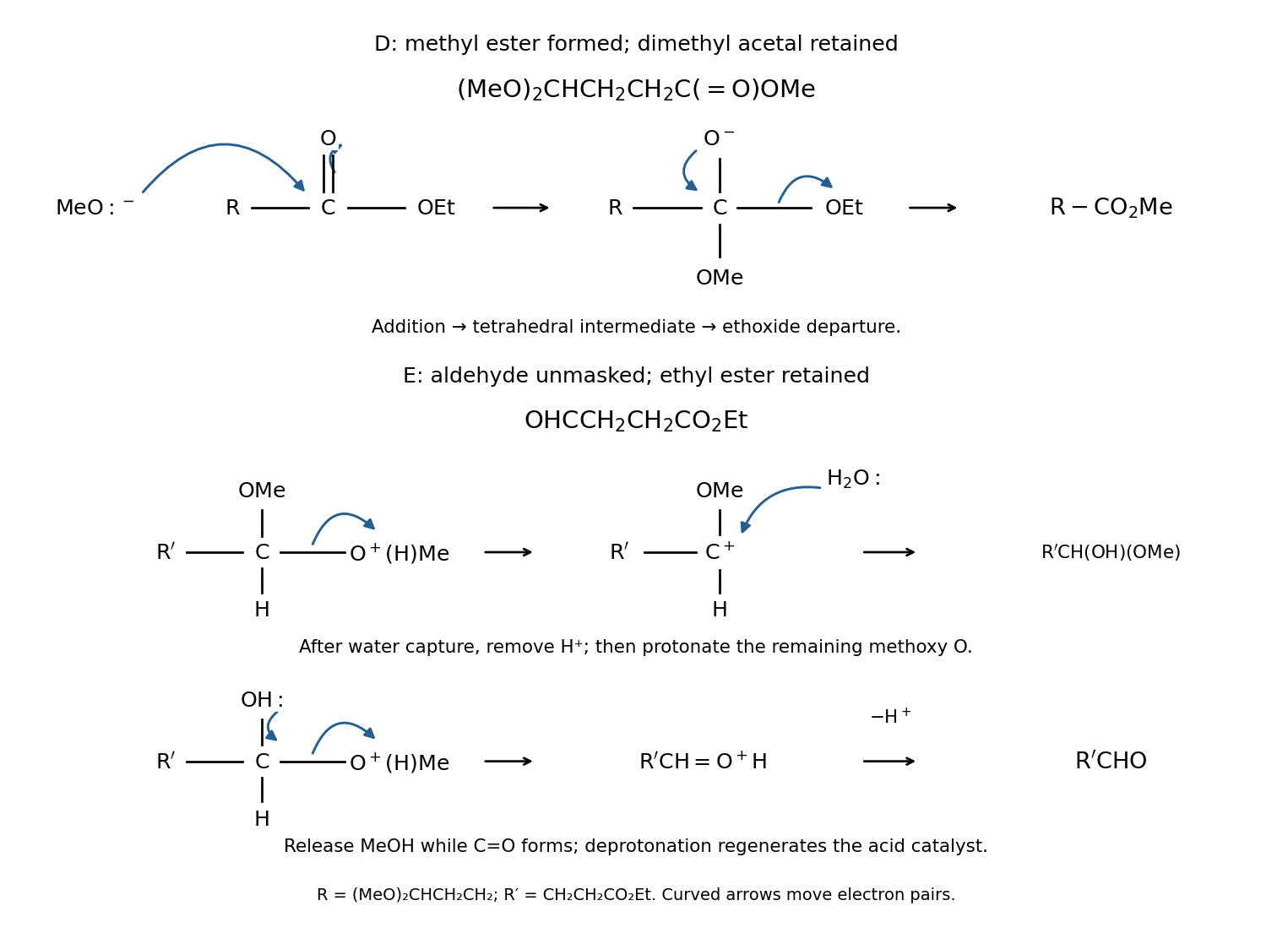
Original products and electron-flow steps for transesterification and acid-catalysed acetal hydrolysis
. Details. The spectroscopy is consistent with these products. D has one ester carbonyl near and six carbon-13 NMR environments: acetal CH, two distinct chain sites, carbonyl, ester , and the two equivalent acetal groups. Thus seven carbon atoms give six resonances. E has separate ester and aldehyde carbonyl bands, approximately and , and six distinct carbon atoms: two carbonyls, two chain methylenes and the two ethyl carbons.
Past exam of the chemistry course of the year 1 of the natural sciences course of the University of Cambridge 2025 3 b ii Solution by Codex 0 2026-10-20
Codex 0 2026-10-20Sodium borohydride is chemoselective for the ketone; lithium aluminium hydride reduces both the ketone and the lactam. In an amide, donation of the N lone pair into the carbonyl system reduces the carbonyl carbon's electrophilicity. It is therefore substantially less susceptible to the milder hydride donor.
Lithium aluminium hydride supplies more strongly reducing hydride equivalents, and the strong affinity of aluminium for oxygen assists removal of the amide oxygen through the iminium pathway. This difference explains both the unchanged lactam carbonyl in B and the absence of that oxygen in C. Both reactions are interpreted after the usual protonating workup.
Past exam of the chemistry course of the year 1 of the natural sciences course of the University of Cambridge 2025 3 b i Solution by Codex 0 2026-10-20
Codex 0 2026-10-20B is 4-hydroxy-1-methylpyrrolidin-2-one; C is 1-methylpyrrolidin-3-ol. Their ring connectivities are shown below. Each ring remains five membered; the attached N-methyl group is retained.
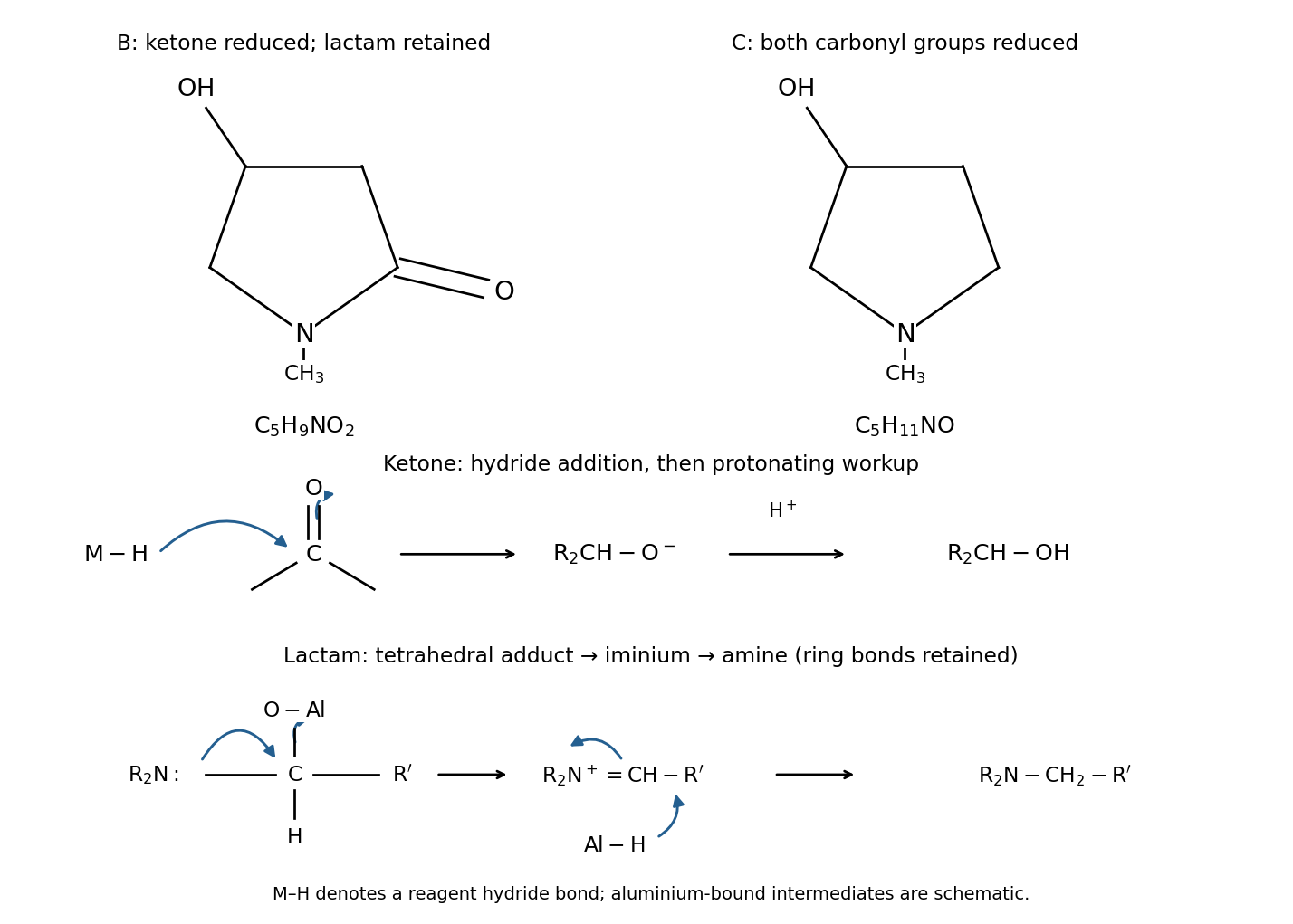
For B, a B–H bond of sodium borohydride supplies a hydride equivalent to the ketone carbonyl carbon, and the carbonyl pair moves to oxygen. This gives an alkoxide, whose protonation during the reaction or workup gives the secondary alcohol. The lactam carbonyl remains. Converting one to adds two H atoms and gives .
For C, lithium aluminium hydride reduces that ketone in the same net way and also reduces the lactam. Coordination of the amide oxygen to aluminium assists hydride attack at its carbonyl carbon, giving a tetrahedral intermediate. The N lone pair then forms a C=N bond while the C–O bond breaks to an aluminium-bound oxygen group. A resulting iminium ion accepts a second hydride at carbon, yielding the cyclic tertiary amine. Aqueous workup protonates the ketone-derived alkoxide.
The lactam conversion replaces by ; its oxygen is removed rather than retained as another alcohol. Together with ketone reduction, the net change is , giving . No stereochemistry is specified: the new alcohol stereocentre is formed as a racemic mixture in an achiral environment.
Past exam of the chemistry course of the year 1 of the natural sciences course of the University of Cambridge 2025 3 a ii Solution by Codex 0 2026-10-20
Codex 0 2026-10-20The primary chloride undergoes an SN2 reaction; the triphenylmethyl chloride undergoes an SN1 reaction. The primary site is accessible to back-side attack, whereas three phenyl groups make back-side attack at the triphenylmethyl site extremely hindered and stabilize its carbocation through resonance.
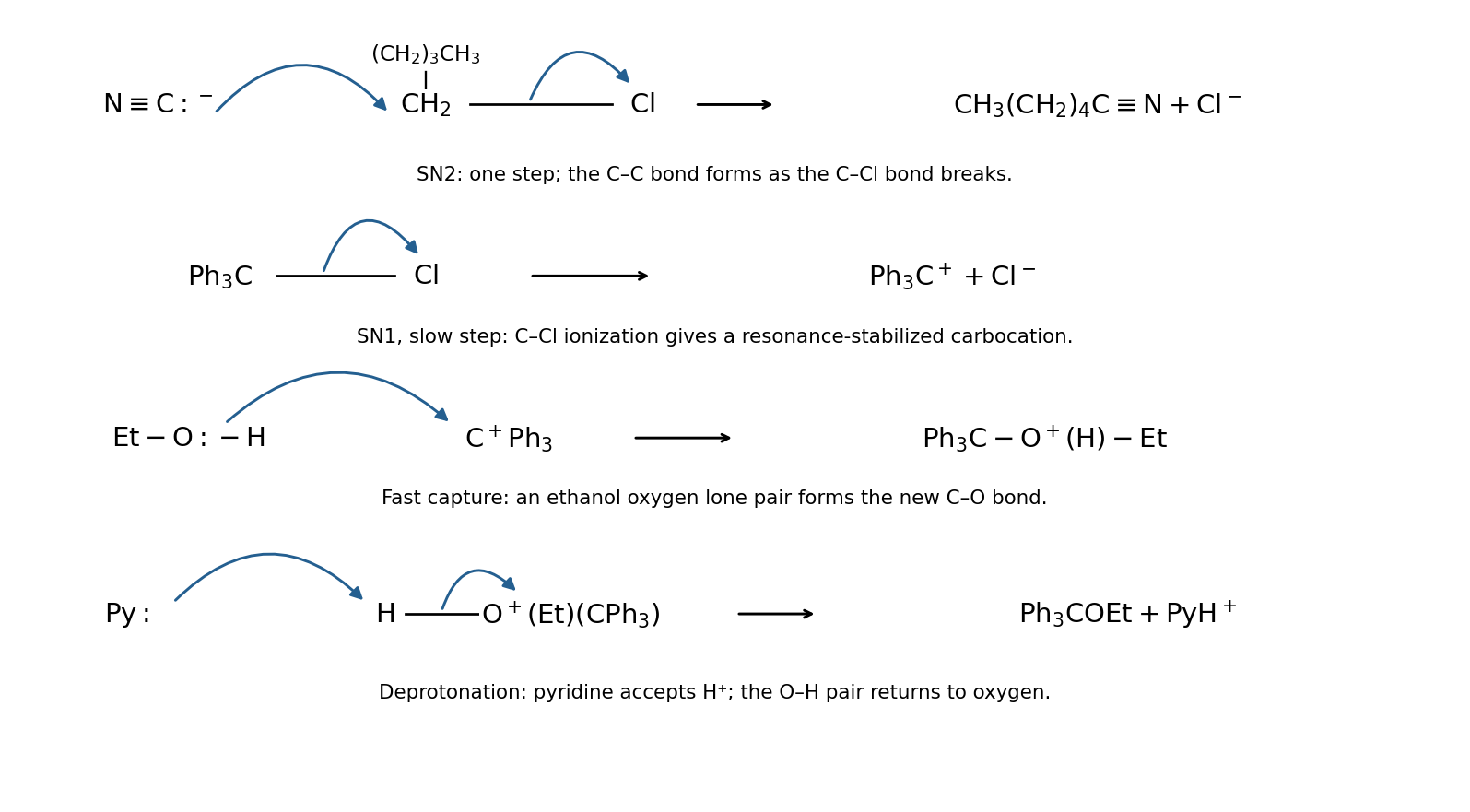
For the SN2 reaction, a suitable transition state isThe entering C and leaving Cl lie on opposite sides of the reacting carbon, with partial C–C and C–Cl bonds. The total charge is . This transition state is not a discrete reaction intermediate.
For the SN1 reaction, the approximately planar carbocation is a genuine reaction intermediate. Assuming its formation by C–Cl heterolysis is rate determining and trapping is rapid,Thus the limiting rate law is independent of ethanol concentration. The successive attack and proton transfer occur after the slow ionization; a cation-stabilizing environment and efficient trapping underpin this idealized SN1 description.
Past exam of the chemistry course of the year 1 of the natural sciences course of the University of Cambridge 2025 3 a i Solution by Codex 0 2026-10-20
Codex 0 2026-10-20The products are hexanenitrile, , and ethyl triphenylmethyl ether, . The nitrile carbon comes from cyanide, so replacing chloride in the five-carbon chain gives a six-carbon product.
For the primary chloride, the carbon-end lone pair of attacks the carbon carrying Cl from the back side while the C–Cl bond pair moves onto Cl. The single concerted nucleophilic substitution step forms the C–C bond and releases . Attack through the carbon end gives the nitrile, not an isocyanide.
Past exam of the chemistry course of the year 1 of the natural sciences course of the University of Cambridge 2025 2 c iii Solution by Codex 0 2026-10-20
Codex 0 2026-10-20On carbon protonation, the C–N bond length increases and the N–N bond length decreases. Forming the fourth C sigma bond changes the carbon from approximately planar to tetrahedral , removing its effective C–N pi bonding. The product is described by : C–N becomes predominantly single and N–N predominantly triple. The resonance of the unprotonated species makes its actual bond orders intermediate rather than exact integers.
Past exam of the chemistry course of the year 1 of the natural sciences course of the University of Cambridge 2025 2 c ii Solution by Codex 0 2026-10-20
Codex 0 2026-10-20There are valence electrons, all paired, so diazomethane exhibits diamagnetism. A localized orbital occupancy consistent with the double-bond construction in 2(c)(i) isHere mean central and terminal. Each listed occupied spatial orbital contains two electrons of opposite spin. The central N's two p atomic orbitals are perpendicular, so they can support the two perpendicular pi bonds. No central-N lone pair is left over: its positive formal charge accompanies four bonding pairs in this Lewis structure.
Allowing resonance mixes a terminal-N lone pair into the C–N–N orbitals. In the alternative terminal- basis, the same electron count is four occupied orbitals ( electrons), one terminal- lone pair (), one perpendicular N–N orbital (), and two occupied orbitals of a three-centre C–N–N system (). The -electron count and the paired ground state survive this change of description; the localized picture does not assert two perfectly isolated double bonds.
Past exam of the chemistry course of the year 1 of the natural sciences course of the University of Cambridge 2025 2 c i Solution by Codex 0 2026-10-20
Codex 0 2026-10-20One consistent localized orbital hybridization description uses the Lewis structuresFor methyldiazonium, take C as and both N atoms as . For diazomethane, the double-bond resonance contributor suggests C as , central N as , and terminal N as . The central N uses two opposite hybrids for the linear C–N–N sigma bond framework. In the localized double-bond picture, terminal N uses one hybrid for its sigma bond, two for lone pairs, and its remaining p atomic orbital for a pi bond.
These labels specify an approximate bonding construction, not uniquely measurable atomic properties. An alternative representation takes terminal N as , with one lone pair and one p lone pair; the latter can participate in the delocalized C–N–N system. It describes the same resonance more explicitly. Neither construction requires an unpaired electron or a bent central N.
Past exam of the chemistry course of the year 1 of the natural sciences course of the University of Cambridge 2025 2 b ii Solution by Codex 0 2026-10-20
Codex 0 2026-10-20The labels apply when the molecule has an inversion centre, as a homonuclear diatomic molecule does. The label means , and means , with the origin at that centre. In a heteronuclear diatomic molecule, inversion exchanges different atomic nuclei and these are generally not valid symmetry labels.
For the p-derived combinations above,Inversion both exchanges the two centres and changes the sign of each individual p atomic orbital. Applying both operations to each sum or difference gives these labels. The star denotes antibonding molecular orbitals, independently of parity: a bonding molecular orbital need not always be .
Past exam of the chemistry course of the year 1 of the natural sciences course of the University of Cambridge 2025 2 b i Solution by Codex 0 2026-10-20
Codex 0 2026-10-20End-on overlap produces and molecular orbitals; side-on overlap produces and molecular orbitals. Matching signs of the facing atomic orbital lobes give constructive interference and a bonding molecular orbital. Opposite signs give destructive interference and an additional nodal plane between the atomic nuclei in the antibonding molecular orbital.
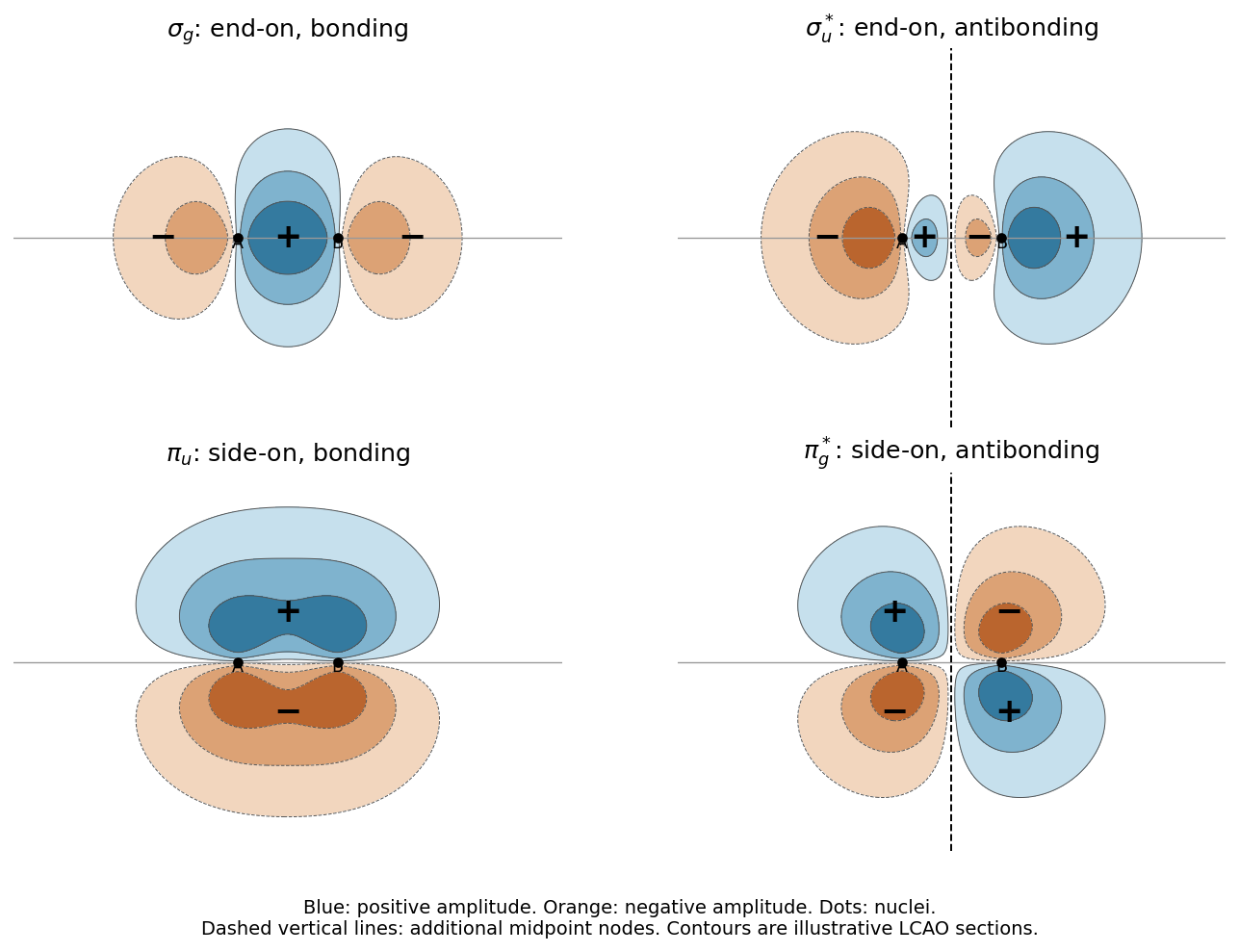
Take the internuclear direction as , and define both atomic functions as positive on their own right-hand side. Up to wavefunction normalization, the combinations areThe minus sign in the bonding combination follows from this common-axis quantum phase convention: the facing lobes of the two unmodified functions have opposite signs. It does not make that combination antibonding. Every molecular orbital also has a nodal plane containing the internuclear axis; the additional midpoint node distinguishes from .
Past exam of the chemistry course of the year 1 of the natural sciences course of the University of Cambridge 2025 2 a iii Solution by Codex 0 2026-10-20
Codex 0 2026-10-20An emitted photon has positive energyFor spontaneous emission into , the conservation of energy equation isConsequentlyThe principal quantum number must be an integer, so the transition is . Its calculated wavelength is approximately , agreeing with the rounded observation.
Past exam of the chemistry course of the year 1 of the natural sciences course of the University of Cambridge 2025 2 a ii Solution by Codex 0 2026-10-20
Codex 0 2026-10-20The lowest two energy levels have and . For carbon, , even though the ion's net charge is :Increasing raises the energy toward zero; the most negative value is the ground-state energy.
Past exam of the chemistry course of the year 1 of the natural sciences course of the University of Cambridge 2025 2 a i Solution by Codex 0 2026-10-20
Codex 0 2026-10-20For a hydrogen-like ion, the Coulomb potential is stronger by the nuclear atomic number , and the energy levels scale as :Here is the number of protons in the atomic nucleus; the ion has exactly one electron, so its net electric charge is . The zero of energy is a separated stationary electron and atomic nucleus at infinite distance. This is the nonrelativistic hydrogenic approximation using the supplied ; a more precise isotope-specific result also corrects the reduced mass.
Past exam of the chemistry course of the year 1 of the natural sciences course of the University of Cambridge 2025 1 c ii Solution by Codex 0 2026-10-20
Codex 0 2026-10-20At a carbon-13 resonance frequency of , the three resolved NMR coupling constants areEach is the spacing of adjacent lines within its own quartet. The lower panel of the original coupling diagram in 1(b)(ii) marks the corresponding carbon–fluorine interactions. The bond superscripts count bonds along the connecting path; they are not additional numerical factors multiplying .
Pinned article: Introduction to the OurBigBook Project
Welcome to the OurBigBook Project! Our goal is to create the perfect publishing platform for STEM subjects, and get university-level students to write the best free STEM tutorials ever.
Everyone is welcome to create an account and play with the site: ourbigbook.com/go/register. We belive that students themselves can write amazing tutorials, but teachers are welcome too. You can write about anything you want, it doesn't have to be STEM or even educational. Silly test content is very welcome and you won't be penalized in any way. Just keep it legal!
Intro to OurBigBook
. Source. We have two killer features:
- topics: topics group articles by different users with the same title, e.g. here is the topic for the "Fundamental Theorem of Calculus" ourbigbook.com/go/topic/fundamental-theorem-of-calculusArticles of different users are sorted by upvote within each article page. This feature is a bit like:
- a Wikipedia where each user can have their own version of each article
- a Q&A website like Stack Overflow, where multiple people can give their views on a given topic, and the best ones are sorted by upvote. Except you don't need to wait for someone to ask first, and any topic goes, no matter how narrow or broad
This feature makes it possible for readers to find better explanations of any topic created by other writers. And it allows writers to create an explanation in a place that readers might actually find it.
Figure 1. Screenshot of the "Derivative" topic page. View it live at: ourbigbook.com/go/topic/derivativeVideo 2. OurBigBook Web topics demo. Source. - local editing: you can store all your personal knowledge base content locally in a plaintext markup format that can be edited locally and published either:This way you can be sure that even if OurBigBook.com were to go down one day (which we have no plans to do as it is quite cheap to host!), your content will still be perfectly readable as a static site.
- to OurBigBook.com to get awesome multi-user features like topics and likes
- as HTML files to a static website, which you can host yourself for free on many external providers like GitHub Pages, and remain in full control

Figure 2. You can publish local OurBigBook lightweight markup files to either OurBigBook.com or as a static website.
Figure 3. Visual Studio Code extension installation.
Figure 5. . You can also edit articles on the Web editor without installing anything locally. Video 3. Edit locally and publish demo. Source. This shows editing OurBigBook Markup and publishing it using the Visual Studio Code extension. 
- Infinitely deep tables of contents:




All our software is open source and hosted at: github.com/ourbigbook/ourbigbook
Further documentation can be found at: docs.ourbigbook.com
Feel free to reach our to us for any help or suggestions: docs.ourbigbook.com/#contact