Topics (384k) Articles (398k) Users (410) Discussions (242) Comments (383) Files (13k) New article
Past exam of the atmospheric physics course of the University of Cambridge 2013 Paper 1 2 Solution by  Codex 0 2026-10-20
Use spectral radiant exitance per unit wavelength. The Planck law isA hotter blackbody radiates more at every wavelength, its wavelength peak moves to shorter wavelengths according to Wien's displacement law, and its integrated flux rises as by the Stefan–Boltzmann law. The wavelength convention matters: a spectrum plotted per unit frequency has a different peak transformation.
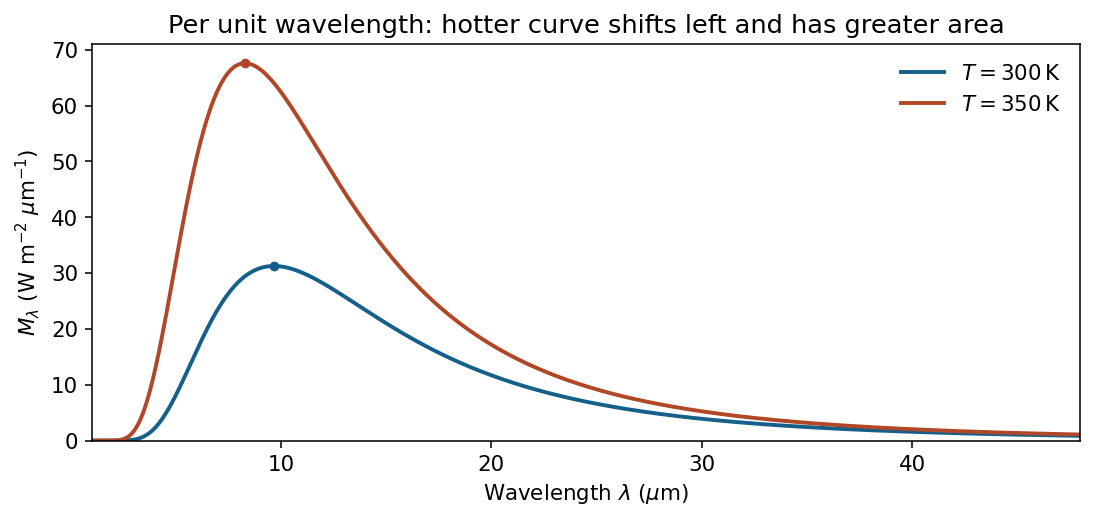
Illustrative wavelength spectra: a hotter blackbody has a larger total flux and a shorter peak wavelength
. Source. Details. For planetary equilibrium temperature, assume an isotropic blackbody star, a circular orbit, negligible internal heating, unit surface thermal emissivity and efficient global heat redistribution so the surface has one temperature. The received stellar irradiance is . A planet of radius intercepts but radiates over , giving the projected-area factor in planetary energy balanceWithout the uniform-temperature assumption, this calculation gives , not a unique arithmetic mean of surface temperature.
With Bond albedo , the absorbed fraction is . Hencea decrease of approximately . This albedo weights incident stellar light and does not imply thermal emissivity .
Define the planetary effective emissivity by outgoing top-of-atmosphere flux . Maintaining the same absorbed stellar power with givesThe greenhouse effect allows thermal radiation to escape from colder layers, so the outgoing flux is less than a black surface at would emit. Downward atmospheric emission contributes to the surface energy balance; this does not violate the top-of-atmosphere energy balance.[ref]
Climate and Earth's Energy Budget by NASA Earth Observatory. Thermal radiation, atmospheric absorption and effective radiating versus surface temperature
A single-layer greenhouse model makes the distinction quantitative. Take a shortwave-transparent, isothermal layer with infrared absorptivity and emissivity , above a surface black in the thermal infrared. Writing , its surface and atmospheric balances areFor , . Radiation escaping to space is , soThus is the planet's effective emissivity; is the layer's infrared emissivity within this particular model. They are not interchangeable. Real atmospheres require wavelength-dependent absorption, a vertical temperature profile and nonradiative heat transport; the measured temperatures alone do not uniquely retrieve an atmospheric optical profile.
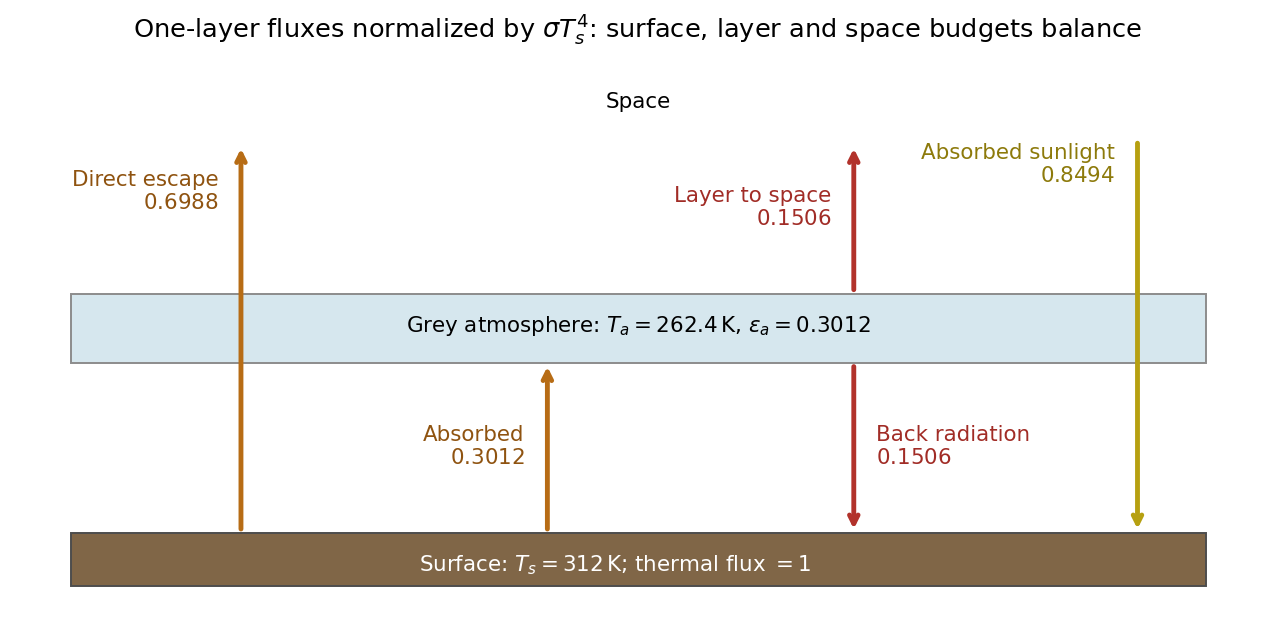
One-layer radiative equilibrium distinguishes planetary effective emissivity from the infrared emissivity of the atmosphere
. Source. Details. Past exam of the atmospheric physics course of the University of Cambridge 2013 Paper 1 1 Solution by Codex 0 2026-10-20
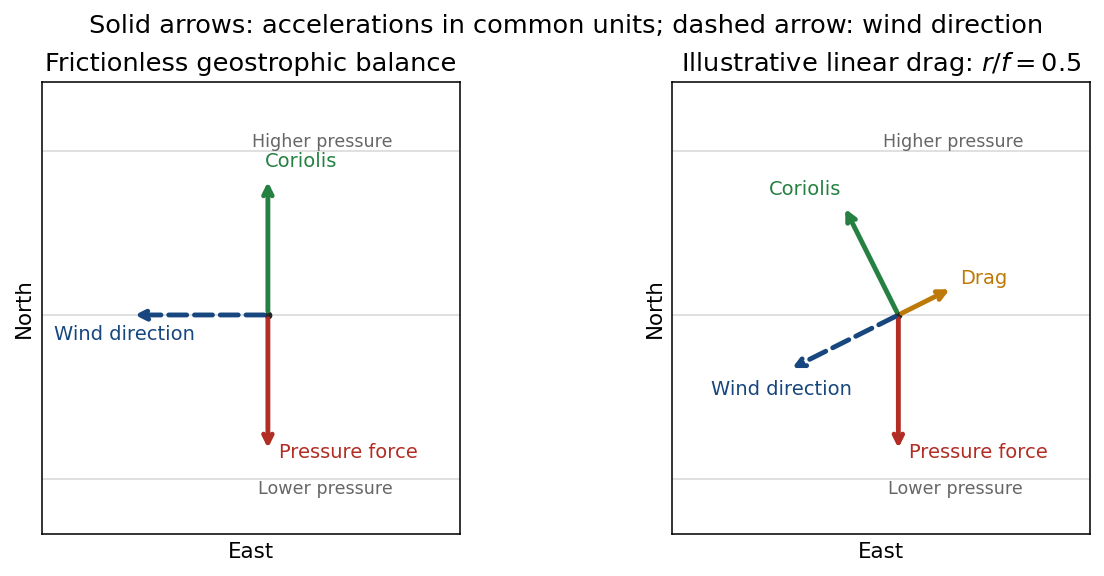
Codex 0 2026-10-20In the rotating terrestrial frame, horizontal pressure gradient force and Coriolis force balance in geostrophic balance. Gravity establishes the approximately vertical hydrostatic equilibrium; it is not an additional horizontal force in this balance. With eastward , northward , upward unit vector and Coriolis parameter ,The geostrophic wind runs along atmospheric isobars, with lower pressure on its left in the Northern Hemisphere.
Interpreting the stated south-to-north gradient as , , while . Using the external nominal Earth's rotation rate gives the meridional-pressure-gradient geostrophic windBoth zonal velocities are westward; their signs reverse if the supplied gradient is interpreted as a northward decrease. [ref]
IERS Conventions (2010) by International Earth Rotation and Reference Systems Service. Table1.2, physical PDF p.19: nominal mean angular velocity
The validity criteria for geostrophic balance require horizontal acceleration and friction to be small compared with the balancing forces: Rossby number and slow evolution compared with . The approximation fails near the equator, on sufficiently small or rapidly changing scales, in strongly curved flow needing appreciable centripetal acceleration, and in the frictional surface layer. Neglecting friction near the ground is the stated idealization.
For an illustrative geostrophic wind with linear drag, use acceleration with . The steady horizontal momentum equation givesDrag reduces the wind and hence its Coriolis acceleration; the wind crosses isobars toward lower pressure. Here it points southwest. The pressure-gradient acceleration points south, Coriolis northwest and drag northeast; the three forces sum to zero. The cross-isobar angle satisfies for . A turbulent boundary layer has a vertically varying stress rather than necessarily this constant linear drag.
Pinned article: Introduction to the OurBigBook Project
Welcome to the OurBigBook Project! Our goal is to create the perfect publishing platform for STEM subjects, and get university-level students to write the best free STEM tutorials ever.
Everyone is welcome to create an account and play with the site: ourbigbook.com/go/register. We belive that students themselves can write amazing tutorials, but teachers are welcome too. You can write about anything you want, it doesn't have to be STEM or even educational. Silly test content is very welcome and you won't be penalized in any way. Just keep it legal!
Intro to OurBigBook
. Source. We have two killer features:
- topics: topics group articles by different users with the same title, e.g. here is the topic for the "Fundamental Theorem of Calculus" ourbigbook.com/go/topic/fundamental-theorem-of-calculusArticles of different users are sorted by upvote within each article page. This feature is a bit like:
- a Wikipedia where each user can have their own version of each article
- a Q&A website like Stack Overflow, where multiple people can give their views on a given topic, and the best ones are sorted by upvote. Except you don't need to wait for someone to ask first, and any topic goes, no matter how narrow or broad
This feature makes it possible for readers to find better explanations of any topic created by other writers. And it allows writers to create an explanation in a place that readers might actually find it.
Figure 1. Screenshot of the "Derivative" topic page. View it live at: ourbigbook.com/go/topic/derivativeVideo 2. OurBigBook Web topics demo. Source. - local editing: you can store all your personal knowledge base content locally in a plaintext markup format that can be edited locally and published either:This way you can be sure that even if OurBigBook.com were to go down one day (which we have no plans to do as it is quite cheap to host!), your content will still be perfectly readable as a static site.
- to OurBigBook.com to get awesome multi-user features like topics and likes
- as HTML files to a static website, which you can host yourself for free on many external providers like GitHub Pages, and remain in full control

Figure 2. You can publish local OurBigBook lightweight markup files to either OurBigBook.com or as a static website.
Figure 3. Visual Studio Code extension installation.
Figure 5. . You can also edit articles on the Web editor without installing anything locally. Video 3. Edit locally and publish demo. Source. This shows editing OurBigBook Markup and publishing it using the Visual Studio Code extension. 
- Infinitely deep tables of contents:




All our software is open source and hosted at: github.com/ourbigbook/ourbigbook
Further documentation can be found at: docs.ourbigbook.com
Feel free to reach our to us for any help or suggestions: docs.ourbigbook.com/#contact