Topics (384k) Articles (398k) Users (410) Discussions (242) Comments (383) Files (13k) New article
Past exam of the atomic and Optical Physics course of the University of Cambridge 2014 Paper 1 2 Solution by  Codex 0 2026-10-20
Set the ground-state energy to zero. Bose-Einstein occupation of an excited level is , with . As particles are added, approaches zero and the excited-state population saturates. Separating the ground state from the density-of-states integral therefore givesThe excited-state integral must actually converge: alone is not a sufficient condition in complete generality. A power law with suffices at low energy, as in the stated three-dimensional box.
Let denote the density-of-states prefactor, not a heat capacity. Substitution givesThe condensate has zero energy on this reference, so a further factor of in the integral givesRelative to the classical value, the ratio is . Macroscopic occupation of the zero-energy state and the Bose distribution both lower the average energy.
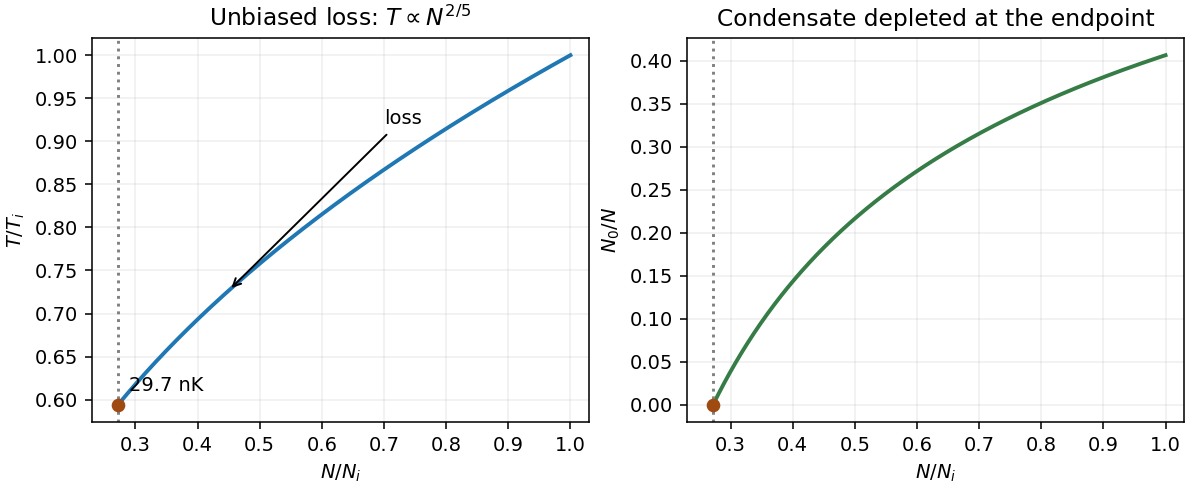
At fixed volume the condensed gas has . Unbiased random loss keeps average constant, henceRemoving a condensate atom removes essentially no energy and by itself leaves the excited cloud's temperature unchanged. Removing an excited atom removes its energy; during re-equilibration, some zero-energy condensate atoms join the excited population and share the remaining energy, lowering temperature. Averaging over unbiased loss gives the stated constant energy per particle, even though each individual type of loss need not preserve it separately.
Using and the supplied volume,There is only one occupied internal spin state, so no factor belongs in the density of states. During loss, , hence . Condensation disappears at :As a consistency check, agrees with .
Both this process and evaporative cooling of atoms require particle loss and re-equilibration. Ordinary evaporation preferentially removes energetic atoms, reducing , and can cool an uncondensed classical gas. Here loss is energy independent, stays constant, and cooling relies on the condensed gas's unusual equation of state; random loss of a classical ideal gas would leave its temperature unchanged. Exact noninteraction would prevent collisional rethermalization: the imposed equilibrium assumption can be understood as weak thermalizing interactions whose equation-of-state corrections are neglected.
Past exam of the atomic and Optical Physics course of the University of Cambridge 2014 Paper 1 1 Solution by Codex 0 2026-10-20
Codex 0 2026-10-20For hydrogen, the leading characteristic scales areOrder-one spin and nuclear magnetic factors, and state-dependent factors, are suppressed here. Gross atomic structure is Coulomb binding. Fine structure includes relativistic kinetic and spin-orbit effects, with Thomas precession affecting the spin-orbit coefficient. Hyperfine structure couples electronic motion and spin to the nuclear magnetic moment, whose inverse nuclear mass makes it much weaker. The contact spin interaction can remain in an s state where orbital spin-orbit coupling vanishes.
For positronium, the reduced mass is . Its gross levels and separation scale areThus the mean ground-state electron–Positron separation is twice the infinite-proton-mass hydrogen value: both means have the same factor multiplying their respective Bohr radii. Retaining proton recoil makes the ratio , very slightly below two. Separation is not the distance of either positronium constituent from its centre of mass.
Interpret the spin operators in units of , as required by the printed Zeeman term, so has units of energy. Two spin halves give four eigenstates. At zero field, total spin and projection label the singlet and triplet. At high field relative to the hyperfine scale, the individual projections become approximately good quantum numbers. Total projection remains exact at every field, but does not for the two mixed states.
Choose the quantization axis along . The aligned-spin states and both have because their Zeeman shifts cancel. In the other product-state sector,For physical positronium . At there is a triplet at and a singlet at . At large positive field the mixed states approach and , with energies and respectively, while the aligned pair remains degenerate at .
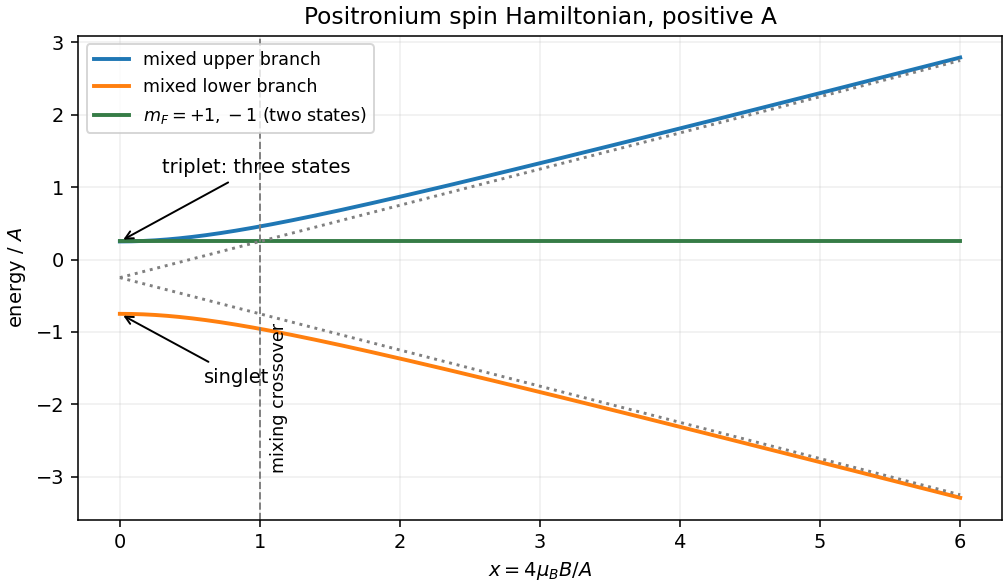
The dimensionless mixing parameter is . A crossover estimate is , rather than a sharp transition. The scale already gives a field of a few tesla. Using the physical hyperfine interval givesThe numerical hyperfine interval is external physical input, not a number supplied by the symbolic Hamiltonian.[ref]
New Precision Measurement of Hyperfine Splitting of Positronium by A. Ishida and others. arXiv:1310.6923, abstract, measured interval approximately 203.39 GHz
The high-field limit here still presumes that orbital distortion is negligible compared with Coulomb binding. Past exam of the atomic and Optical Physics course of the University of Cambridge 2013 Paper 1 2 Solution by Codex 0 2026-10-20
Codex 0 2026-10-20For the Bogoliubov spectrum, define and . For repulsive interactions and ,Thus the low-momentum excitations are gapless phonons and the high-momentum branch approaches free-particle curvature. The crossover occurs when kinetic and interaction energy are comparable. The Landau criterion follows because an obstacle moving at velocity can supply energy to an excitation. HereThis is the homogeneous phonon kinematic threshold, not a guarantee that every perturbation dissipates immediately above it.
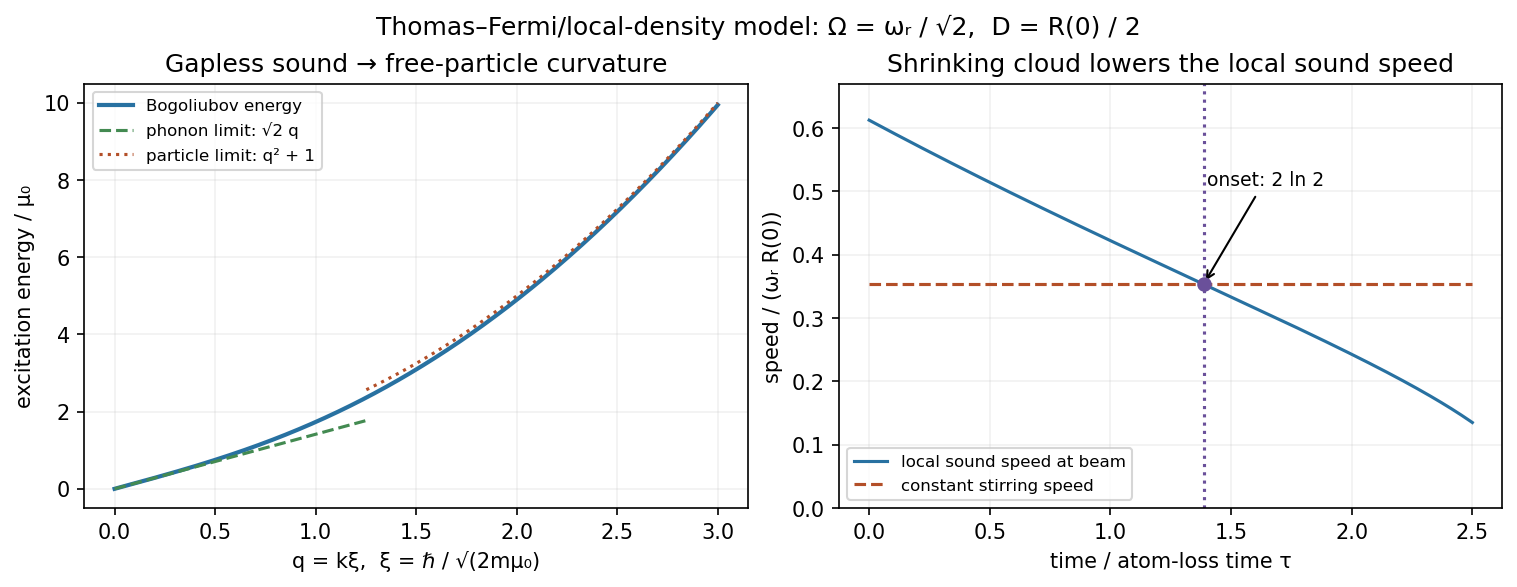
In two dimensions, has units of inverse area and has units of energy times area. Therefore is dimensionless. Neglecting the kinetic term in the Gross–Pitaevskii equation, with positive coupling, giveswith outside the radius in the Thomas–Fermi approximation for a condensate. Multiplication givesThe sharp edge is an approximation; the neglected gradient term rounds it over a healing length scale.
Using the local sound-speed criterion for circular condensate stirring, the moving beam has speed . The local interaction chemical potential is , soThe onset equality is and the permitted excitation condition isThis uses the beam speed as the local relative-flow scale. A finite hole can distort the surrounding flow or nucleate vortices, so the result is the requested local phonon estimate, not a universal necessary condition for all experimental stirring.
For the loss-driven onset of condensate stirring, first integrate the density:At fixed coupling and trap frequency, and . Hence while stays fixed. For , threshold requires . Starting at ,At onset, , and the beam is still inside the cloud. Excitations become kinematically allowed just beyond this equality, provided the stipulated adiabatic regime of the Thomas–Fermi approximation for a condensate remains valid.
Past exam of the atomic and Optical Physics course of the University of Cambridge 2013 Paper 1 1 Solution by Codex 0 2026-10-20
Codex 0 2026-10-20For a free-space electric dipole transition, the spontaneous emission rate in SI units isHere includes the relevant dipole components; a specified single polarization requires its corresponding matrix element.
A complete scattering cycle returns the internal state to the ground state and changes the atomic momentum to . ThusFor photon-scattering recoil heating with isotropic emission of fixed momentum magnitude, , givingThe first term is the velocity-dependent work of absorption and can cool an atom if the photon opposes its motion. The last two are positive absorption and emission recoil energies. If the actual absorbed directions are also isotropic and independent of , the first term averages to zero. For approximately equal incoming and outgoing photon momenta ,Isotropic incident illumination alone would not guarantee isotropic absorption if Doppler-dependent excitation selected directions.
Source qualification for the trapped calculation. Set for the same atom. The printed Gaussian has the wrong width for the specified harmonic oscillator: the printed ground and first-excited functions have squared norms and , respectively. The normalized oscillator states fixed by the given instead useAlso, one common complex phase multiplying both off-diagonal terms does not make the Hamiltonian a Hermitian operator. Use an absorption matrix element and its Hermitian conjugate for emission; choosing the opposite propagation convention reverses the imaginary sideband phase but not a transition probability. The physical results below use these explicitly stated corrections. Parts (i) and (ii) also give the literal integrals of the printed functions.
Conditional motional heating and recoil averaging. With , an oscillator eigenstate has . Therefore the absorption outcomes haveThe same statements hold for the specified emission outcomes and . Internal excitation energy goes into, or comes from, the photon and is distinct from this external energy change. Emission into the first motional state makes the emitted photon correspondingly less energetic.
A sudden recoil from gives probabilities , so while . The rare first sideband transfers a whole trap quantum, much larger than ; the mean is neverthelessThe emission average is the same for a one-dimensional recoil of the same magnitude. Projecting isotropic three-dimensional emission onto one axis instead gives a factor for that axis.
A sudden unobserved kick initially raises kinetic energy by and leaves the position distribution, hence potential energy, unchanged. It creates a coherent superposition of motional states. The equal kinetic/potential increments above concern energy-eigenstate-conditioned outcomes, or time-averaged/dephased motion; these are different measurement conditions. There is no contradiction.
With , motional sidebands are not cleanly resolved, and a short-lived excited atom has little time to move before decay. In the stronger sudden limit the recoil-kick picture is direct. For only the stated inequality, finite linewidth weights can change numerical factors; it does not fix an exact continuous-wave scattering rate. The average heating remains of recoil order per absorption or emission, and of order when both absorption and emission kicks are counted at full magnitude. For the axial component of isotropic three-dimensional emission, the emission contribution instead carries the factor noted above. Strong confinement suppresses the chance of changing , but does not make its averaged recoil energy disappear. This agrees with free-space recoil heating while replacing small continuous energy changes by rare quantized motional changes.
Pinned article: Introduction to the OurBigBook Project
Welcome to the OurBigBook Project! Our goal is to create the perfect publishing platform for STEM subjects, and get university-level students to write the best free STEM tutorials ever.
Everyone is welcome to create an account and play with the site: ourbigbook.com/go/register. We belive that students themselves can write amazing tutorials, but teachers are welcome too. You can write about anything you want, it doesn't have to be STEM or even educational. Silly test content is very welcome and you won't be penalized in any way. Just keep it legal!
Intro to OurBigBook
. Source. We have two killer features:
- topics: topics group articles by different users with the same title, e.g. here is the topic for the "Fundamental Theorem of Calculus" ourbigbook.com/go/topic/fundamental-theorem-of-calculusArticles of different users are sorted by upvote within each article page. This feature is a bit like:
- a Wikipedia where each user can have their own version of each article
- a Q&A website like Stack Overflow, where multiple people can give their views on a given topic, and the best ones are sorted by upvote. Except you don't need to wait for someone to ask first, and any topic goes, no matter how narrow or broad
This feature makes it possible for readers to find better explanations of any topic created by other writers. And it allows writers to create an explanation in a place that readers might actually find it.
Figure 1. Screenshot of the "Derivative" topic page. View it live at: ourbigbook.com/go/topic/derivativeVideo 2. OurBigBook Web topics demo. Source. - local editing: you can store all your personal knowledge base content locally in a plaintext markup format that can be edited locally and published either:This way you can be sure that even if OurBigBook.com were to go down one day (which we have no plans to do as it is quite cheap to host!), your content will still be perfectly readable as a static site.
- to OurBigBook.com to get awesome multi-user features like topics and likes
- as HTML files to a static website, which you can host yourself for free on many external providers like GitHub Pages, and remain in full control

Figure 2. You can publish local OurBigBook lightweight markup files to either OurBigBook.com or as a static website.
Figure 3. Visual Studio Code extension installation.
Figure 5. . You can also edit articles on the Web editor without installing anything locally. Video 3. Edit locally and publish demo. Source. This shows editing OurBigBook Markup and publishing it using the Visual Studio Code extension. 
- Infinitely deep tables of contents:




All our software is open source and hosted at: github.com/ourbigbook/ourbigbook
Further documentation can be found at: docs.ourbigbook.com
Feel free to reach our to us for any help or suggestions: docs.ourbigbook.com/#contact