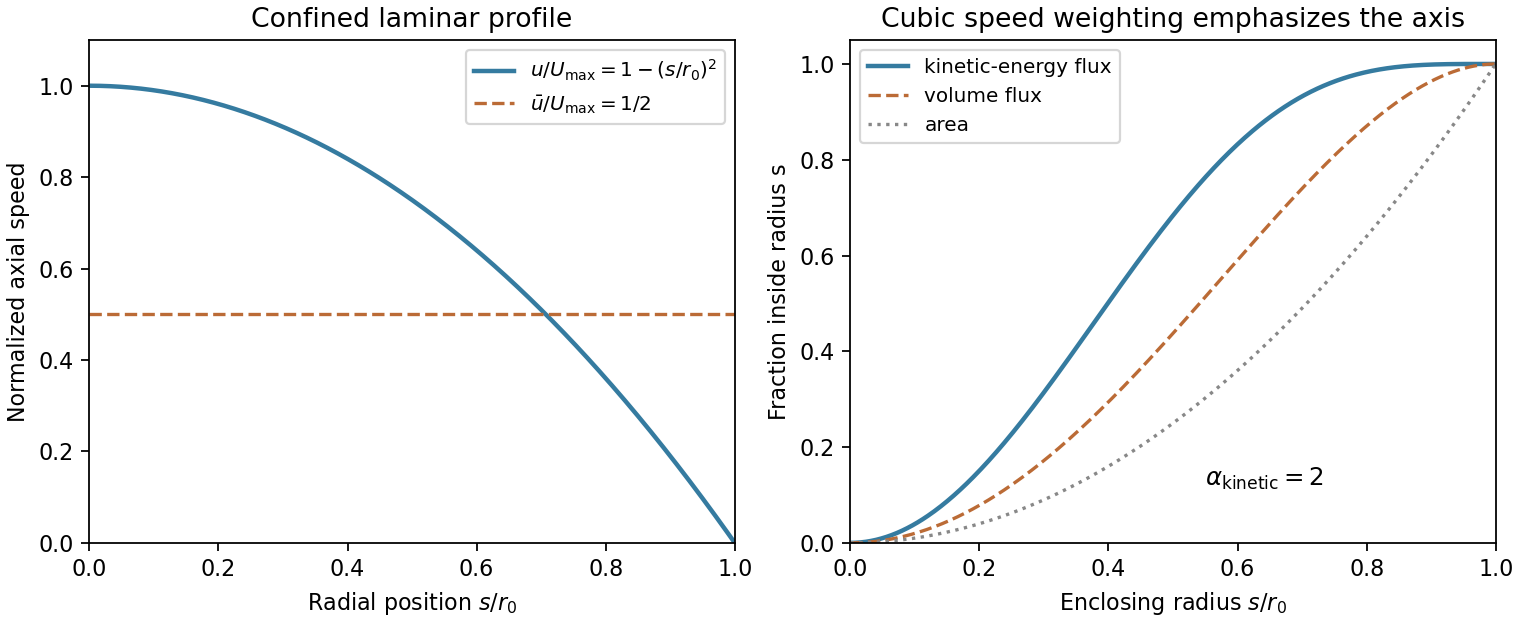
Use the idealized fully developed, laminar cylindrical-flow model implied by the fixed cross-section and zero velocity at its sides. Take the jet length to be , as for a central source reaching the cloud boundary; if the source is off-centre, the actual path length must replace . Let denote distance from the jet axis and write the axial velocity as . Then , the pressure gradient is , and the axial Navier-Stokes equation reduces toRegularity at excludes a logarithmic term. The imposed no-slip boundary condition gives the Hagen-Poiseuille flow profileThe kinetic energy crossing each area element per unit time is , so the velocity must be cubed before integration. ThusConsequentlyThe mean velocity is . Replacing the profile by in underestimates the flux by two; the kinetic energy correction factor is two for this profile. The radius dependence follows from and cross-sectional area .
The specified is outgoing bulk kinetic-energy flux, not the pressure-work rate , which scales as . In a fully developed section the profile is independent of and pressure work is dissipated as heat; entrance acceleration and energy supply establish the profile. A turbulent or freely entraining astrophysical jet need not have this no-slip parabolic structure. The model assumes a long enough, laminar confined region and neglects entrance losses and gravity.

Articles by others on the same topic
There are currently no matching articles.