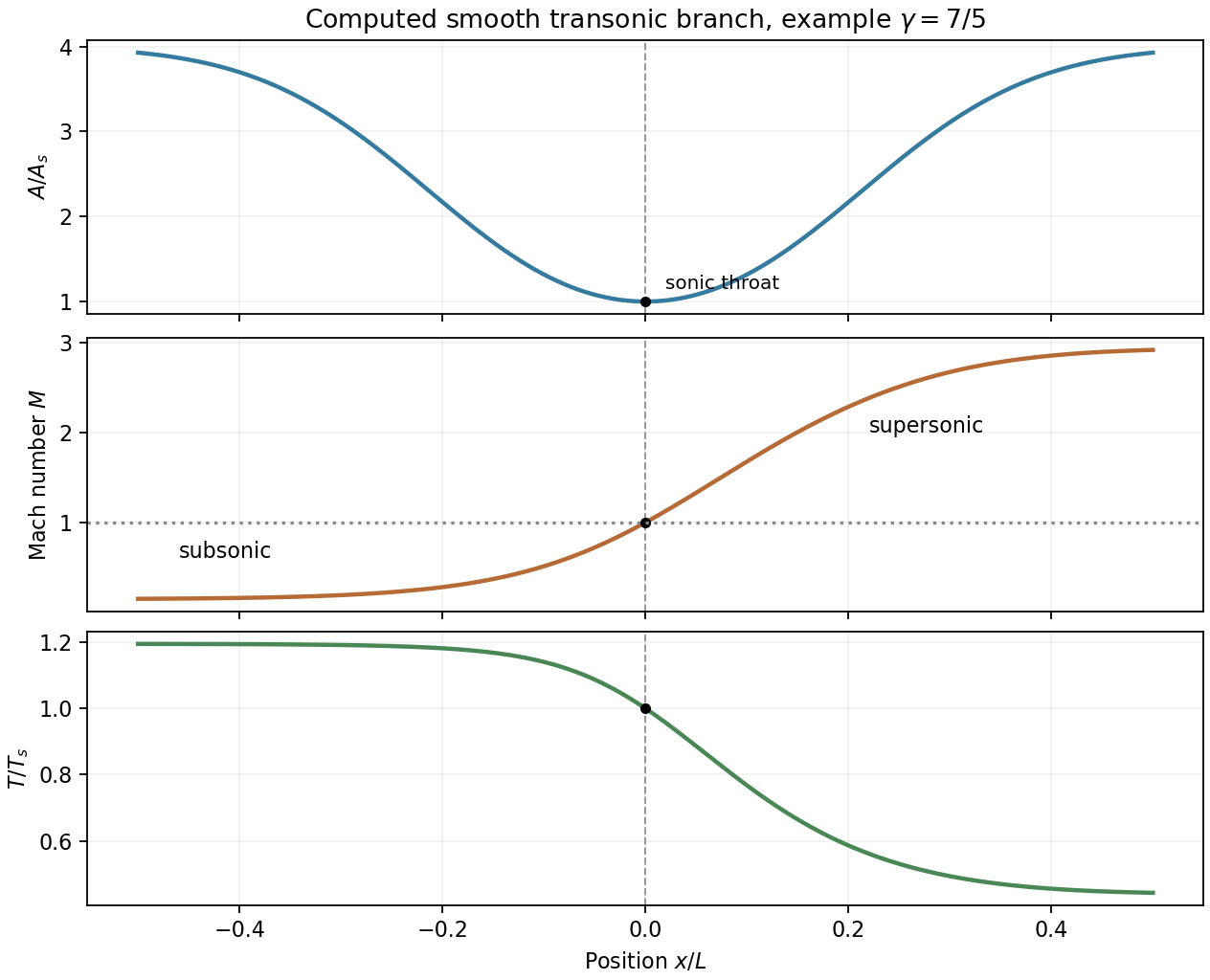
Treat the gas as a smooth quasi-one-dimensional flow through a rigid passage, neglecting axial body forces and heat input. It is the confining medium that is incompressible; the flowing gas must remain compressible. With area and axial speed , continuity and inviscid momentum balance giveCombining their logarithmic differentials yields the nozzle area-velocity relationA smooth crossing of requires an area extremum. The given radius is positive and has derivative , which vanishes only at within the slab and changes from negative to positive there. Thus this station is the unique throat, with and . The specified subsonic inlet and supersonic outlet select the smooth accelerating branch, soA throat by itself does not guarantee transonic flow for arbitrary reservoir and back pressures; that branch is specified here. Before the throat a converging section accelerates subsonic flow; beyond it a diverging section accelerates supersonic flow.[ref]
Nozzle Design by NASA Glenn Research Center. Supersonic and Subsonic Flow, continuity/momentum derivation of the area-velocity relation and choked throat
For the temperature task, evaluate the mass flux and sound speed at the throat using :The ideal-gas relation then givesThis expresses the sonic temperature in terms of the entropy constant, geometry, mass flux and composition; no numerical value of or is provided. Equivalently and . The slab length drops out because the sonic thermodynamic state depends on the minimum area, not on the axial distance over which a lossless smooth nozzle contracts. As a check, conserved stagnation enthalpy gives .[ref]
Mass Flow Choking by NASA Glenn Research Center. equations 1–10 and 19, sonic mass-flow maximum and temperature/Mach relation
The result assumes cross-sectional thermodynamic uniformity and negligible transverse kinetic energy. Exact multidimensional flow through a sharply varying passage can have a curved sonic surface; the radius profile alone does not solve that boundary-value problem. The original numerical plot below computes the standard quasi-one-dimensional branch, rather than reproducing the supplied passage sketch.

Articles by others on the same topic
There are currently no matching articles.