A finite-amplitude compression can steepen because different parts of the wave travel at different characteristic speeds. For a right-moving simple wave in a perfect gas, one may write in terms of the local velocity perturbation . Faster compressive characteristics catch slower ones. When the smooth inviscid description would become multivalued, a physical compression shock replaces it. A rarefaction normally spreads rather than forming an entropy-violating expansion shock.[ref]
Lecture notes: Astrophysical fluid dynamics by Gordon I. Ogilvie. §§6.1.3–6.2, simple-wave reduction and characteristic crossing
Across a locally planar shock, use velocities relative to its moving front. The Rankine-Hugoniot conditions for a perfect gas conserve mass, momentum and total energy flux:where is the specific enthalpy. For upstream normal Mach number ,Thus a normal compression shock increases pressure, density and temperature, reduces the normal velocity, and changes a supersonic upstream flow to subsonic downstream flow in the shock frame. In the strong-shock limit, compression approaches , which is four for a monatomic gas. A shock conserves total energy but generates entropy; an adiabatic shock is not an isentropic compression. For a calorically perfect gas, stagnation temperature is conserved while stagnation pressure falls.[ref]
Normal Shock Wave Equations by NASA Glenn Research Center. normal-shock property ratios, total-temperature conservation and total-pressure loss
Real dissipative processes resolve the narrow front; the jump conditions do not require its detailed internal profile. In a continuum-gas experiment a shock tube can produce a moving shock by releasing a pressure discontinuity. pressure probes separated along the tube measure arrival speed and the pressure jump; distinguishing the shock from the following contact surface is essential. A contact surface can have a density/entropy jump with continuous pressure and normal velocity, whereas a shock carries nonzero mass flux through its front.
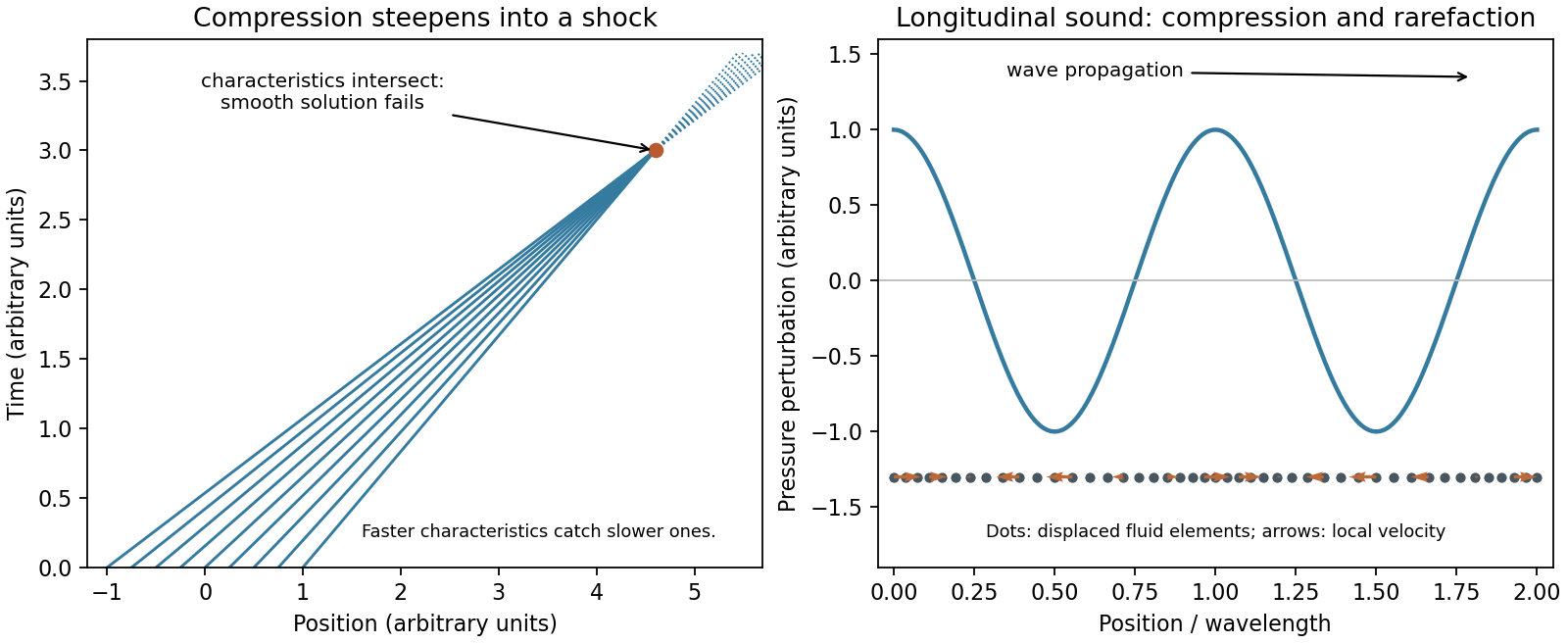
Original characteristic-crossing and longitudinal acoustic wave diagrams
. Details. 
Articles by others on the same topic
There are currently no matching articles.