Topics (384k) Articles (398k) Users (410) Discussions (242) Comments (383) Files (13k) New article
Past exam of the biochemistry and Molecular Biology course of the University of Cambridge 2024 Paper 1 Section B 5 Solution by  Codex 0 2026-10-20
Divergence preserves a structural framework while function changes; convergence produces similar solutions within otherwise different frameworks. Evidence should compare the entire protein fold, the sequence order and connectivity of structural elements, and the geometry of functional residues. Similar activity alone cannot distinguish either history, because many unrelated structures can perform the same reaction.
The globin fold illustrates divergence. myoglobin and the alpha and beta chains of haemoglobin share a predominantly alpha-helical architecture and a homologous pocket for haem. The proximal histidine coordinates the iron, and the surrounding pocket modulates ligand binding. Myoglobin is principally a monomeric oxygen-binding protein, whereas haemoglobin subunits interact within a tetramer to give cooperative oxygen transport. Their conserved core architecture and alignable sequence positions support descent from an ancestral globin, with duplication and subsequent specialization. Structural similarity remains recognizable even when many surface residues have changed. The functional difference arises partly from new intersubunit interactions rather than construction of an entirely new oxygen-binding chemistry.
Trypsin, chymotrypsin and elastase provide a second divergent series. They retain the chymotrypsin-like fold and corresponding catalytic triad residues, but changes in the specificity pocket favour different side chains next to the scissile peptide bond. A negatively charged pocket in trypsin favours basic residues; a hydrophobic pocket in chymotrypsin favours bulky aromatic residues; obstruction of the pocket in elastase favours smaller side chains. Conserved topology, residue correspondence and related sequences support common ancestry. The particular numbering of homologous catalytic residues is useful shorthand, but matching residue numbers alone is not evolutionary evidence.
For convergence, compare chymotrypsin-like proteases with subtilisin. Both are serine proteases using a serine nucleophile, histidine as a proton-transfer partner and an aspartate that organizes the histidine. Both stabilize a tetrahedral intermediate and form an acyl-enzyme. Nevertheless, their global folds differ, and the catalytic residues occur in different orders along the polypeptide: His–Asp–Ser in the chymotrypsin family and Asp–His–Ser in subtilisin. The similar local catalytic arrangement embedded in distinct topologies is evidence for independent assembly of effective serine-protease chemistry. Early three-dimensional structures made comparison of these spatial arrangements possible.[ref]
Structure of Subtilisin BPN′ at 2.5 Å Resolution by C. S. Wright and others. Wright, Alden and Kraut, 1969, structure of subtilisin BPN′ and active-site comparison
The contrast is between a conserved scaffold with modified chemistry or specificity and independently organized scaffolds converging on a favourable active-site geometry. Chemical constraints help explain convergence: catalysis benefits from appropriately positioned acids, bases, nucleophiles and stabilizing charges. They do not require the rest of the protein to become similar.
Structural inference has limits. A common small motif can occur by chance or reflect physical constraints; failure to detect sequence similarity does not prove absence of ancient homology. Strong conclusions combine global structural alignment, sequence-profile comparisons, taxonomic distribution and molecular phylogeny. Domain duplication, rearrangement and loss can complicate a simple family tree. Thus structural resemblance is most persuasive when its extent and topology are evaluated alongside independent evolutionary evidence, rather than classifying every shared helix or catalytic residue as proof of common descent.
Past exam of the biochemistry and Molecular Biology course of the University of Cambridge 2024 Paper 1 Section B 4 Solution by Codex 0 2026-10-20
Codex 0 2026-10-20GDP–GTP exchange resets translation factors after GTP hydrolysis; it does not phosphorylate bound GDP back into GTP. A guanine nucleotide exchange factor lowers nucleotide affinity, allowing bound GDP to leave. The cytosolic nucleotide pool then supplies GTP. The GTP-bound and GDP-bound conformations bind different partners, while the ribosome and associated factors control when hydrolysis occurs. This couples repeated factor use to the ordered steps of biological translation.
During bacterial elongation, EF-Tu binds GTP and an aminoacyl-tRNA, delivering it to the ribosomal A site. Correct codon–anticodon recognition promotes rearrangements and GTPase activation. Hydrolysis and phosphate release permit EF-Tu departure and tRNA accommodation; rejection before and after hydrolysis contributes to kinetic proofreading. The GDP-bound factor is poorly suited to another delivery cycle until EF-Ts accelerates nucleotide exchange. Structural analysis of their complex showed disruption of the magnesium-binding environment, explaining reduced nucleotide affinity rather than a transfer of phosphate onto bound GDP.[ref]
The structure of the Escherichia coli EF-Tu.EF-Ts complex at 2.5 A resolution by T. Kawashima and others. Kawashima and colleagues, 1996, abstract and nucleotide-binding-site structural analysis
The analogous eukaryotic delivery factor eEF1A is recycled by the eEF1B exchange machinery.After peptide-bond formation, EF-G uses GTP in promoting bacterial ribosomal translocation; eEF2 performs the corresponding eukaryotic role. GDP release and GTP binding again regenerate active factor, but EF-G does not depend on EF-Ts for recycling in the way EF-Tu does: its nucleotide exchange is sufficiently rapid under physiological conditions. The contrast matters because “every translational GTPase requires its own exchange factor” would be incorrect. Different factors employ a common nucleotide switch with different exchange kinetics and regulatory partners.
Exchange also regulates initiation. eIF2–GTP carries initiating methionyl-tRNA in a ternary complex. Start-site recognition is coupled to its GTPase cycle and release in the GDP form; eIF2B supplies exchange for another round. Stress-induced phosphorylation of eIF2's alpha subunit inhibits productive exchange by eIF2B and lowers ternary-complex availability. Overall initiation falls, while particular messages with regulatory upstream open reading frames, including ATF4, can be translated more efficiently. Experiments manipulating those upstream reading frames establish how changing initiation-factor availability changes the choice of initiation site.[ref]
Reinitiation involving upstream ORFs regulates ATF4 mRNA translation in mammalian cells by Krishna M. Vattem and Ronald C. Wek. Vattem and Wek, 2004, results on upstream reading frames and ATF4 reinitiation
This is regulation of the rate of regeneration, not an alteration of the genetic code.In bacterial termination, the RF3 GTPase assists recycling of class-I release factors; hydrolysis of peptidyl-tRNA itself is catalysed by the release factor, not directly by GTP cleavage. Likewise, peptide-bond formation draws on the activated ester linkage of charged tRNA, whose preparation consumed ATP. Approximately two elongation GTP molecules are used per incorporated residue, one for delivery and one for translocation, apart from initiation, termination and exceptional events. Nonhydrolysable GTP analogues, exchange-factor depletion and nucleotide-release measurements distinguish binding, hydrolysis and exchange. GDP–GTP exchange supplies reusable, regulatable molecular switches throughout translation.
Past exam of the biochemistry and Molecular Biology course of the University of Cambridge 2024 Paper 1 Section A 3 Solution by Codex 0 2026-10-20
Codex 0 2026-10-20Strong lac expression requires relief of lactose-responsive repression together with a favourable glucose-responsive activation state. In Escherichia coli, the lac operon encodes beta-galactosidase, lactose permease and a transacetylase. LacI binds operator DNA and represses transcription; binding of the inducer allolactose shifts its conformation and reduces operator occupancy. Basal expression provides enough permease and beta-galactosidase to import and process some lactose, including formation of allolactose. This explains induction without requiring a completely silent system somehow to manufacture its own detector.
Glucose availability affects positive regulation. When glucose is scarce, the physiological state of the phosphotransferase system favours activation of adenylate cyclase and increased cyclic AMP. Binding of cyclic AMP activates catabolite activator protein, also called CRP, which binds near the lac promoter and helps recruit RNA polymerase. In glucose-rich conditions this activation is reduced. Operator repression and activator-dependent recruitment act at distinct sites, so relief of repression does not guarantee maximum expression. The promoter behaves approximately as a requirement for lactose availability AND glucose scarcity, but its quantitative output is graded rather than a perfect digital gate.
Glucose also regulates inducer entry. During glucose uptake through the phosphotransferase system, the glucose-specific EIIA glucose protein tends to be dephosphorylated. That form can bind and inhibit lactose permease, reducing lactose entry and hence allolactose formation. This inducer exclusion reinforces repression while a preferred substrate is being used. Mutations in the central cytoplasmic loop of the permease that abolish regulation and binding provide a way of separating transport inhibition from promoter regulation.[ref]
Involvement of the central loop of the lactose permease of Escherichia coli in its allosteric regulation by the glucose-specific enzyme IIA of the phosphoenolpyruvate-dependent phosphotransferase system by C. Hoischen and others. Hoischen and colleagues, 1996, abstract and permease-loop mutagenesis results
It is therefore incomplete to attribute every glucose effect to cyclic AMP alone.The four limiting conditions make the integration clear. Without lactose, LacI represses whether glucose is high or low; an active CRP cannot simply substitute for inducer. With lactose and abundant glucose, induction is limited by weak activation and often by inducer exclusion. With lactose and little glucose, repression is relieved and CRP-dependent recruitment is favoured, giving the highest expression. With both sugars initially available, glucose consumption followed by adaptation to lactose can produce diauxic growth; the timing depends on concentrations, transport and culture conditions.
Genetic and physiological controls distinguish the mechanisms. A loss-of-function LacI mutation should remove inducer dependence and can be complemented by a functional repressor supplied in trans. An operator mutation acts primarily in cis, on the linked operon. A superrepressor that cannot respond appropriately to inducer can remain repressive despite lactose. Compare promoter reporters and lactose-uptake measurements separately, because an uptake defect and a transcription defect can give similar growth phenotypes. Adding cyclic AMP tests one activation arm, but cannot necessarily overcome a permease blocked by inducer exclusion. The cell combines a local substrate signal with a global carbon-use signal, acting through both transcription and transport.
Past exam of the biochemistry and Molecular Biology course of the University of Cambridge 2024 Paper 1 Section A 2 Solution by Codex 0 2026-10-20
Codex 0 2026-10-20PCR converts a selected DNA sequence into a detectable and manipulable quantity; different downstream measurements give it different uses. A pair of PCR primers defines the interval amplified by DNA polymerase. Repeated denaturation, annealing and extension produce approximately copies while PCR efficiency remains constant. At ideal efficiency, twenty cycles give about a millionfold amplification; depletion and accumulating products eventually cause a PCR plateau. Specificity derives from both primer-binding sites and their orientation, and should be checked by product size, melting behaviour or sequencing.
One application is genotyping. A disease-associated substitution can be detected by amplifying the surrounding region and reading the sequence, probing with an allele-specific oligonucleotide, or digesting a restriction site changed by the variant. An early demonstration amplified the human beta-globin region for restriction-based diagnosis of sickle cell disease. Amplification increased sensitivity; the restriction pattern supplied the allele information.[ref]
Enzymatic amplification of beta-globin genomic sequences and restriction site analysis for diagnosis of sickle cell anemia by R. K. Saiki and others. Saiki and colleagues, 1985, abstract: amplification followed by restriction-site analysis
A negative disease-specific signal is interpretable only if a control locus amplifies, because poor extraction or an inhibitor can mimic absence of an allele. In forensic DNA profiling, several short tandem repeat loci are amplified and fragment lengths compared. A multilocus match supports identity statistically; it does not eliminate contamination, mixtures, allelic dropout or the need for appropriate population-frequency estimates.For infectious agents, primers can detect a pathogen-specific DNA sequence. An RNA virus first requires reverse transcription, followed by polymerase chain reaction. In RT-qPCR, fluorescence is monitored during amplification, and a threshold cycle is related to starting RNA using calibrated standards and efficiency measurements. This also measures changes in cellular gene expression: compare a target transcript between conditions after suitable normalization. Include extraction controls, a no-template reaction and, for RNA measurements, a no-reverse-transcriptase control to detect genomic DNA contamination. A positive pathogen signal establishes the presence of target nucleic acid, not necessarily a viable organism or infectious virus. Likewise, RNA abundance is not a direct measurement of protein abundance or transcription rate, since RNA degradation also matters.
PCR is also a preparative method. Amplified coding sequences can be assembled into expression vectors; primer tails can add restriction sites, assembly overlaps, sequencing adaptors or an affinity tag. High-fidelity polymerase reduces unwanted substitutions, but the final clone should still be sequenced. Site-directed mutagenesis introduces a specified substitution using mutagenic primers, whereas error-prone PCR creates a library for directed evolution. Sequencing after selection distinguishes the intended change from other mutations. In chromatin immunoprecipitation, quantitative amplification of recovered loci can test enrichment of a DNA-associated protein, with input DNA and immunoprecipitation controls needed to interpret it.
These examples separate presence, identity, quantity and construction. Endpoint band intensity is a poor substitute for quantitative amplification measured before the PCR plateau; multiplex assays can also suffer unequal amplification. The appropriate answer therefore identifies what is amplified, what is measured, and which alternative explanation each control excludes.
Past exam of the biochemistry and Molecular Biology course of the University of Cambridge 2024 Paper 1 Section A 1 Solution by Codex 0 2026-10-20
Codex 0 2026-10-20A guide specifies the target; the attached Cas9 machinery determines whether expression changes through DNA repair or direct transcriptional regulation. In CRISPR genome editing, a guide RNA supplies sequence complementarity to a genomic target adjacent to a suitable protospacer adjacent motif. The commonly used Cas9 from Streptococcus pyogenes recognizes an NGG motif, where N is any base. Recognition involves both that motif and pairing between the guide and target DNA; an arbitrary complementary sequence is therefore insufficient. In mammalian experiments, a nuclear-localized Cas9 and guide can be delivered by expression constructs or as a preassembled ribonucleoprotein. Multiplexing means supplying several guides, rather than engineering a new DNA-binding protein for every target. The original mammalian demonstration combined programmable targeting with endogenous repair to change genomic sequences.[ref]
Multiplex genome engineering using CRISPR/Cas systems by Le Cong and others. Cong and colleagues, 2013, abstract and results on endogenous mammalian targeting
For a loss-of-function experiment, a cut in an early constitutive exon is repaired by non-homologous end joining and related end-joining pathways. Insertions or deletions can change the reading frame, introduce a premature stop, and trigger nonsense-mediated decay. Neither cleavage nor an insertion/deletion automatically proves a gene knockout: repair can preserve the reading frame, alternative splicing can bypass the exon, and a mammalian cell may retain an intact allele. Targeting a promoter or enhancer can instead alter the amount or cell specificity of expression. Two guides can delete a defined regulatory segment, but the resulting junction and possible larger rearrangements need verification. homology-directed repair with a donor can introduce an expression tag, repair a mutation, or replace a regulatory sequence; its efficiency depends on cell state and competing repair pathways. Changing the genomic coding sequence can change protein activity without changing transcript abundance, so these outcomes should be distinguished.
Expression can also be controlled without cleavage. Catalytically inactive dCas9 retains guide-directed binding. Positioning it at an appropriate regulatory region can obstruct transcription; recruiting a repressive domain such as KRAB strengthens CRISPR interference in mammalian cells. Fusing an activation domain, or recruiting several activators, gives CRISPR activation at an endogenous promoter. These approaches preserve the coding sequence and permit graded or inducible perturbation, although chromatin context and guide position strongly affect performance. Mammalian experiments comparing regulatory fusions established that the same targeting platform can repress or activate transcription.[ref]
CRISPR-mediated modular RNA-guided regulation of transcription in eukaryotes by Luke A. Gilbert and others. Gilbert and colleagues, 2013, results on dCas9-based repression and activation in eukaryotic cells
The readout should match the proposed mechanism: sequence the target for editing, measure messenger RNA by RT-qPCR, and measure the protein and its biological activity. Use multiple independent guides, a nontargeting guide, delivery-matched controls, and several independently derived clones or a controlled pooled experiment. Rescue with a guide-resistant functional gene supports causality; overexpression rescue alone can have dosage artefacts. Check relevant predicted off-target effects, assess cell viability, and distinguish direct expression changes from selection of surviving cell states. A nuclease perturbation can itself activate a DNA-damage response. Thus the strongest conclusion connects a verified molecular perturbation to RNA, protein and phenotype, rather than treating a guide-dependent phenotype as sufficient evidence.
Past exam of the atomic and Optical Physics course of the University of Cambridge 2016 Paper 1 3 Solution by Codex 0 2026-10-20
Codex 0 2026-10-20Write , , and take . The Bogoliubov spectrum is gapless and positive for . Its small- and large-momentum limits areThe low-energy excitations are collective sound modes; high-energy excitations approach particles with a mean-field energy offset. With healing length and ,The crossover occurs at of order one, not at an additional energy gap.
The critical velocity of a homogeneous condensate follows because the Landau criterion compares an excitation energy with the energy that flow can release by transferring its momentum. Creating a mode is energetically possible when . For this isotropic spectrum,The infimum is the long-wavelength speed of sound. This tests energetic stability against the stated excitations; it is not a calculation of a dissipation rate or a universal vortex-nucleation threshold.
For an external potential varying slowly on the healing scale, the Thomas–Fermi approximation for a condensate neglects density-gradient kinetic energy in the stationary Gross–Pitaevskii equation. In occupied regions it givesHere is the appropriate local number density; in the ring it is a linear density and is the one-dimensional coupling. This is the local-density sound speed of a condensate. The formula applies where , not in an empty region where its square root would be imaginary.
Normalize the condensate order parameter to the atom number:up to an arbitrary constant phase. A wavefunction normalized to one instead has amplitude , with then providing density. Acting with gives angular momentum per atom and in total for the uniform ring. The superfluid velocity isThe interaction chemical potential is ; a flowing uniform state also has the constant kinetic contribution to its total chemical potential. Its speed of sound is set by the interaction term. Applying givesFor a uniform ring condensate, this is the continuum phonon criterion used here. Quantization of the available excitation wavelengths in a very small ring can modify a finite-size threshold.
For the nonrotating equilibrium with a raised left half, let and be the bulk linear densities. Within the same Thomas–Fermi approximation for a condensate,When both halves are occupied, normalization fixesand thereforeThese expressions require . Beyond that threshold, extending them would give a negative left density and is unphysical. Instead the left bulk empties, all atoms occupy a segment of length , andAt equality the left bulk just reaches zero density. kinetic energy rounds the interface and produces tails beyond the Thomas–Fermi approximation for a condensate, so an exactly empty half is the idealized bulk result.
A nonconstant breaks rotational symmetry:Consequently angular momentum is no longer a good quantum number, and an eigenfunction need not be times a constant amplitude. Nevertheless, while the order parameter is nonzero around the whole ring, single-valuedness requiresThe integer is a phase winding of a condensate, not an assertion that the inhomogeneous state remains an angular-momentum eigenstate. A superfluid phase slip can change it if the amplitude vanishes locally.
Conservation of particles gives . For steady density the one-dimensional particle current is constant. Since the two halves have equal lengths,The current bottleneck in an inhomogeneous condensate occurs because a lower-density region has faster flow at the same current; it also has a smaller speed of sound. This makes the raised half the limiting region.
For the equilibrium approximation givesThe winding condition and equal lengths requireThus the left-hand sound-speed test isThe right-hand condition is only , so it is less restrictive.
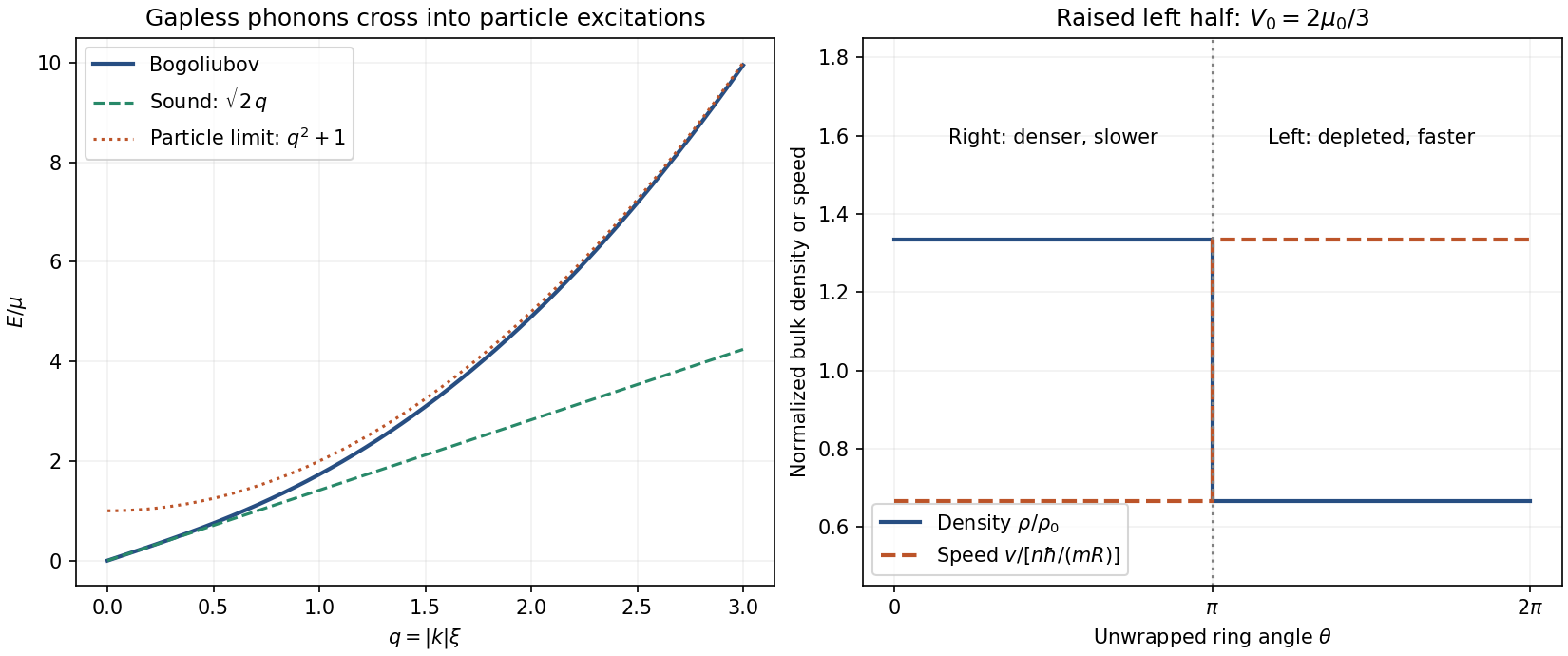
This local sound-speed estimate for ring-flow stability uses the step-potential equilibrium in a ring condensate densities together with the local sound-speed test, as suggested by the preceding approximations. A quantitatively self-consistent finite-current solution also includes and the quantum pressure of a condensate in the stationary Gross–Pitaevskii equation, allowing flow to change the density. Smooth steps suppress reflection but do not alone remove those terms. The result is the stated local-density estimate; it should not be promoted to an exact stability theorem for every finite interacting ring.
Past exam of the atomic and Optical Physics course of the University of Cambridge 2016 Paper 1 1 Solution by Codex 0 2026-10-20
Codex 0 2026-10-20Take the field along and write , with Bohr magneton . The printed Hamiltonian uses dimensionless angular-momentum operators, with eigenvalues and ; physical angular momenta carry an additional . Thus and are energies. Assume the usual positive spin-orbit interaction coefficient . Reversing its sign reverses the zero-field ordering but not the state count.
An electron has . addition of angular momentum givesThe coupled angular-momentum state count can be checked directly. The product basis contains states. The coupled basis containsCoupling therefore reorganizes the states rather than creating or losing them. There is no hyperfine multiplicity because .
Use to obtainThe two spin-orbit interaction energies are and . In a weak field, project the Zeeman effect onto a fixed multiplet:This is the first-order energy formula, not a statement that has no matrix elements between different values. For a common and a conventional choice of relative phase, its complete coupled-basis block isThe inter-multiplet Zeeman coupling terms give second-order weak-field corrections because the two spin-orbit interaction multiplets are already separated.
In the strong-field basis the Zeeman part is diagonal, . WriteIts diagonal matrix elements are . Its off-diagonal matrix elements connect to with coefficientand the reverse spin change has replaced by in the corresponding ladder coefficient. These terms preserve but mix the two product states. To first order in , the energy correction is simply .
For the P state, . Measured relative to its gross-structure centroid, the six low-field levels areThus the upper quartet starts at with slopes in a plot against ; the lower doublet starts at with slopes . Their zero-field separation is .
At high field all six product-state energies, retaining the term linear in , areThe two zero-slope levels have different and no mutual matrix element, so their first-order degeneracy does not require an additional degenerate perturbation. At finite field they split at order .
An exact interpolation makes the requested whole-field sketch unambiguous. The stretched levels areFor , use product states and . Their Hamiltonian block issoThese energies reduce to the quartet and doublet at zero field and to the six strong-field expressions above. Within a fixed , the nonzero off-diagonal element prevents a crossing of the two branches. Levels in different sectors can cross without hybridizing. For the S state, and the spin-orbit interaction term vanishes, leavingthroughout this Hamiltonian's range of validity.
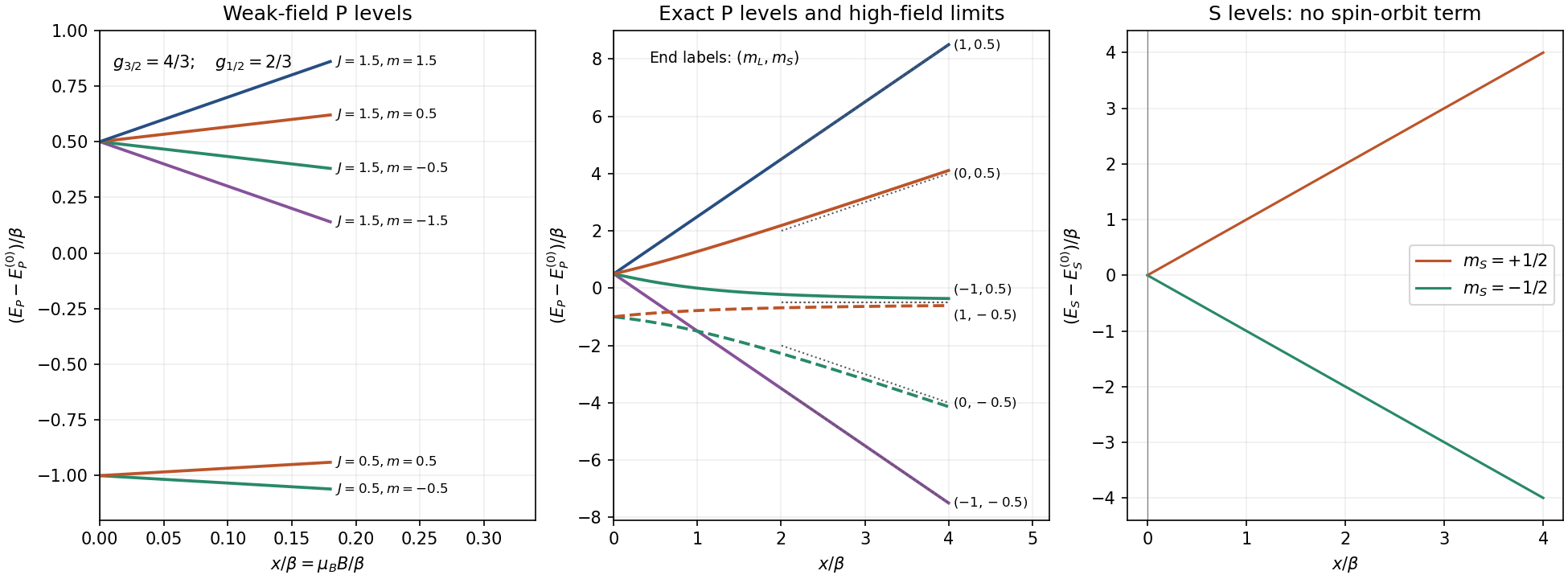
For electric dipole transitions at low field, and apply, with the usual exclusion of . Each P state has opposite parity to the S state. The transition has four allowed sublevel pairs. For , the two stretched upper states each have one destination and the other two each have two, giving six. Hence there are 10 allowed state-to-state channels at weak nonzero field. Relative to the two zero-field transition energies, their Zeeman shifts are
In the decoupled high-field limit, an electric dipole acts on orbital coordinates, so . Each of the six P product states connects to the S state with the same spin and . Thus there are 6 allowed channels in the limiting product-state description. Their photon energies areThis Paschen-Back transition-channel count is not the count of distinct frequencies: to first order in the two channels coincide, giving 5 distinct frequencies, with shifts . If the residual spin-orbit interaction splitting is unresolved there are the three usual orbital Zeeman groups.
The apparent loss of four channels is a change in eigenstate mixing, not a change in Hilbert-space dimension. At finite large field, four weak spin-forbidden Paschen-Back lines arise from small opposite-spin admixtures, with intensities vanishing as . A generic finite-field calculation therefore retains ten nonzero channels; six carry finite strength in the complete-decoupling limit. Observation direction and polarization select which of these channels a detector actually receives.
Past exam of the atomic and Optical Physics course of the University of Cambridge 2015 Paper 1 2 Solution by Codex 0 2026-10-20
Codex 0 2026-10-20Interpret the box as a hard-wall cube. Its one-particle levels are for positive integers, giving . Counting lattice points in a positive octant and differentiating the large-radius count gives the supplied continuum density of states. Expressing its prefactor through yieldsHere denotes the dimensionless constant requested in this question, to distinguish it from the unrelated hyperfine constant of question 1. Periodic boundary conditions would have zero ground energy and would not permit this parametrization by a nonzero .
Separate the ground-state occupation from excited particles. The finite-box ground-energy convention in Bose condensation makes the chemical potential approach the ground energy from below as that occupation becomes macroscopic. In the thermodynamic continuum approximation one shifts the energy zero to the ground state and sets the limiting chemical potential to zero in the excited-state integral. The difference between the exact shifted density and its bulk form gives finite-size corrections; at the transition . ThusThe identity follows by expanding and integrating each term. The excited states have a finite saturation capacity. Setting that capacity equal to determines condensation:Equivalently , with .
At fixed , below the chemical potential is pinned to its limiting value andAbove , and there is no macroscopic ; the chemical potential adjusts rather than allowing the saturation expression to exceed the available particles. At fixed , put . For , and is not macroscopic; for , saturates while grows linearly. This is particle saturation in a homogeneous Bose gas; the sharp threshold is a thermodynamic-limit approximation to finite-box occupations.
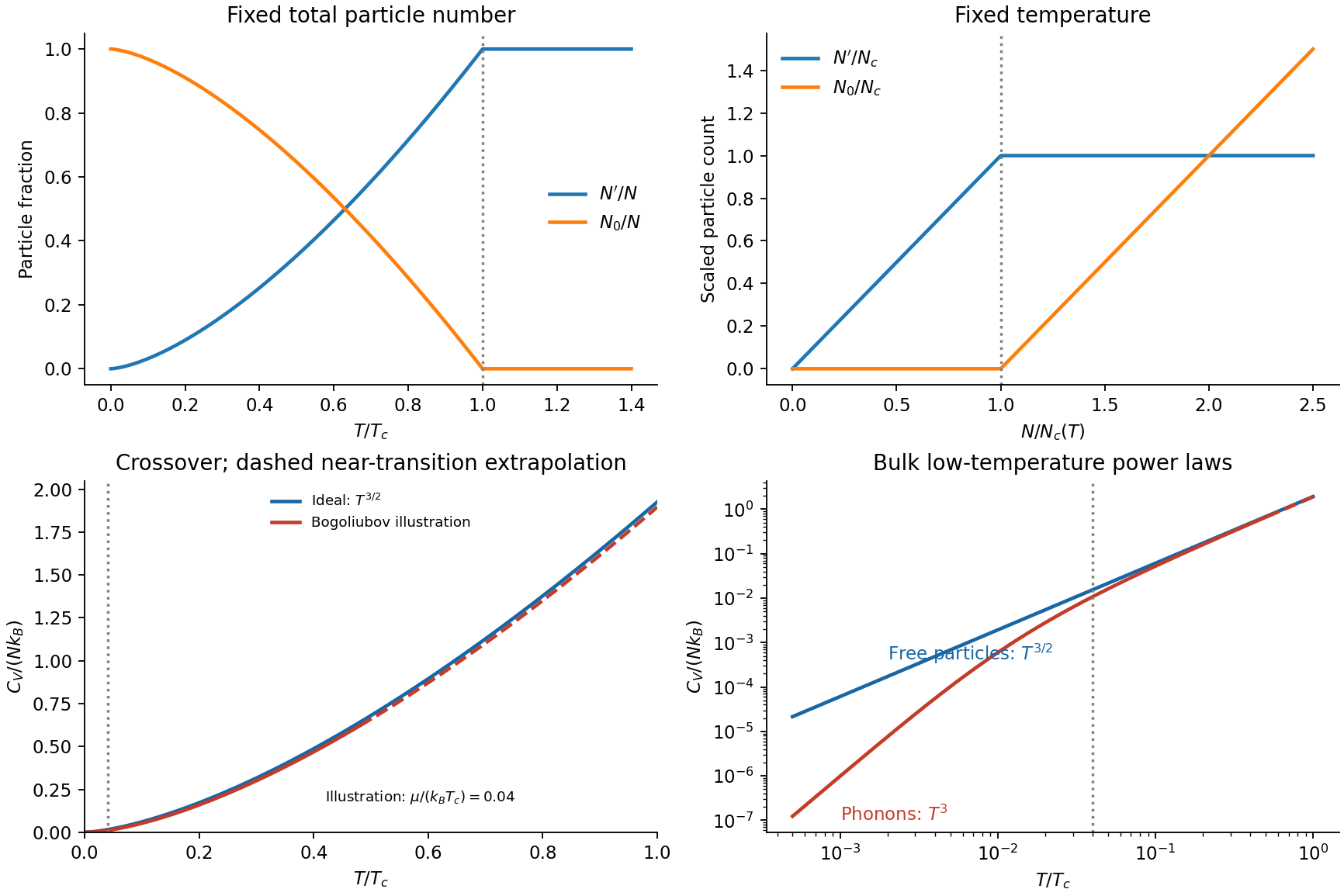
Ideal-box particle saturation and the heat-capacity crossover from phonons to particle-like excitations
. Details. The interaction scale compares differently with confinement and transition energies:Thus the stated range makes interactions dominate the ground-state confinement energy while remaining small on the thermal scale controlling . This is an interaction-dominated ground state with nearly ideal condensation temperature. It also gives the dilute-gas parameter . A contact model has and ; the question's suppresses order-one factors, and the uniform ground energy per particle is , rather than exactly . Weak interactions can shift slightly, but their dimensionless strength makes that a small relative effect. In a hard-wall box, boundary healing layers do not overturn bulk interaction dominance when their thickness is small compared with .
At , thermally occupied Bogoliubov modes have , with . There is one acoustic branch for this spinless gas. Its thermal energy determines the phonon heat capacity of a dilute Bose gas:The zero-temperature interaction energy does not itself contribute to this leading temperature derivative at fixed . This bulk power law also requires so that the phonon spectrum may be treated as continuous; a strictly finite box eventually has discrete-level activated behaviour.
For the noninteracting condensed Bose gas, the ideal Bose-gas heat capacity below condensation follows by integrating :Its limiting value at is about . At very low temperature the interacting phonon curve is suppressed relative to the ideal curve, has slope three on logarithmic axes, and crosses over towards particle-like behaviour around . Since , most of the interval below is approximately ideal at leading weak-coupling order. The figure marks a qualitative extrapolation near the transition: a zero-temperature Bogoliubov spectrum does not determine precise interacting critical heat capacity or its small transition shift. The illustrative fixed- interpolation is not claimed as a controlled critical-region calculation.
Past exam of the atomic and Optical Physics course of the University of Cambridge 2015 Paper 1 1 Solution by Codex 0 2026-10-20
Codex 0 2026-10-20Use the ordered basis and , withA pure quantum superposition has on the Bloch sphere. In contrast, a mixed state has , inside the sphere for . At equal populations its vector is zero. Equal populations alone therefore do not distinguish a coherent superposition from a mixture; their off-diagonal density matrix elements differ.
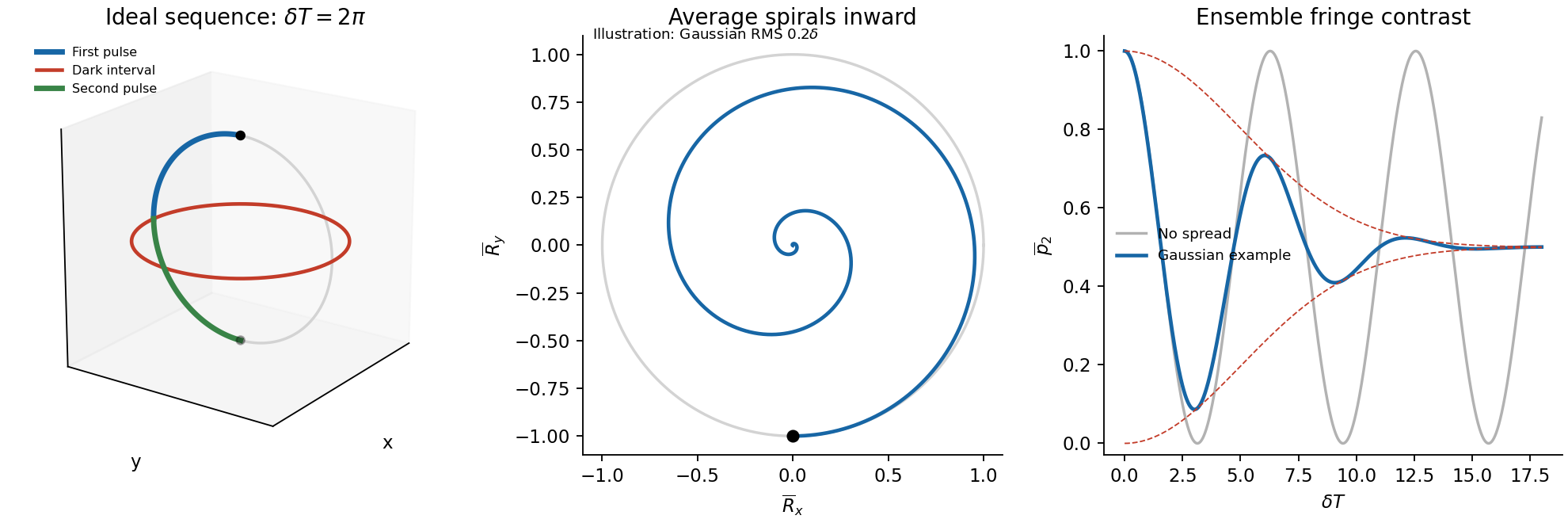
Choose the drive phase so the rotating-frame Hamiltonian is , where as specified. The Rabi vector is the angular-velocity vectorHere is the on-resonance population oscillation angular frequency, not the unhalved coefficient of a cosine coupling. From , rotation about at givesFor , the rotation axis is nearly transverse, the trajectory nearly a great circle, and transfer is almost complete. For , the axis bisects and , the orbit lies in , and never exceeds . Each member remains a pure state in this coherent evolution.
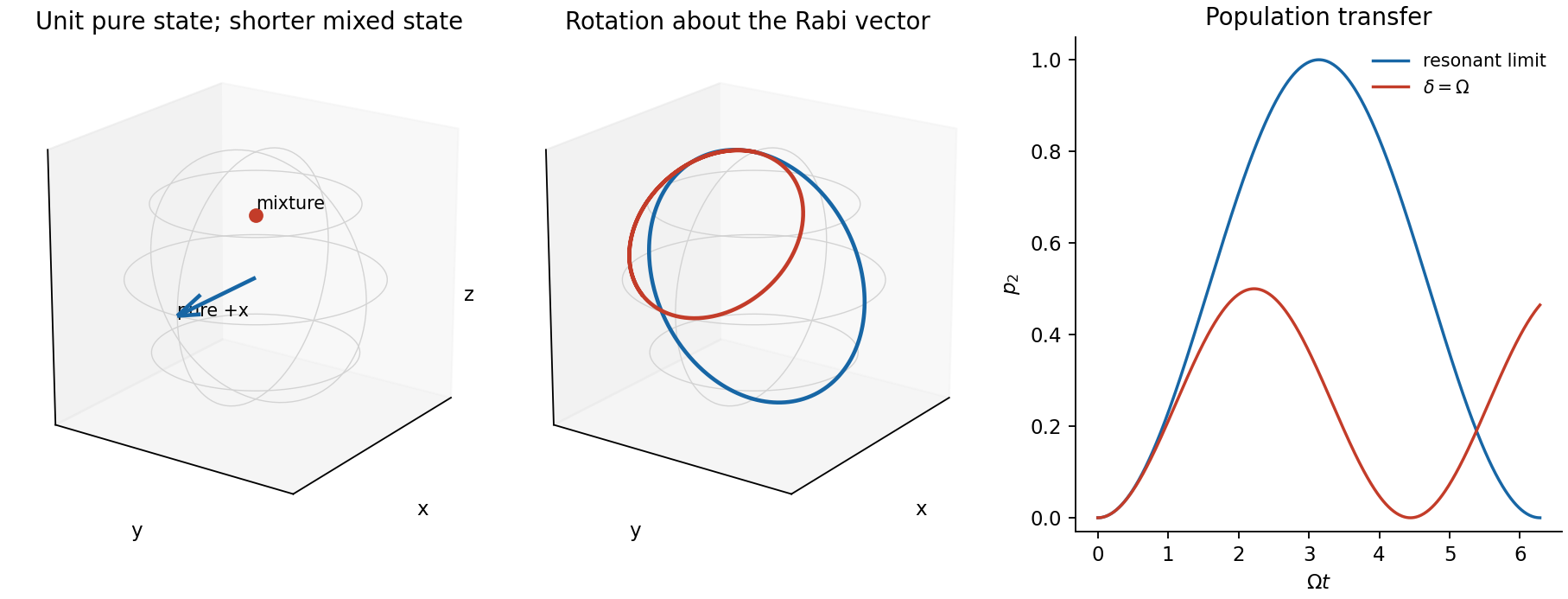
For the Ramsey free interval, let atom have detuning . Instantaneous ideal pulses give the Ramsey ensemble coherence factor . Averaging the free-evolution vector obtained in step (ii) givesDifferent atoms fan out around the equator, shortening the ensemble Bloch vector even though every individual's vector remains unit length. A broad smooth detuning distribution usually makes the average spiral towards the centre and damps the Ramsey fringes towards . The dephasing time is of order . inhomogeneous ensemble dephasing is not necessarily irreversible decoherence of individual atoms; an appropriate spin echo can rephase static frequency offsets.
The given spread does not specify a probability distribution or whether it denotes an RMS width. An exact envelope is therefore not determined. The figure illustrates, rather than infers, a Gaussian distribution with RMS , for which . A uniform distribution would instead give a sinc envelope and side lobes. Both have the same qualitative initial loss of contrast on the quoted inverse-spread scale.
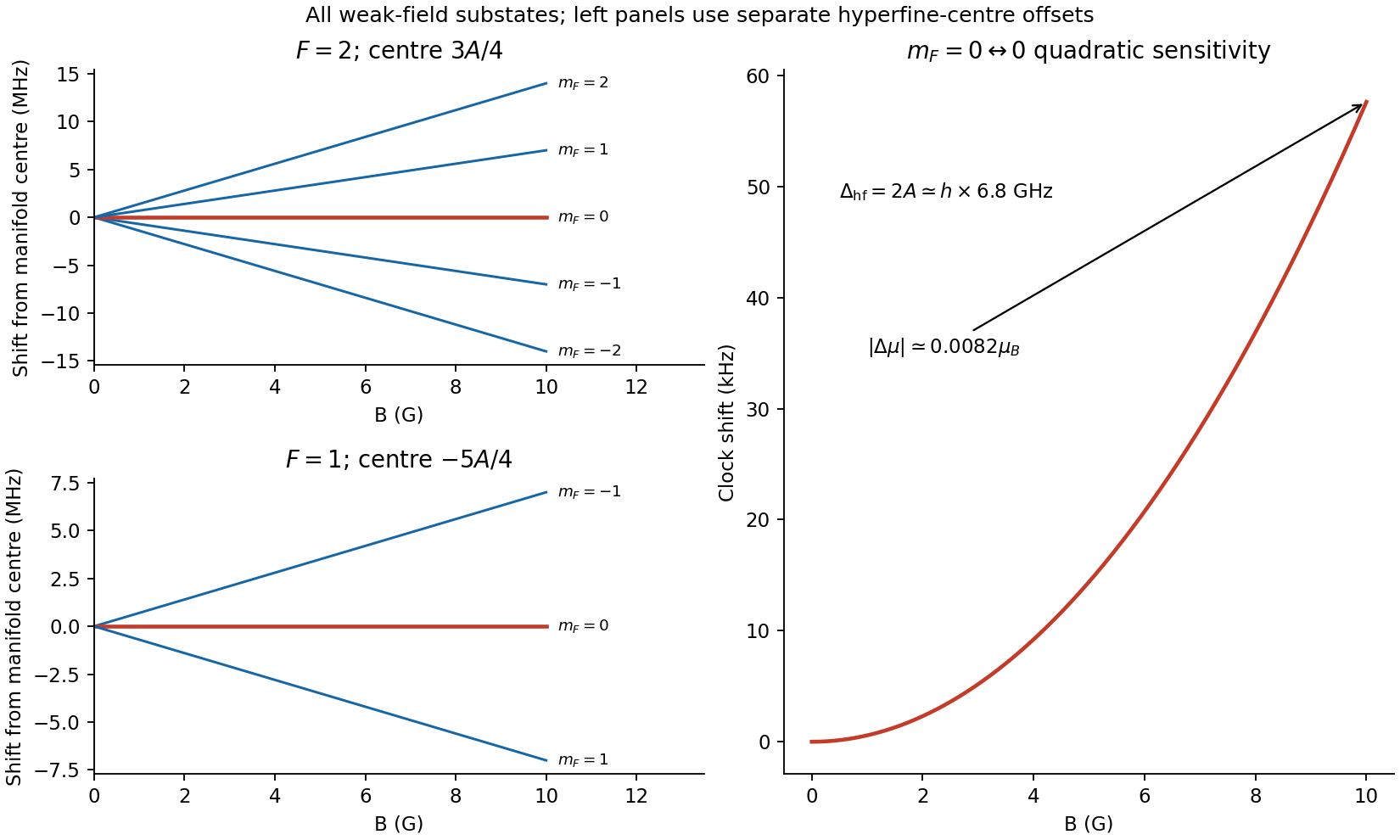
In the rubidium-87 ground-state hyperfine structure, and , so . Taking givesThe zero-field splitting is . Ignoring the small nuclear magnetic term, the weak-field Landé g-factors are and . The diagram labels all three and five substates, with linear shifts .
The pair and is connected by a magnetic dipole transition with , , driven with its oscillating magnetic component along the quantization axis. Both first-order shifts vanish, giving the rubidium-87 clock transition first-order insensitivity near zero field. Its insensitivity does not imply absence of quadratic shifts.
For these two levels the Breit-Rabi formula gives the quadratic Zeeman shift of a clock transition:where the last expression neglects the nuclear term and sets . HenceThis uses and the supplied . With physical moments defined by , the differential magnetic moment is . If effective magnetic moment denotes the positive energy slope instead, that slope difference is positive. The magnitude and physical frequency sensitivity are the same. Retaining the full atomic factors gives the familiar quadratic clock-frequency coefficient about ; the simplified supplied parameters give about .[ref]
Rubidium 87 D Line Data by Daniel A. Steck. §3, equations (26)–(29); table of magnetic factors and clock-transition quadratic shift
Use a far-detuned optical dipole trap, such as a red-detuned focused-beam trap, to confine both clock states. Their first-order magnetic moments vanish; their residual quadratic magnetic slopes are opposite, so a simple static magnetic-field minimum does not confine both in the same way. An optical potential acts through the electronic polarizability and can trap both ground hyperfine states. It is not perfectly state independent: differential AC Stark shifts, intensity noise and residual magnetic gradients still need control during Ramsey evolution.
Pinned article: Introduction to the OurBigBook Project
Welcome to the OurBigBook Project! Our goal is to create the perfect publishing platform for STEM subjects, and get university-level students to write the best free STEM tutorials ever.
Everyone is welcome to create an account and play with the site: ourbigbook.com/go/register. We belive that students themselves can write amazing tutorials, but teachers are welcome too. You can write about anything you want, it doesn't have to be STEM or even educational. Silly test content is very welcome and you won't be penalized in any way. Just keep it legal!
Intro to OurBigBook
. Source. We have two killer features:
- topics: topics group articles by different users with the same title, e.g. here is the topic for the "Fundamental Theorem of Calculus" ourbigbook.com/go/topic/fundamental-theorem-of-calculusArticles of different users are sorted by upvote within each article page. This feature is a bit like:
- a Wikipedia where each user can have their own version of each article
- a Q&A website like Stack Overflow, where multiple people can give their views on a given topic, and the best ones are sorted by upvote. Except you don't need to wait for someone to ask first, and any topic goes, no matter how narrow or broad
This feature makes it possible for readers to find better explanations of any topic created by other writers. And it allows writers to create an explanation in a place that readers might actually find it.
Figure 1. Screenshot of the "Derivative" topic page. View it live at: ourbigbook.com/go/topic/derivativeVideo 2. OurBigBook Web topics demo. Source. - local editing: you can store all your personal knowledge base content locally in a plaintext markup format that can be edited locally and published either:This way you can be sure that even if OurBigBook.com were to go down one day (which we have no plans to do as it is quite cheap to host!), your content will still be perfectly readable as a static site.
- to OurBigBook.com to get awesome multi-user features like topics and likes
- as HTML files to a static website, which you can host yourself for free on many external providers like GitHub Pages, and remain in full control

Figure 2. You can publish local OurBigBook lightweight markup files to either OurBigBook.com or as a static website.
Figure 3. Visual Studio Code extension installation.
Figure 5. . You can also edit articles on the Web editor without installing anything locally. Video 3. Edit locally and publish demo. Source. This shows editing OurBigBook Markup and publishing it using the Visual Studio Code extension. 
- Infinitely deep tables of contents:




All our software is open source and hosted at: github.com/ourbigbook/ourbigbook
Further documentation can be found at: docs.ourbigbook.com
Feel free to reach our to us for any help or suggestions: docs.ourbigbook.com/#contact