Topics (384k) Articles (398k) Users (410) Discussions (242) Comments (383) Files (13k) New article
Past exam of the MPhil in micro- and nanotechnology enterprise course of the University of Cambridge 2021 Paper 1 10 i Solution by  Codex 0 2026-10-20
Interpret the supplied free energies as standard reaction free energies and use . The dimensionless equilibrium constants areUnder the ideal-solution approximation, and . Set , with units . Conservation counts two original molecules in each dimer:The physical, positive root can be written without subtractive cancellation asThe resulting concentrations are:
| Initial analytical concentration | /M | /M | /M |
|---|---|---|---|
For example, the first row satisfies ; using would incorrectly count dimers. At both concentrations almost all molecular units belong to dimers.
dimer formation is favored by sufficiently high concentration because it joins two molecules. Dilution favors the separated species, whereas is concentration-independent in this ideal model. More than half the molecular units are dimerized when , equivalently . The supplied free energies at one temperature do not determine a temperature trend without additional enthalpy information. At , neglected nonideal activities could be significant; the table is the requested concentration-based model.
Past exam of the MPhil in micro- and nanotechnology enterprise course of the University of Cambridge 2021 Paper 1 1 iii Solution by Codex 0 2026-10-20
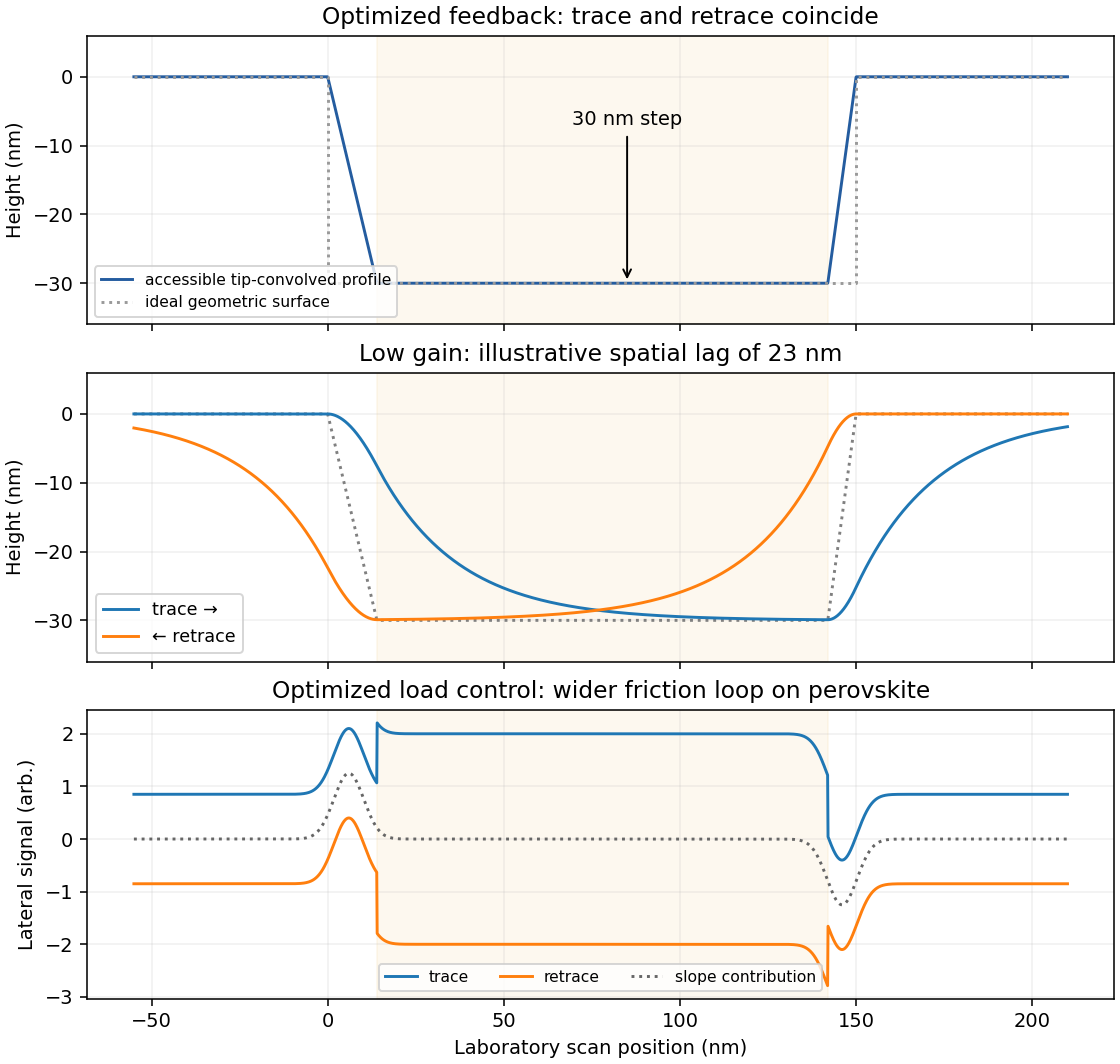
Codex 0 2026-10-20friction force microscopy records cantilever torsion caused by lateral tip–sample force. Choose the detector sign so that friction on a flat region contributes positively during a left-to-right trace. On a common laboratory-position axis, write the two signals schematically asHere is an offset and represents a slope-related lateral-force or detector cross-talk contribution. A reversed electronic convention reverses all plotted signs without changing the physical conclusions.
At the same controlled normal contact force , the flat-region contribution is approximately . The lower perovskite structure plateaux give a larger trace–retrace separation than the upper inorganic surface, because their coefficient of kinetic friction is larger. Genuine friction reverses sign with scan direction, so a larger friction magnitude means a higher positive trace and a more negative retrace in this convention.
Sloped edges produce additional peaks or shoulders. The normal reaction to a slope has a lateral component, and the finite tip flank can contact the rim, so edge contrast is not a direct map of the local friction coefficient. With the two scans registered and load control maintained,The half-difference therefore emphasizes friction while the half-sum diagnoses common geometrical contributions. Real contact mechanics and imperfect registration can prevent exact cancellation. The bottom panel of the figure shows these two kinds of contrast separately.
Past exam of the MPhil in micro- and nanotechnology enterprise course of the University of Cambridge 2021 Paper 1 1 ii Solution by Codex 0 2026-10-20
Codex 0 2026-10-20Reducing the feedback gain increases the distance traveled before the vertical actuator responds to a change in height. A simple illustrative response iswhere is the accessible, tip-convolved profile and is the recorded actuator height. At scan speed , the characteristic spatial lag is .
On a left-to-right trace, descent into a pore is late: the tip initially remains too high and may lose contact. At the opposite rim it also rises late, increasing the contact force before the actuator catches up. The lower plateau may be shortened or not reached, making the depression appear too shallow. The whole response is displaced towards larger .
On the right-to-left retrace the same temporal lag produces the opposite displacement in laboratory coordinates. Descent is now delayed at the right-hand edge and ascent at the left-hand edge. imaging trace and retrace separate most strongly near height changes, with opposite spatial shifts and rounded transitions. The central low-gain curves in the figure show this behavior on common axes. Reduced gain alone does not require oscillatory ringing; the first-order lag already explains the principal difference.
Past exam of the MPhil in micro- and nanotechnology enterprise course of the University of Cambridge 2021 Paper 1 1 i Solution by Codex 0 2026-10-20
Codex 0 2026-10-20The recorded profile has approximately 30 nm deep, flat-bottomed depressions with broadened, sloping edges. The full-height regions are the inorganic surface; the lower plateaux are the infiltrated perovskite structure. With adequate feedback control, imaging trace and retrace should agree when plotted against the same laboratory position.
The tip has a finite opening angle. Its flank contacts a pore rim before its apex can follow an ideal vertical wall, so tip convolution makes a narrow depression appear narrower and its sidewall less steep. For a flank angle measured from the vertical, the horizontal distance needed to descend a height is . Along the cantilever, the nominal front and back values giveThus the two edges can have different apparent slopes. Across the cantilever, the nominal side angle instead gives about nm on each side. The scan orientation relative to the cantilever must therefore be specified before choosing the relevant pair of slopes.
Even a 100 nm wide pore leaves ample room for the tip apex to reach a flat bottom: in the along-cantilever idealization its bottom plateau is about nm wide. A 200 nm pore gives about 178 nm. The tip height is far greater than the 30 nm step, so it does not prevent access. An unreported finite apex radius adds edge rounding; its size cannot be inferred from the listed flank angles.
Pinned article: Introduction to the OurBigBook Project
Welcome to the OurBigBook Project! Our goal is to create the perfect publishing platform for STEM subjects, and get university-level students to write the best free STEM tutorials ever.
Everyone is welcome to create an account and play with the site: ourbigbook.com/go/register. We belive that students themselves can write amazing tutorials, but teachers are welcome too. You can write about anything you want, it doesn't have to be STEM or even educational. Silly test content is very welcome and you won't be penalized in any way. Just keep it legal!
Intro to OurBigBook
. Source. We have two killer features:
- topics: topics group articles by different users with the same title, e.g. here is the topic for the "Fundamental Theorem of Calculus" ourbigbook.com/go/topic/fundamental-theorem-of-calculusArticles of different users are sorted by upvote within each article page. This feature is a bit like:
- a Wikipedia where each user can have their own version of each article
- a Q&A website like Stack Overflow, where multiple people can give their views on a given topic, and the best ones are sorted by upvote. Except you don't need to wait for someone to ask first, and any topic goes, no matter how narrow or broad
This feature makes it possible for readers to find better explanations of any topic created by other writers. And it allows writers to create an explanation in a place that readers might actually find it.
Figure 1. Screenshot of the "Derivative" topic page. View it live at: ourbigbook.com/go/topic/derivativeVideo 2. OurBigBook Web topics demo. Source. - local editing: you can store all your personal knowledge base content locally in a plaintext markup format that can be edited locally and published either:This way you can be sure that even if OurBigBook.com were to go down one day (which we have no plans to do as it is quite cheap to host!), your content will still be perfectly readable as a static site.
- to OurBigBook.com to get awesome multi-user features like topics and likes
- as HTML files to a static website, which you can host yourself for free on many external providers like GitHub Pages, and remain in full control

Figure 2. You can publish local OurBigBook lightweight markup files to either OurBigBook.com or as a static website.
Figure 3. Visual Studio Code extension installation.
Figure 5. . You can also edit articles on the Web editor without installing anything locally. Video 3. Edit locally and publish demo. Source. This shows editing OurBigBook Markup and publishing it using the Visual Studio Code extension. 
- Infinitely deep tables of contents:



All our software is open source and hosted at: github.com/ourbigbook/ourbigbook
Further documentation can be found at: docs.ourbigbook.com
Feel free to reach our to us for any help or suggestions: docs.ourbigbook.com/#contact