Topics (374k) Articles (387k) Users (410) Discussions (242) Comments (383) Files (13k) New article
Past exam of the computer science course of the University of Oxford 2015 Intelligent systems 3 c iv Solution by  Codex 0 2026-10-31
Always true. Replace every all-different constraint by the pairwise inequalities on its scope. Then solutions are precisely the proper graph colourings of the primal graph using values from as colours. Put .
A graph of treewidth has a proper graph colouring with at most colours. Here is a constructive proof. In a width- tree decomposition, remove any leaf bag contained in its neighbor. If more than one bag remains, a leaf bag has a vertex absent from its neighbor. The running-intersection property means that vertex occurs only in the leaf bag, so every neighbor of the vertex belongs to that bag. It has at most neighbors. If only one bag remains, it has at most vertices and the same degree bound holds.
Remove the chosen vertex and repeat; deleting vertices cannot increase the width of the restricted tree decomposition. Now colour in reverse removal order. At most already coloured neighbors forbid colours, so one of colours is always available. Since the integer inequality gives , this produces a satisfying assignment:The common unrestricted constraint domain and the exclusively all-different constraints are essential: arbitrary constraint relations do not reduce to graph colouring in this way.
Past exam of the computer science course of the University of Oxford 2015 Intelligent systems 3 c iii Solution by Codex 0 2026-10-31
Codex 0 2026-10-31True in some cases and false in others. Equality of the constraint domain size and treewidth does not decide satisfiability.
For an unsatisfiable example, let and impose the three binary all-different constraints , , and . The primal graph is a triangle, with treewidth two. It needs three different values, so no solution exists despite .
For a satisfiable example, take four variables with the same constraint domain and constraintsIts primal graph is a four-cycle of treewidth two: bags and give width two, while width one would require a forest. The assignment satisfies all constraints.
Past exam of the computer science course of the University of Oxford 2015 Intelligent systems 3 c ii Solution by Codex 0 2026-10-31
Codex 0 2026-10-31True in some cases and false in others: the two numerical inequalities do not guarantee a solution.
For an unsatisfiable example satisfying both inequalities, take six variables, a constraint domain with five values, and , , with all-different constraints onAny pair of the six variables occurs together in at least one of these scopes: view the variables as the three pairs , and each scope as the union of two pairs. All six values must therefore be distinct. This is impossible with five available values, even though and .
For a satisfiable example with the same , take three disjoint groups of four variables and impose one all-different constraint on each group. Assign values separately in every group. All three constraints hold with .These examples concern the intended cases in which the antecedent holds; they do not rely on vacuous truth of an implication.
Past exam of the computer science course of the University of Oxford 2015 Intelligent systems 3 c i Solution by Codex 0 2026-10-31
Codex 0 2026-10-31Always true. An all-different constraint of arity requires distinct values. If , the pigeonhole principle makes even one such constraint impossible. Since , at least one is present, and consequently
Past exam of the computer science course of the University of Oxford 2015 Intelligent systems 3 b iii Solution by Codex 0 2026-10-31
Codex 0 2026-10-31Use the ordinary treewidth of the primal graph of the constraint hypergraph: two variables are adjacent whenever they occur together in an all-different constraint. Equivalently, a tree decomposition of this constraint hypergraph has a bag containing every constraint scope, together with the running-intersection requirement for each variable. This is distinct from taking the treewidth of its incidence drawing.
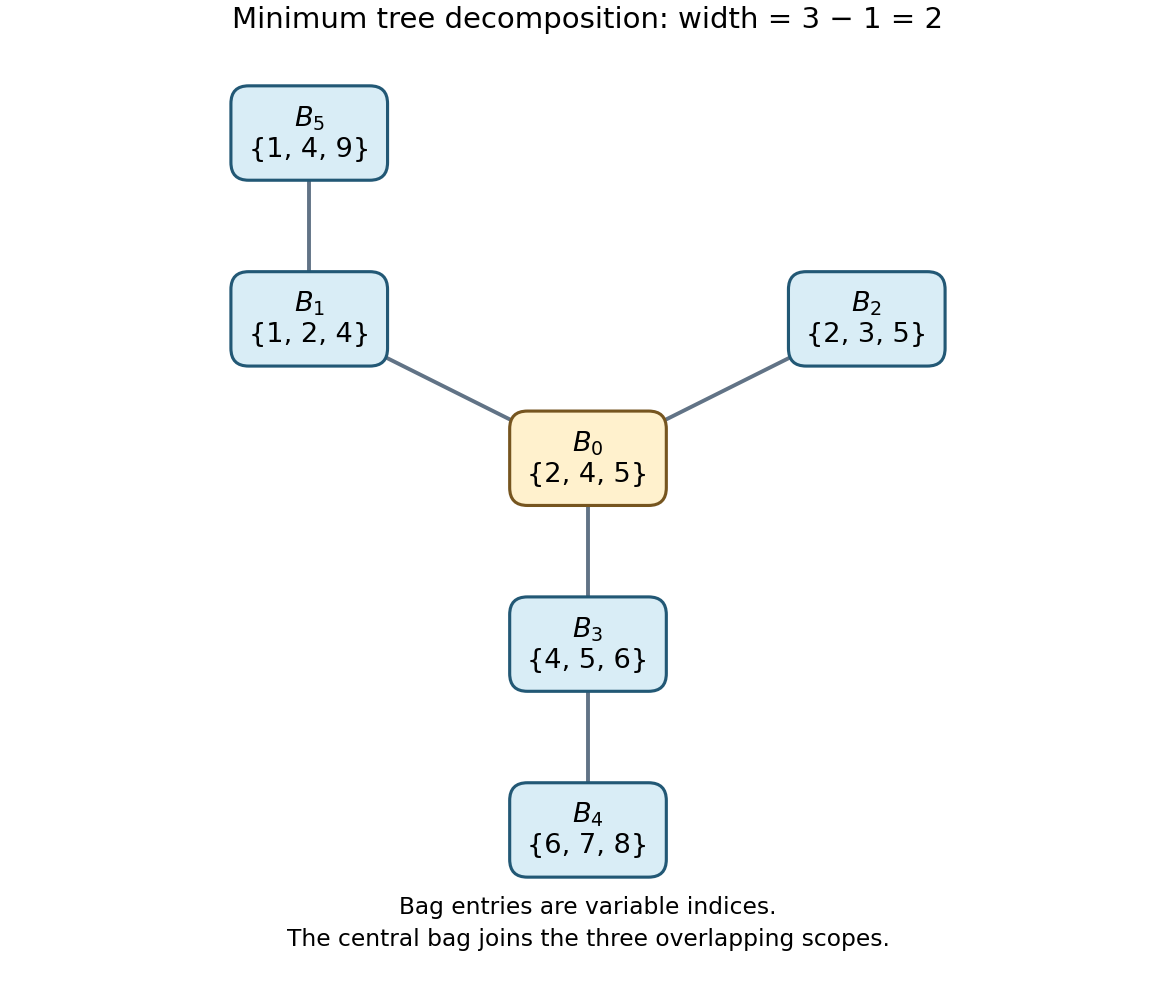
Every constraint scope is contained in its own bag, and every variable occurs. The nontrivial running-intersection checks are: occurs along ; along the connected branches ; along ; along ; and along . Each of the other variables occurs in just one bag. This is therefore a valid tree decomposition of width .
Conversely, any of the original three-variable constraint scopes forms a clique of size three in the primal graph. Such a clique must be contained in one bag of every tree decomposition, forcing width at least two. The upper and lower bounds agree:
Past exam of the computer science course of the University of Oxford 2015 Intelligent systems 3 b ii Solution by Codex 0 2026-10-31
Codex 0 2026-10-31The constraint hypergraph has one vertex for each of and one hypergraph edge for each constraint scope:Here abbreviates . These five scopes follow the corrected source.[ref]
Intelligent Systems examination paper by the University of Oxford (2015). Printed p. 4, corrected Question 3(b), constraints (1)–(5)
The diagram uses the incidence representation: round nodes are the original variables, square nodes represent hypergraph edges, and a joining line means that the variable belongs to that constraint scope. The square nodes are not extra variables of .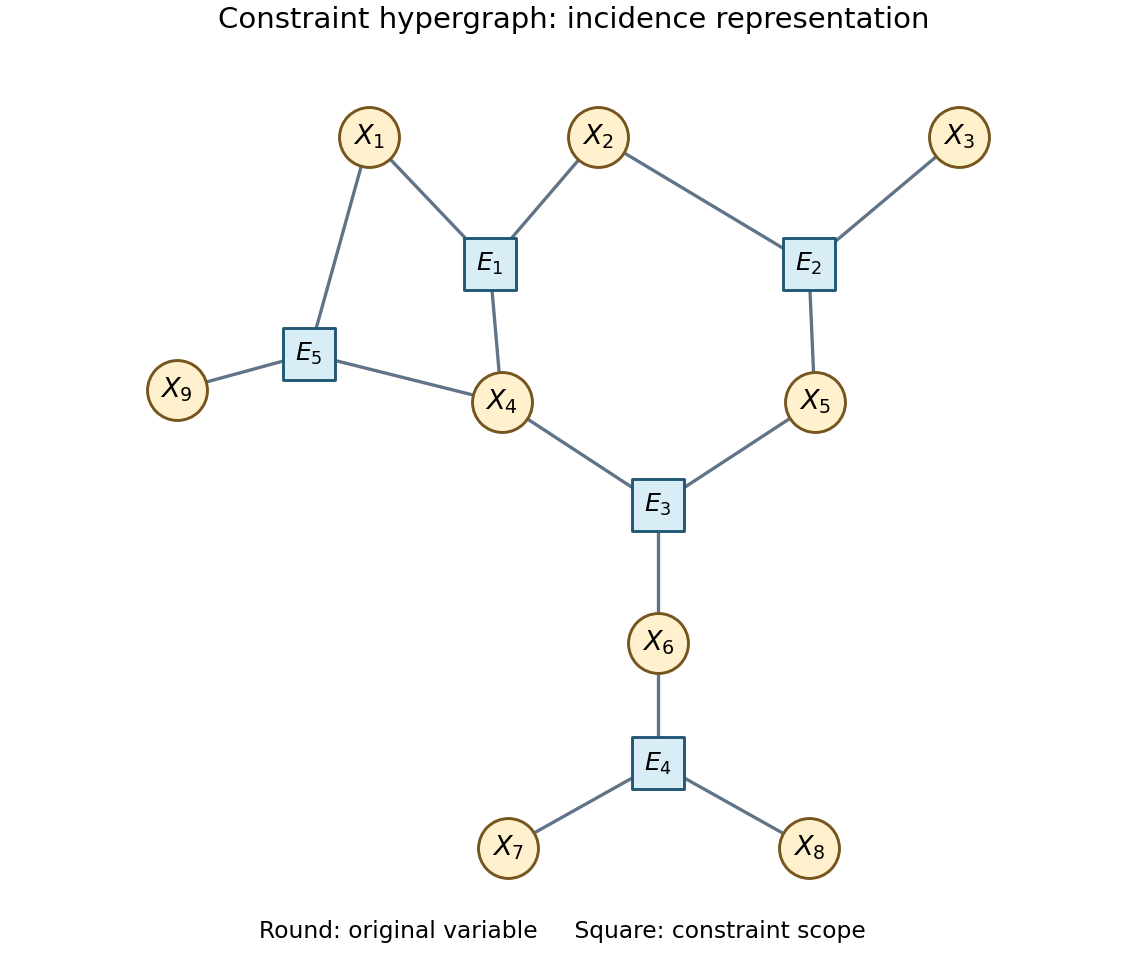
In particular, the central pattern involving forms a cycle through three constraint scopes; the scopes cannot themselves simply be joined into a valid tree decomposition without an additional bag.
Past exam of the computer science course of the University of Oxford 2015 Intelligent systems 3 b i Solution by Codex 0 2026-10-31
Codex 0 2026-10-31Choose the distinct values of and call them . There are choices. Constraint (5), on , immediately forces .
Constraints (2) and (3) require and , respectively. Since the constraint domain has exactly three values, . Constraint (2) now forces , and constraint (3) forces . Finally, constraint (4) permits or .
Every choice just described satisfies all five all-different constraints, and the forced-value argument shows there are no other possibilities. HenceIn the order , the two forms arewhere ranges over the six permutations of .
Past exam of the computer science course of the University of Oxford 2015 Databases 1 c ii Solution by Codex 0 2026-10-31
Codex 0 2026-10-31Take a unary database relation and the positive domain relational calculus queryFor the finite input , every pair and belongs to , for every value in the ambient domain. On an infinite ambient domain the answer is infinite. Even if one compares only finite ambient domains, adding a fresh value changes the answer while leaving fixed, violating domain independence of a database query.
The logical disjunction leaves unrestricted in its first branch and unrestricted in its second branch. Thus both variables occur in relational atoms somewhere in the formula, yet database query safety still fails. No negation or implication symbol occurs.
Past exam of the computer science course of the University of Oxford 2015 Databases 1 c i Solution by Codex 0 2026-10-31
Codex 0 2026-10-31Assume the two database queries have compatible output database attributes. ThenFor a finite input database, the result of the relational difference is a subset of the finite result of , so it is finite and introduces no new values. For the usual domain independence of a database query, let be the input database and let be two ambient value domains containing its data and the query constants. Database query safety givesand thereforeAlthough a domain relational calculus expression for the relational difference uses negation, its positive membership requirement in supplies the necessary range restriction. Negation is not by itself a reason for failure of database query safety.
Past exam of the computer science course of the University of Oxford 2015 Databases 1 a iii Solution by Codex 0 2026-10-31
Codex 0 2026-10-31An arithmetic mean is database aggregation, which is outside classical relational algebra. Use SQL:For non-null prices of qualifying sales, the result isEach sale contributes once, even when a car was sold on several invoices. Do not use
SELECT AVG(s.price) AS average_sale_price
FROM Sales AS s
JOIN Car AS c ON c.serialnumber = s.serialnumber
WHERE c.make = 'Saab';DISTINCT inside AVG: two different sales at the same price must both count. The car's database primary key makes the relational join match each sale to exactly one car, so the relational join introduces no extra weighting.If there are no qualifying non-null prices,
AVG returns SQL NULL. It ignores null prices if the implementation permits them; it does not replace an absent arithmetic mean with zero.[ref]Aggregate Functions in the PostgreSQL documentation. Section 9.21,
avg and the paragraph on aggregates with no selected rows Past exam of the computer science course of the University of Oxford 2015 Databases 1 a ii Solution by Codex 0 2026-10-31
Codex 0 2026-10-31Construct the required models and the actual customer–model purchases using relational projection and a natural join:The Cartesian product lists every obligation: every customer paired with every model present in
Car. The relational difference consists of unfulfilled obligations. Remove the customer identifiers occurring in this database relation and only then recover names:This is an explicit relational division construction with all customers as the candidate universe. If there are no models, there are no missing obligations, so every customer qualifies. A version starting solely from customers occurring in would incorrectly omit customers with no purchases in that empty-model case.The quantified object here is the
model database attribute, so two makes sharing a model value contribute one required value. If a different application identified a model by the pair (make, model), both the required and purchased relational projections would use that pair. Also, Car contains unsold cars: a model available only in unsold inventory is still a required model, and then nobody qualifies. Testing identifiers before names prevents different customers with the same name from pooling their purchases. Past exam of the computer science course of the University of Oxford 2015 Databases 1 a i Solution by Codex 0 2026-10-31
Codex 0 2026-10-31First use relational selection to keep the Saab cars, then a natural join to find their sales, and finally a relational join to identify the corresponding salespeople. A relational projection givesThe foreign keys ensure that every sale has the referenced car and salesperson. Several qualifying sales by the same person produce just one occurrence of their name under set semantics. Two distinct people with the same name also yield that name only once: this is the requested relational projection onto names.
Past exam of the computer science course of the University of Oxford 2015 Concurrent programming 3 b iii Solution by Codex 0 2026-10-31
Codex 0 2026-10-31A FIFO semaphore must reserve a released permit for the oldest waiter. Merely waking the oldest caller is insufficient if a newcomer can consume the permit first. Keep an explicit FIFO queue of private wait records, and transfer the permit directly to the oldest record. Each record has its own monitor, so releasing a permit wakes exactly its chosen recipient.
class FifoBinarySemaphore(initiallyAvailable: Boolean) extends Semaphore {
  private final class Waiter { var granted = false }
  private val queue = scala.collection.mutable.Queue[Waiter]()
  private var available = initiallyAvailable

  def down: Unit = {
    val mine: Option[Waiter] = synchronized {
      if (available) {
        assert(queue.isEmpty)
        available = false
        None
      } else {
        val w = new Waiter
        queue.enqueue(w)
        Some(w)
      }
    }
    mine.foreach { w =>
      var interrupted = false
      w.synchronized {
        while (!w.granted) {
          try { w.wait() }
          catch { case _: InterruptedException => interrupted = true }
        }
      }
      if (interrupted) Thread.currentThread().interrupt()
    }
  }

  def up: Unit = synchronized {
    if (queue.nonEmpty) {
      val w = queue.dequeue()
      // available stays false: this permit is reserved for w.
      w.synchronized {
        w.granted = true
        w.notify()
      }
    } else {
      require(!available, "unmatched binary-semaphore release")
      available = true
    }
  }
}
The wait loop is deliberately uninterruptible with interruption status restored after acquisition: abandoning a queued wait record would otherwise strand its reserved permit. A caller that acquires must still complete the buffer operation.
granted is read and written under the wait record's own monitor. The persistent flag prevents a lost wake-up if up runs after registration but before the caller begins waiting. Spurious wakeups simply repeat the loop.The outer monitor serializes registration and the FIFO queue. A caller either consumes a genuinely free permit when nobody is queued, or appends one record.
up removes exactly the front record and leaves available false, even if its owner has not yet resumed. A newcomer must queue behind existing records instead of stealing the handoff. The outer-to-inner lock ordering in up is safe because waiting callers release the outer monitor before acquiring their private monitors; no caller holds a private monitor while trying to reacquire the outer one.private val empty: Semaphore = new FifoBinarySemaphore(true)
private val full: Semaphore = new FifoBinarySemaphore(false)This is a complete implementation when inserted in
SemaphoreMemory: its write and read methods remain exactly the displayed methods. Pending writers obtain empty-slot permissions in registration order on empty; pending readers obtain full-slot permissions in registration order on full. Each handoff permits just one caller to access the slot, soFirst-come-first-served means the order in which concurrent calls register under the monitor; two overlapping calls have no externally determined order. The guarantee is separate for the two kinds of caller. A global order combining reads and writes cannot be required: an initial read must wait while a later write supplies its value. Subject to eventual scheduling and the arrival of matching operations of the opposite kind, no registered caller is overtaken by a later caller of its own kind. The design avoids broadcast wakeups as well as barging. Past exam of the computer science course of the University of Oxford 2015 Concurrent programming 3 b ii Solution by Codex 0 2026-10-31
Codex 0 2026-10-31Give the two waiting predicates different semaphores.
empty has one permit initially; full has zero. A writer takes the empty permit before touching the slot and transfers permission to a reader by releasing full. A reader does the reverse.class SemaphoreMemory[T] extends Memory[T] {
private val empty: Semaphore = new CountingSemaphore(1)
private val full: Semaphore = {
val s = new CountingSemaphore(1)
s.down
s
}
private var slot: Option[T] = None
def write(msg: T): Unit = {
empty.down
slot = Some(msg)
full.up
}
def read: T = {
full.down
val result = slot.get
slot = None
empty.up
result
}
}For a single slot, a separate mutex around
slot is unnecessary. There is a unique circulating permission: either an empty permit is available, a writer holds it, a full permit is available, or a reader holds it. During the transition the sum of available permits can be zero; it is never necessary to assert that it is always one. In particular, the next writer cannot start until the preceding reader has finished reading, cleared the slot and released empty.The monitor operations inside each semaphore also establish the required happens-before relation: the write precedes
full.up, and a successful subsequent full.down makes it visible to the reader. Likewise, the reader's clearing precedes the next writer's successful empty.down. Slot accesses therefore need no unsynchronized visibility assumption. The invariant isOnly writers wait on empty, and only readers wait on full. With the single-notification semaphore implementation in part (a), a state change wakes at most one waiter of the appropriate kind, avoiding the thundering herd of part (i). This is an efficiency improvement, not yet a first-come-first-served guarantee.If one or more readers arrive before the first writer, they block on the initially unavailable
full semaphore. Their waits release its monitor, so they do not prevent a writer from obtaining the independent empty permit. The first write releases full and permits exactly one reader to take that value. Remaining readers wait for later writes; they never see uninitialized storage. Past exam of the computer science course of the University of Oxford 2015 Concurrent programming 3 b i Solution by Codex 0 2026-10-31
Codex 0 2026-10-31Use one monitor to protect both the occupied flag and the slot.
Option supplies an empty marker without confusing an empty slot with a valid null payload.class MonitorMemory[T] extends Memory[T] {
private var slot: Option[T] = None
def write(msg: T): Unit = synchronized {
while (slot.nonEmpty) wait()
slot = Some(msg)
notifyAll()
}
def read: T = synchronized {
while (slot.isEmpty) wait()
val result = slot.get
slot = None
notifyAll()
result
}
}A writer changes empty to full while holding the monitor; a reader changes full to empty while holding the same monitor. The corresponding successful assignment or removal is its linearization point. No second writer can overwrite a full slot, and no two readers can remove one value. Rechecking in a
while handles spurious wakeups and competition after notification.There are two different waiting predicates on the same monitor: writers need empty, readers need full. A single arbitrary
notify could wake a caller of the wrong kind. For example, after a reader empties the slot, waking another reader leaves it waiting again while a writer remains asleep, potentially stranding the computation. notifyAll prevents that lost wake-up pattern by allowing every waiter to recheck. Thus,With many users, each change wakes numerous software threads even though at most one can use that new slot state. Most reacquire the monitor, find their predicate false and sleep again. This thundering herd wastes context switches and lock acquisitions. It also supplies no fairness or arrival-order guarantee. Past exam of the computer science course of the University of Oxford 2015 Concurrent programming 2 b ii Solution by Codex 0 2026-10-31
Codex 0 2026-10-31Run two
dfFringe producers on synchronous one-to-one message-passing channels, and compare one received leaf from each. Catch closure separately on each input: otherwise the first closure could hide an extra value in the other fringe. An extra value or unequal pair is enough to stop immediately.def sameFringe(node1: Array[Node], root1: NodeId,
node2: Array[Node], root2: NodeId): Boolean = {
val a = OneOne[NodeId]
val b = OneOne[NodeId]
var equal = true
def next(p: ?[NodeId]): Option[NodeId] =
try { Some(p ? ()) }
catch { case _: io.threadcso.process.Stopped => None }
val compare = proc {
var done = false
try {
while (!done) {
val x = next(a)
val y = next(b)
(x, y) match {
case (None, None) => done = true
case (Some(u), Some(v)) if u == v => ()
case _ => equal = false; done = true
}
}
} finally { a.closeIn; b.closeIn }
}
(dfFringe(node1, root1, a) || dfFringe(node2, root2, b) || compare)()
equal
}After successful comparisons, the first identities in the two leaf sequences agree. The first differing pair disproves equality of sequences; simultaneous exhaustion proves it; exhaustion on exactly one side disproves it. Therefore,Closing both inputs on every comparator exit releases either producer if it is waiting in an output. The closure handler in
dfFringe then returns normally, and the parallel composition joins before equal is read. For finite trees and eventual scheduling, the comparator's next read either obtains a leaf or observes completion, so there is no deadlock caused by reading the two inputs in a fixed order.Only a constant amount of leaf data is stored. After an early mismatch, each producer may already have traversed toward its next leaf and be blocked offering it; cancellation prevents unbounded speculation or deliberate construction of the remaining fringe. Occasionally a short unequal fringe is already completely traversed when its final distinguishing value is compared. The streaming guarantee is that neither complete fringe needs to be materialized in advance, and work stops as soon as inequality is established.
Past exam of the computer science course of the University of Oxford 2015 Concurrent programming 2 b i Solution by Codex 0 2026-10-31
Codex 0 2026-10-31Use the recorded child list as the depth-first traversal order. A leaf of a tree has no children, so it contributes its own identity once. Closure cancels the remaining traversal; a normal completion closes the output so that a consumer can detect end-of-fringe.
def dfFringe(node: Array[Node], root: NodeId, fringe: ![NodeId]): PROC = proc {
  def walk(v: NodeId): Unit = {
    val cs = node(v).children
    if (cs.isEmpty) fringe ! v
    else cs.foreach(walk)
  }
  try { walk(root) }
  catch { case _: io.threadcso.process.Stopped => () }
  finally { fringe.closeOut }
}
A completed finite spanning tree has no recursive child graph cycle, so this visits a finite number of vertices. A blocked leaf send is released if its output closes. A singleton root is itself a leaf of a tree and is output once. With sufficient call-stack space,
Past exam of the computer science course of the University of Oxford 2015 Concurrent programming 2 a ii Solution by Codex 0 2026-10-31
Codex 0 2026-10-31Use one logical traversal token carrying the discovered vertex set and the active LIFO stack of vertices. The current vertex either discovers its first still-unvisited outgoing graph neighbour, or returns to its preceding stack entry. The former records both the child's parent in a rooted tree and the parent's child. Unlike concurrent flooding discovery, this visits one entire branch before the next, giving an actual depth-first search.
The important directed-graph detail is that a child's parent need not be an outgoing graph neighbour. Return the token by routing it through the original directed graph; a routing hop does not count as a traversal visit. The following duplicate-suppressed flooding route requires no previously known topology and sends only to immediate outgoing graph neighbours.
final case class Token(visited: Set[NodeId], stack: List[NodeId], serial: Int)
sealed trait Msg
final case class Route(serial: Int, target: NodeId, token: Token) extends Msg
case object Finished extends Msg
Here
stack.head is the current vertex. Use the same paired toNode and fromNode ports as in (i), now with the new Msg type. Set mailbox capacity to , normalize neighbours with distinct, and again leave the mailboxes open until all processes have joined. The following helpers are local functions inside each node's generated process.def span: PROC = proc {
val adj = neighbours.distinct
val routed = scala.collection.mutable.Set[Int]()
var entered = false
var done = false
def flood(message: Msg): Unit =
for (w <- adj) toNode(w) ! message
def move(target: NodeId, state: Token): Unit = {
val s = state.serial + 1
routed += s
flood(Route(s, target, state.copy(serial = s)))
}
def step(t: Token): Unit = {
assert(t.stack.head == me)
if (!entered) {
entered = true
parent = if (t.stack.tail.isEmpty) me else t.stack.tail.head
children = Nil
}
adj.find(w => !t.visited(w)) match {
case Some(w) =>
children = children :+ w
move(w, Token(t.visited + w, w :: t.stack, t.serial))
case None =>
t.stack.tail match {
case p :: rest => move(p, t.copy(stack = p :: rest))
case Nil => flood(Finished); done = true
}
}
}
if (me == 0) step(Token(Set(0), List(0), 0))
while (!done) {
fromNode(me) ? () match {
case r @ Route(s, target, t) =>
if (!routed(s)) {
routed += s
if (target == me) step(t) else flood(r)
}
case Finished => flood(Finished); done = true
}
}
}Every route number is globally unique: there is one logical token, and its serial increases at every move. The sender inserts that serial in its own
routed set before flooding; this stops a returning copy from circulating again. Intermediate vertices forward the first copy of an envelope and ignore later copies. Its target consumes exactly one copy without forwarding it. Because the directed graph is strongly connected, a simple directed path from sender to target exists; its intermediate vertices eventually relay the envelope. Thus each move eventually finishes.A routed return can pass through a vertex not yet discovered by the depth-first search. That vertex only forwards the envelope: it does not run
step, change entered, or assign a parent. This distinction is essential. For the directed cycle , returning from two to one uses , while the logical traversal stack changes from to .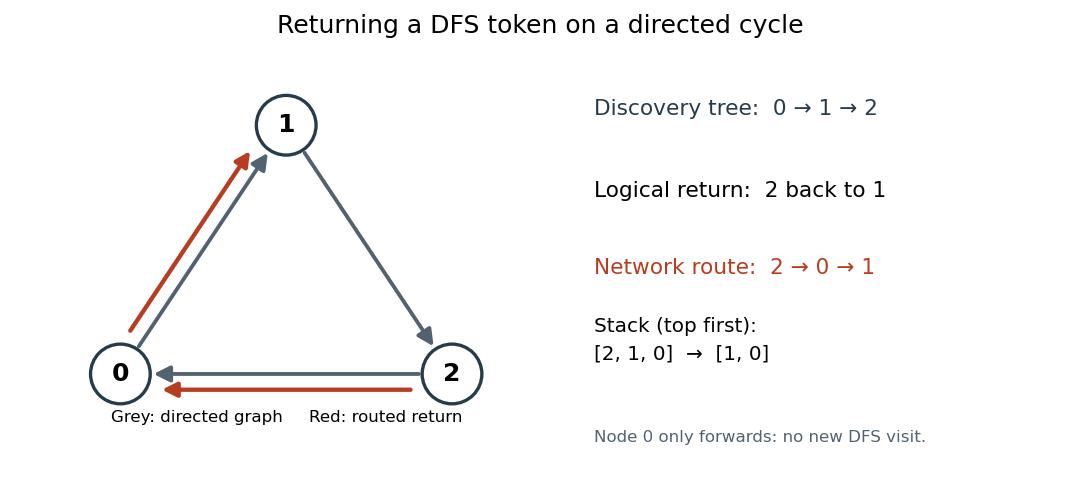
A depth-first search return follows a routed directed path when the child has no reverse directed edge
. Details. The discovered vertex set only grows. Each newly discovered vertex is pushed once and later popped once; an exhausted vertex can never acquire a new unvisited neighbour as this set grows. Consequently there are exactly downward moves and return moves. When the root exhausts its outgoing graph neighbours, every vertex has been visited, by the standard reachability argument for depth-first search. Each nonroot parent was recorded along the actual downward directed edge, and
children records exactly those assignments in discovery order.There are route envelopes, each forwarded at most once per outgoing directed edge, and one final
Finished flood. Each node forwards Finished before exiting; strong connectivity therefore delivers it everywhere. There are at most total messages into any mailbox, below the proposed capacity. Even a mailbox whose process has already exited cannot block later sends. All processes terminate withThis deliberately trades communication efficiency for a simple valid solution on a genuinely directed graph. A direct parent acknowledgement would instead require an additional bidirectional-edge assumption, which the question does not supply. Past exam of the computer science course of the University of Oxford 2015 Concurrent programming 2 a i Solution by Codex 0 2026-10-31
Codex 0 2026-10-31A directed graph needs an explicit termination argument. After assigning its parent in a rooted tree, a vertex must still receive later traffic: having no new graph neighbours to discover is not proof that other senders have finished. Use a discovery wave together with duplicate-suppressed announcements of activated vertices. Both kinds of message identify their immediate sender, who has already activated.
sealed trait Msg { def from: NodeId }
final case class Discover(from: NodeId) extends Msg
final case class Active(from: NodeId, origin: NodeId) extends Msg
Let
adj = neighbours.distinct. The actual communication objects must expose both input and output ports: the paper's Seq[![Msg]] annotation supplies only output capabilities, although the following sentence also requires receiving. Set up one shared-writer, single-reader buffered message-passing channel per vertex, publish its output in toNode, and keep its input in fromNode. Only node i reads fromNode(i). These are the two ports of the same underlying mailbox, not additional graph edges. The question's prohibition on buffered message-passing channels applies to Question 1(a), not to this question.Take , reliable delivery, eventual scheduling, finite
adj, and mailbox capacity . Every node has at most distinct incoming neighbours, including itself if there is a self-loop. The bound below ensures that no send blocks merely because a mailbox's receiver is not currently reading. Do not close these shared mailboxes on local process termination: late, redundant traffic is harmless and bounded. Their creator can release them after the parallel composition has joined. For example, the concrete setup can useval mailbox = Vector.fill(N)(N2NBuf[Msg](B, 0, 1))
val toNode: Seq[![Msg]] = mailbox
val fromNode: Seq[?[Msg]] = mailboxHere the zero writer count makes the shared output independent of individual writer departures; processes do not call its
closeOut during the search.def span: PROC = proc {
val adj = neighbours.distinct
var started = false
val known = scala.collection.mutable.Set[NodeId]()
def announce(origin: NodeId): Unit = {
if (!known(origin)) {
known += origin
for (w <- adj) toNode(w) ! Active(me, origin)
}
}
def activate(sender: NodeId): Unit = {
started = true
parent = if (me == 0) 0 else sender
for (w <- adj if me == 0 || w != parent)
toNode(w) ! Discover(me)
announce(me)
}
if (me == 0) activate(0)
while (known.size < N) {
val message = fromNode(me) ? ()
if (!started) activate(message.from)
message match {
case Discover(_) => ()
case Active(_, origin) => announce(origin)
}
}
}An announcement may be a vertex's first incoming message. It then serves as a discovery message too: its immediate sender is already active, and the receiving vertex adopts that sender as its parent in a rooted tree before forwarding anything. This preserves the required first-message rule. In particular, an inactive vertex never forwards announcements while remaining inactive, which could invalidate the parent-order argument.
For each nonroot vertex, its parent in a rooted tree activated strictly earlier. Repeated parent-following therefore cannot make a graph cycle and eventually reaches the unique initially active vertex, zero. Each parent assignment uses an actual incoming directed edge. Strong connectivity ensures eventual activation of every vertex: if an activated set were proper, a directed path from zero to an inactive vertex would have a first edge leaving that set. Its sender sends a discovery message along that edge; excluding its own parent does not exclude an inactive neighbour.
Each activation sends at most one
Discover on each outgoing directed edge. For each of the origins, each vertex forwards Active at most once on each outgoing directed edge. Therefore a mailbox receives at most messages over the whole run, proving the chosen nonblocking storage bound. Each origin's announcement eventually reaches every vertex, since every first receipt forwards it on all outgoing directed edges. Thus every known set reaches size and every process terminates, even if redundant messages remain unread:No timeout is used to conclude that the distributed work has finished. This uses larger finite mailboxes to make the termination proof simple, rather than assuming that simultaneous synchronous broadcasts cannot deadlock. Past exam of the computer science course of the University of Oxford 2015 Concurrency 1 d ii Solution by Codex 0 2026-10-31
Codex 0 2026-10-31In the displayed network, the first cells retain values and cell is still in its initial state. It accepts only a value in , so it cannot accept the incoming sentinel value. For the first cell blocks the external sentinel value; for a stored cell blocks while trying to pass it to an empty neighbour. ThusTo handle shorter inputs, add an empty-cell branch to the initial state. An empty cell then terminates the downward scan and immediately returns an empty sequence. Earlier occupied cells append their retained values exactly as before; later cells need not participate. This works for every , because the occupied prefix of the chain alone produces the required output. For , the original sentinel-only tail still supplies the empty suffix. Every cell receives the same modification.
Pinned article: Introduction to the OurBigBook Project
Welcome to the OurBigBook Project! Our goal is to create the perfect publishing platform for STEM subjects, and get university-level students to write the best free STEM tutorials ever.
Everyone is welcome to create an account and play with the site: ourbigbook.com/go/register. We belive that students themselves can write amazing tutorials, but teachers are welcome too. You can write about anything you want, it doesn't have to be STEM or even educational. Silly test content is very welcome and you won't be penalized in any way. Just keep it legal!
Intro to OurBigBook
. Source. We have two killer features:
- topics: topics group articles by different users with the same title, e.g. here is the topic for the "Fundamental Theorem of Calculus" ourbigbook.com/go/topic/fundamental-theorem-of-calculusArticles of different users are sorted by upvote within each article page. This feature is a bit like:
- a Wikipedia where each user can have their own version of each article
- a Q&A website like Stack Overflow, where multiple people can give their views on a given topic, and the best ones are sorted by upvote. Except you don't need to wait for someone to ask first, and any topic goes, no matter how narrow or broad
This feature makes it possible for readers to find better explanations of any topic created by other writers. And it allows writers to create an explanation in a place that readers might actually find it.
Figure 1. Screenshot of the "Derivative" topic page. View it live at: ourbigbook.com/go/topic/derivativeVideo 2. OurBigBook Web topics demo. Source. - local editing: you can store all your personal knowledge base content locally in a plaintext markup format that can be edited locally and published either:This way you can be sure that even if OurBigBook.com were to go down one day (which we have no plans to do as it is quite cheap to host!), your content will still be perfectly readable as a static site.
- to OurBigBook.com to get awesome multi-user features like topics and likes
- as HTML files to a static website, which you can host yourself for free on many external providers like GitHub Pages, and remain in full control

Figure 2. You can publish local OurBigBook lightweight markup files to either OurBigBook.com or as a static website.
Figure 3. Visual Studio Code extension installation.
Figure 5. . You can also edit articles on the Web editor without installing anything locally. Video 3. Edit locally and publish demo. Source. This shows editing OurBigBook Markup and publishing it using the Visual Studio Code extension. 
- Infinitely deep tables of contents:




All our software is open source and hosted at: github.com/ourbigbook/ourbigbook
Further documentation can be found at: docs.ourbigbook.com
Feel free to reach our to us for any help or suggestions: docs.ourbigbook.com/#contact