Topics (384k) Articles (398k) Users (410) Discussions (242) Comments (383) Files (13k) New article

For a closed point on a smooth projective curve, the quotient in has -dimension . Additivity of Euler characteristic therefore changes by that residue-field degree. Every line bundle is associated with a divisor, so iteration proves the displayed formula. The dualizing sheaf on a smooth projective curve identifies with and converts this Euler-characteristic formula into the usual divisor form of Riemann-Roch theorem.
For finitely many distinct points on a smooth projective genus- curve, choose . The Riemann-Roch theorem gives , so choose with a sole pole of exact order at . Then has exactly those poles with that order: all other summands are regular at each , so no principal part can cancel. This is an explicit construction rather than an unspecified generic choice of section.
An initially resting perfect gas with adiabatic index next to a piston develops a smooth rarefaction. The incoming invariant gives . Pressure falls as until , when the piston speed is . Thereafter the gas edge moves at that limiting constant speed while the piston accelerates away, opening a vacuum gap.
A proper Riemann integral on a compact interval requires a bounded integrand, but a derivative can be unbounded. For away from zero and , the difference quotient gives , whereas for . At , this derivative is and is unbounded. The fundamental theorem of calculus version that integrates a derivative therefore needs an explicit integrability hypothesis.
Let on . Suppose finitely many nonoverlapping closed intervals, of total length at least , can be chosen for each , with Riemann integrable on each. Refine the intervals to make their total Darboux sum gap less than . The remaining length contributes at most . Taking proves global Riemann integrability by the Riemann integrability criterion.
Let consist of numbers whose decimal digits all lie in a fixed set with digits. The allowed prefixes give closed decimal intervals of length covering , with no endpoints in . A partition of an interval at those endpoints gives an upper Darboux sum at most . Every cell contains a terminating decimal outside , so the lower Darboux sum is zero. Thus the indicator function is Riemann integrable with Riemann integral zero. Such sets illustrate how an uncountable set may have an integrable indicator function of zero integral.
Let be bounded on and continuous on . For any positive error tolerance, isolate . Its contribution to the difference of upper Darboux sums and lower Darboux sums is at most . On , uniform continuity supplies a partition of an interval with arbitrarily small remaining oscillation sum. The Riemann integrability criterion then proves integrability, even when the values oscillate without a limit at the endpoint.
For a common interval partition, the oscillation of a function on an interval satisfies . Refining two good Darboux sums therefore proves integrability of the sum. Lipschitz composition preserves Riemann integrability, so absolute values preserve it too. The identity then proves the assertion for the maximum.
The indicator of the rational numbers is not Riemann integrable on a nondegenerate interval: every subinterval contains both rational and irrational points, so its lower sum is zero and its upper sum is the interval length.
Enumerate the rational points of a compact nondegenerate interval as . Each singleton indicator function is Riemann integrable with integral zero. Their pointwise supremum is the Dirichlet function, which is not Riemann integrable. Thus even a uniformly bounded countable supremum need not preserve integrability.
Suppose a nonconstant holomorphic map from a connected compact Riemann surface has degree of a holomorphic map two and exactly four distinct branch values of a holomorphic map. The valency theorem forces each of their fibres to contain one ramification point with , a simple ramification point of a holomorphic map. HenceThis determines the genus without recognizing a torus in a drawing.
A concrete realization is the compact Riemann surface obtained by adding the two points at infinity to the even-degree hyperelliptic model given by the algebraic curveProjection to has degree of a holomorphic map two. At a simple zero of , is a local coordinate and , so . At infinity set and : then . There are two points with , , each unramified since is a local coordinate. The four finite roots are therefore all the branch values of a holomorphic map.[ref]
Geometry of Surfaces by Nigel Hitchin (B3a course 2013). Section 3.3, printed pp. 41-43: local coordinates at simple roots, two points at infinity for even polynomial degree, and ramification count
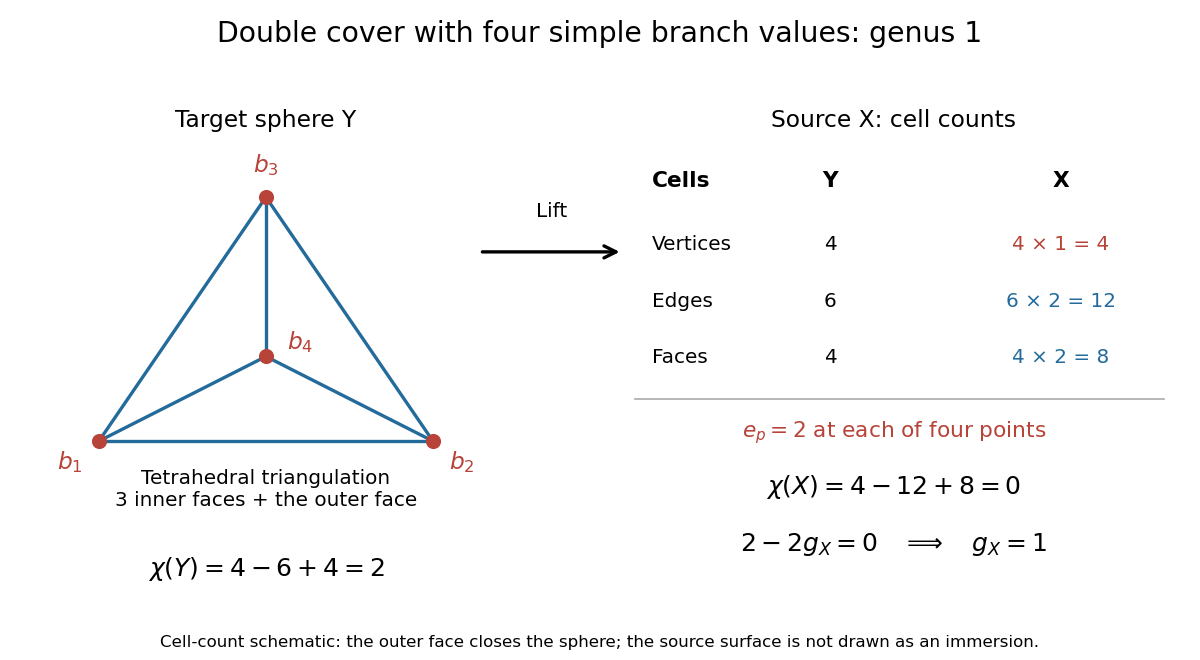
Cell-count schematic for a double cover of the sphere with four simple branch values: four vertices, twelve edges and eight faces upstairs
. Details. Choose a triangulation of a surface on the Riemann sphere with these four branch values of a holomorphic map as vertices, combinatorially the boundary of a tetrahedron. Its counts are . Upstairs, each vertex has one preimage and each open edge and face has two lifts: , giving Euler characteristic . This is a cell schematic, not a geometric immersion of . The Triangulation proof of the Riemann-Hurwitz formula applies the same counting idea after refining a general triangulation of a surface around the branch values of a holomorphic map.[ref]
Geometry of Surfaces by Nigel Hitchin (B3a course 2013). Section 3.2, Theorem 3.2 and its triangulation proof, printed pp. 38-39
For an integer , extend to a holomorphic map from the Riemann sphere to itself with . A nonzero finite regular value has distinct preimages, so the degree of a holomorphic map is . At zero the analytic ramification index is . At infinity, use local coordinates upstairs and downstairs: the same holomorphic map becomes , so too. Everywhere else the derivative is nonzero.
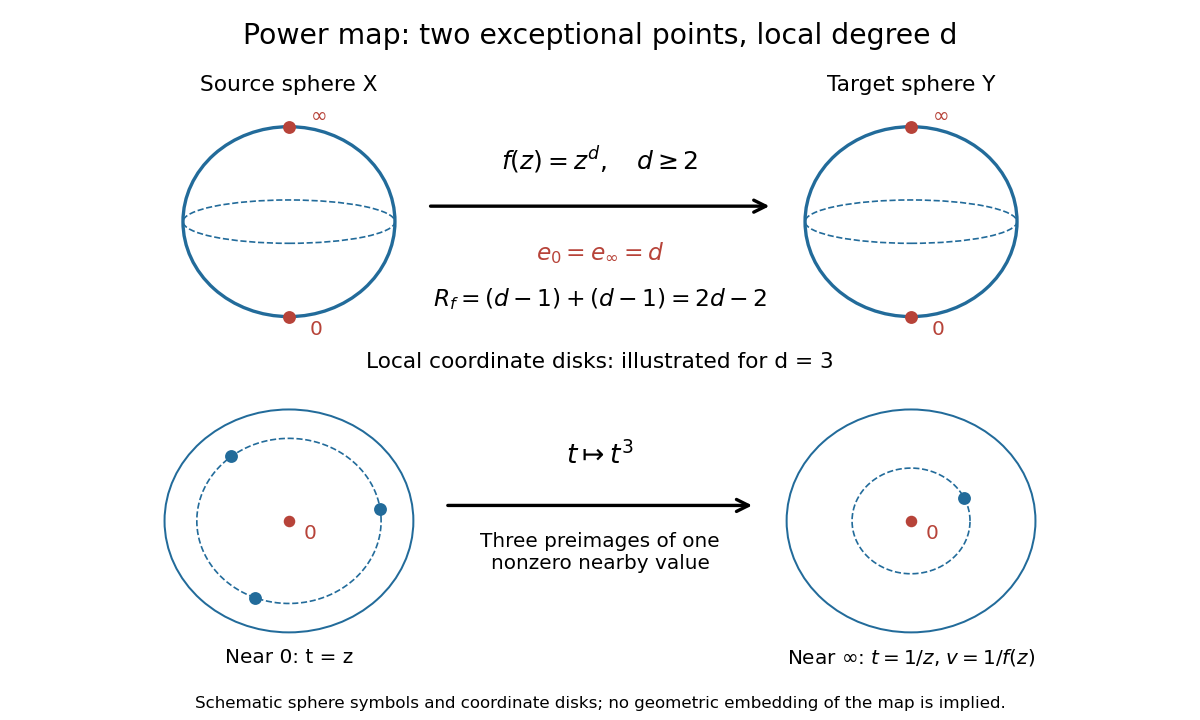
Schematic of the sphere power map and its local degree: zero and infinity both have ramification index d
. Details. There are two distinct ramification points and two distinct branch values of a holomorphic map, butFor , the total ramification of a holomorphic map is four, not two. The local-circle panel shows three nearby preimages converging to the single ramification point. For the holomorphic map is the identity and neither zero nor infinity is ramified.
Count ramification points upstairs in , weighted by , rather than counting distinct branch values of a holomorphic map downstairs in . Grouping by fibres givesThe cardinality counts distinct points; the degree of a holomorphic map counts them with their analytic ramification indices. Thus each summand is the number of missing distinct preimages in that fibre.[ref]
Riemann Surfaces by Constantin Teleman (Lent Term 2003). Lecture 5, Definition 5.16, printed p. 19: total branching index as the sum of fibre deficits
The phrase branch point varies across conventions: to keep the two surfaces distinct, use ramification point for and branch value of a holomorphic map for . The existing name branch point of a holomorphic map here denotes the latter. Several ramification points can share one branch value of a holomorphic map.
A Quine atom is a set whose sole member is itself. It violates the Axiom of foundation while respecting the axiom of extensionality. Swapping pairwise distinct old objects with their singletons in a Rieger-Bernays permutation model supplies many Quine atoms, provided those transpositions have disjoint supports. For example, the old ordinals and their singletons are disjoint families.
The dimensionless Richardson constant is the coefficient in the mean-square pair-separation law. Under the simple self-similar diffusivity closure, . Its universality requires scale locality, adequate scale separation and loss of initial-condition memory; a finite-time fit need not isolate this asymptotic coefficient.
At separations well above the integral scale of turbulence, two fluid velocities can decorrelate spatially. If the relative-velocity autocorrelation is stationary and integrable, the displacement identity used in Taylor turbulent dispersion gives the displayed long-time linear mean-square growth. With speed and Lagrangian integral time of order , its relative diffusivity is of order . The characteristic separation grows as , unlike inertial-range Richardson pair dispersion.
For positive initial separation below the Kolmogorov length scale, a phenomenological pair-dispersion model has smooth-flow exponential stretching, inertial-range Richardson pair dispersion, and diffusive large-scale pair dispersion beyond the integral scale of turbulence. A positive Lyapunov exponent is needed for the first regime, scale locality and initial-memory loss for the second, and integrable relative-velocity autocorrelation for the third. The inertial-range crossing time is of order , one outer eddy turnover time.
For , the contracted Bianchi identity and the commutation identity imply . Meanwhile , so their sum is constant on every connected component.
Three distinct particular solutions of a Riccati equation determine every solution by one constant cross-ratio. Indeed, for , differences satisfy . The logarithmic derivatives cancel in the displayed cross-ratio, so it is constant. Solving for gives a rational function of the three solutions and , interpreted on the Riemann sphere at poles.
The weak indirect revealed preference is the reflexive closure of the transitive closure of a relation of direct revealed comparisons. Equivalently, it consists of finite chains, including chains of length zero. The diagonal convention is essential if the relation is to be an intersection of complete weak preference relations on all alternatives.
Pinned article: Introduction to the OurBigBook Project
Welcome to the OurBigBook Project! Our goal is to create the perfect publishing platform for STEM subjects, and get university-level students to write the best free STEM tutorials ever.
Everyone is welcome to create an account and play with the site: ourbigbook.com/go/register. We belive that students themselves can write amazing tutorials, but teachers are welcome too. You can write about anything you want, it doesn't have to be STEM or even educational. Silly test content is very welcome and you won't be penalized in any way. Just keep it legal!
Intro to OurBigBook
. Source. We have two killer features:
- topics: topics group articles by different users with the same title, e.g. here is the topic for the "Fundamental Theorem of Calculus" ourbigbook.com/go/topic/fundamental-theorem-of-calculusArticles of different users are sorted by upvote within each article page. This feature is a bit like:
- a Wikipedia where each user can have their own version of each article
- a Q&A website like Stack Overflow, where multiple people can give their views on a given topic, and the best ones are sorted by upvote. Except you don't need to wait for someone to ask first, and any topic goes, no matter how narrow or broad
This feature makes it possible for readers to find better explanations of any topic created by other writers. And it allows writers to create an explanation in a place that readers might actually find it.
Figure 1. Screenshot of the "Derivative" topic page. View it live at: ourbigbook.com/go/topic/derivativeVideo 2. OurBigBook Web topics demo. Source. - local editing: you can store all your personal knowledge base content locally in a plaintext markup format that can be edited locally and published either:This way you can be sure that even if OurBigBook.com were to go down one day (which we have no plans to do as it is quite cheap to host!), your content will still be perfectly readable as a static site.
- to OurBigBook.com to get awesome multi-user features like topics and likes
- as HTML files to a static website, which you can host yourself for free on many external providers like GitHub Pages, and remain in full control

Figure 2. You can publish local OurBigBook lightweight markup files to either OurBigBook.com or as a static website.
Figure 3. Visual Studio Code extension installation.
Figure 5. . You can also edit articles on the Web editor without installing anything locally. Video 3. Edit locally and publish demo. Source. This shows editing OurBigBook Markup and publishing it using the Visual Studio Code extension. 
- Infinitely deep tables of contents:




All our software is open source and hosted at: github.com/ourbigbook/ourbigbook
Further documentation can be found at: docs.ourbigbook.com
Feel free to reach our to us for any help or suggestions: docs.ourbigbook.com/#contact