Topics (384k) Articles (398k) Users (410) Discussions (242) Comments (383) Files (13k) New article
Past exam of the theoretical mechanics course of the University of Oxford 2010 B 6 a Solution by  Codex 0 2026-10-31
For positive depth put . The equations becomeAdding or subtracting twice the second equation to the first givesThus the two characteristic speeds are and the corresponding conserved Riemann invariants are . At a dry front the two speeds coincide; the positive-depth formulas are applied up to that limit.
Past exam of the theoretical mechanics course of the University of Oxford 2010 B 5 a Solution by Codex 0 2026-10-31
Codex 0 2026-10-31 Past exam of the theoretical mechanics course of the University of Oxford 2010 A 3 c Solution by Codex 0 2026-10-31
Codex 0 2026-10-31Suppress hats for this calculation. Transverse pressure uniformity and zero surface pressure give throughout the film. Thus . Integrating twice, using and , givesThe flux is . Integrate continuity across the layer and apply the wall and kinematic conditions to obtain . Restoring hats yieldsThe cubic flux contains downward gravity-driven transport and upward wall entrainment.
Past exam of the theoretical mechanics course of the University of Oxford 2010 A 3 b Solution by Codex 0 2026-10-31
Codex 0 2026-10-31No slip and impermeability give dimensional , on the upward-moving wall, so there. For the interface normal, , and hencein its components. The relevant stresses scale asMultiplying by the inward normal gives the leading tractionIts leading normal component vanishes only if at the interface; the tangential component then requires .
The free surface is material. Applying the material derivative to gives , which in the scaled variables becomes
Past exam of the theoretical mechanics course of the University of Oxford 2010 A 3 a Solution by Codex 0 2026-10-31
Codex 0 2026-10-31 Past exam of the theoretical mechanics course of the University of Oxford 2010 A 2 c Solution by Codex 0 2026-10-31
Codex 0 2026-10-31At these parameters the equation becomes , where . Multiply by and integrate:Outer matching gives and , so . No slip gives . At that point the first integral fixes , so there are exactly two smooth initial-value solutions of the second-order equation satisfying the matching condition. Put . Translation invariance of the supplied profile gives them explicitly:The first decreases monotonically from zero to . The second first rises to at , crosses zero again at , and then tends to . Integrating either profile from zero recovers with .
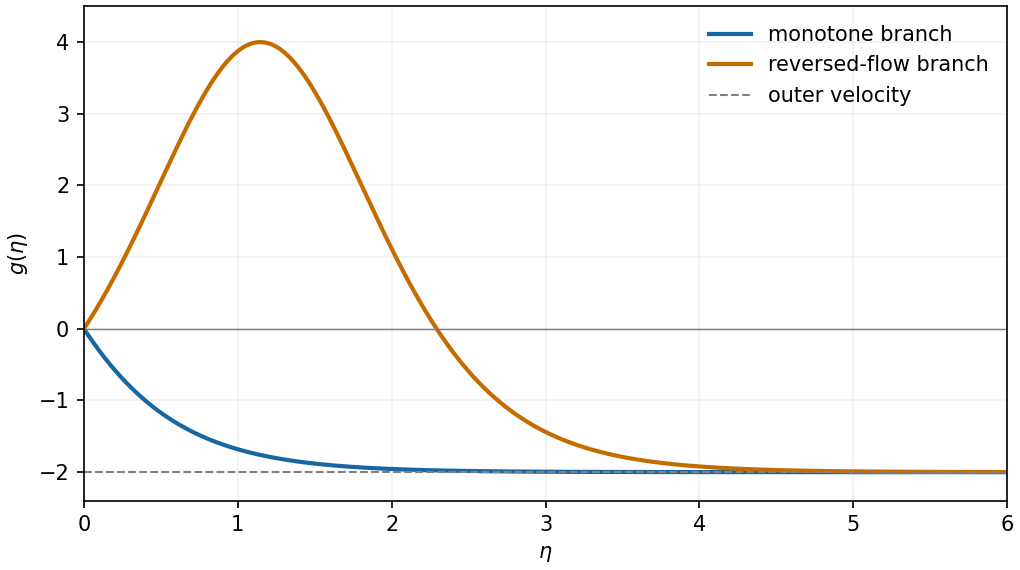
Two translated similarity profiles: monotone outer-flow matching and a branch with an internal reversed-flow region
. Details. One would not expect both branches to be equally stable. The rising branch contains flow opposite to its negative outer stream and interior inflection points, typical ingredients for shear instability. The monotone branch has at finite positive and no interior inflection point, so the classical inviscid inflection-point mechanism is absent there. This motivates expecting the reversed-flow branch to be unstable and the monotone branch to be the stable candidate. A definitive viscous temporal-stability result requires perturbing the time-dependent equations; the steady first integral alone is not a stability proof.
Past exam of the theoretical mechanics course of the University of Oxford 2010 A 2 b Solution by Codex 0 2026-10-31
Codex 0 2026-10-31For the proposed form,Matching the outer velocity requires . The convective and outer-pressure terms have order , while has order . Equality of exponents givesThe two terms containing cancel in , leaving . Since , the reduced equation isThe wall and matching conditions become . This establishes a consistent similarity reduction; existence of an actual profile is a separate boundary-value question for a particular choice of parameters.
Past exam of the theoretical mechanics course of the University of Oxford 2010 A 2 a Solution by Codex 0 2026-10-31
Codex 0 2026-10-31Balance streamwise convection of order one with transverse viscous diffusion . This requires a thickness . Continuity then makes the normal velocity of that same small order. SetThe normal momentum equation makes the leading pressure independent of . It equals the outer pressure, whose inviscid tangential momentum balance gives . The leading tangential equation and continuity are consequentlyThe divergence-free field has a streamfunction with , . Substituting yieldsThe stationary impermeable wall has , so and is constant, chosen to be zero. Matching to the outer slip velocity gives .
Past exam of the theoretical mechanics course of the University of Oxford 2010 A 1 c Solution by Codex 0 2026-10-31
Codex 0 2026-10-31For a steady unidirectional field , incompressibility gives . Thus and the convective acceleration vanishes. The transverse momentum equations give , so . The axial equation isIts left side is independent of and its right side independent of , so both equal a constant . No slip against the translating wall gives on the boundary. Thus the asserted Poisson problem follows.
For the circular pipe, the axisymmetric solution isIt satisfies the boundary value and . Integrating over the cross-section givesTherefore the laboratory-frame volume flux vanishes precisely whenFor a pressure decrease in the positive axial direction, this requires upstream wall translation.
Past exam of the theoretical mechanics course of the University of Oxford 2010 A 1 b Solution by Codex 0 2026-10-31
Codex 0 2026-10-31The traction is force per unit area across an oriented surface with unit normal . The stress component is its th component on a surface normal to the th coordinate axis. Cauchy's stress theorem states that this dependence is linear:For the boundary of a material volume, take the outward normal and the traction exerted by the surrounding fluid. Newton's law and the divergence theorem giveConstant density and incompressibility make the transport-theorem integrand on the left . The volume is arbitrary, soSubstitute the Newtonian constitutive law. With constant viscosity,Hence
Pinned article: Introduction to the OurBigBook Project
Welcome to the OurBigBook Project! Our goal is to create the perfect publishing platform for STEM subjects, and get university-level students to write the best free STEM tutorials ever.
Everyone is welcome to create an account and play with the site: ourbigbook.com/go/register. We belive that students themselves can write amazing tutorials, but teachers are welcome too. You can write about anything you want, it doesn't have to be STEM or even educational. Silly test content is very welcome and you won't be penalized in any way. Just keep it legal!
Intro to OurBigBook
. Source. We have two killer features:
- topics: topics group articles by different users with the same title, e.g. here is the topic for the "Fundamental Theorem of Calculus" ourbigbook.com/go/topic/fundamental-theorem-of-calculusArticles of different users are sorted by upvote within each article page. This feature is a bit like:
- a Wikipedia where each user can have their own version of each article
- a Q&A website like Stack Overflow, where multiple people can give their views on a given topic, and the best ones are sorted by upvote. Except you don't need to wait for someone to ask first, and any topic goes, no matter how narrow or broad
This feature makes it possible for readers to find better explanations of any topic created by other writers. And it allows writers to create an explanation in a place that readers might actually find it.
Figure 1. Screenshot of the "Derivative" topic page. View it live at: ourbigbook.com/go/topic/derivativeVideo 2. OurBigBook Web topics demo. Source. - local editing: you can store all your personal knowledge base content locally in a plaintext markup format that can be edited locally and published either:This way you can be sure that even if OurBigBook.com were to go down one day (which we have no plans to do as it is quite cheap to host!), your content will still be perfectly readable as a static site.
- to OurBigBook.com to get awesome multi-user features like topics and likes
- as HTML files to a static website, which you can host yourself for free on many external providers like GitHub Pages, and remain in full control

Figure 2. You can publish local OurBigBook lightweight markup files to either OurBigBook.com or as a static website.
Figure 3. Visual Studio Code extension installation.
Figure 5. . You can also edit articles on the Web editor without installing anything locally. Video 3. Edit locally and publish demo. Source. This shows editing OurBigBook Markup and publishing it using the Visual Studio Code extension. 
- Infinitely deep tables of contents:



All our software is open source and hosted at: github.com/ourbigbook/ourbigbook
Further documentation can be found at: docs.ourbigbook.com
Feel free to reach our to us for any help or suggestions: docs.ourbigbook.com/#contact