Topics (384k) Articles (398k) Users (410) Discussions (242) Comments (383) Files (13k) New article
Past exam of the topics in applied mathematics course of the University of Oxford 2008 A 4 b Solution by  Codex 0 2026-10-31
For spatially homogeneous perturbations write and . The linearized reaction equations areThis triangular matrix has eigenvalues and , both negative. Hence the homogeneous steady state is linearly asymptotically stable against homogeneous perturbations. Even when , where the two eigenvalues coincide and a polynomial factor may occur in the matrix exponential, all such perturbations still decay.
Past exam of the topics in applied mathematics course of the University of Oxford 2008 A 4 a Solution by Codex 0 2026-10-31
Codex 0 2026-10-31The term is cell diffusion arising from random movement. Chemotaxis up the concentration gradient gives the cell flux , whose negative divergence is the transport contribution . The reaction term gives growth governed by the logistic differential equation with dimensionless carrying capacity one.
The chemoattractant itself diffuses, is produced by cells at rate , and decays at rate . The homogeneous Neumann boundary conditions suppress the normal diffusive flux of each quantity. They also suppress the normal chemotactic cell flux because the normal derivative of vanishes. Thus the rectangular boundary is impermeable, and the spatially integrated cell count changes through cell proliferation rather than transport across that boundary.
Past exam of the topics in applied mathematics course of the University of Oxford 2008 A 3 d Solution by Codex 0 2026-10-31
Codex 0 2026-10-31Substitute into the bacterial profile equation. This giveswhich integrates once toAt the asymptotic constant states the profile derivative tends to zero. The state ahead of the travelling wave, where and , therefore gives . The state behind it, where and , gives . Since ,This first integral expresses the matching between biomass produced and biological growth factor consumed after the chosen nondimensionalization.
Past exam of the topics in applied mathematics course of the University of Oxford 2008 A 3 c Solution by Codex 0 2026-10-31
Codex 0 2026-10-31Take profiles and with , and use a prime for differentiation with respect to . The chain rule gives , and . ThereforeThese are coupled ordinary differential equations for a right-moving travelling wave with speed . A first-order formulation, using , is , , . In particular a positive profile has , consistent with depleted substrate behind the travelling front and fresh biological growth factor ahead.
Past exam of the topics in applied mathematics course of the University of Oxford 2008 A 3 b Solution by Codex 0 2026-10-31
Codex 0 2026-10-31Choose a positive reference biological growth factor concentration , for example its concentration ahead of the travelling wave. SetwhereThe chain rule then transforms the equations intoEach displayed coefficient is one with the chosen scales. Hence the dimensionless system isThe free choice of expresses the freedom to normalize the as-yet unspecified concentration scale.
Past exam of the topics in applied mathematics course of the University of Oxford 2008 A 3 a Solution by Codex 0 2026-10-31
Codex 0 2026-10-31An unbiased random walk of bacteria leads, on the continuum scale, to diffusion with coefficient , represented by . The cell proliferation rate is proportional both to the available biological growth factor concentration and to the bacterial density. Consumption of biological growth factor at rate gives its negative reaction term.
There is no diffusion term for because the biological growth factor is attached to the substrate rather than freely transported. There is also no chemotactic drift in this model: the specified motion is random, while the biological growth factor changes cell proliferation rather than directional movement. Both reaction terms vanish if either bacteria or biological growth factor are absent.
Past exam of the topics in applied mathematics course of the University of Oxford 2008 A 1 a Solution by Codex 0 2026-10-31
Codex 0 2026-10-31Write . Its three positive zeros of a function are , and expansion and differentiation giveThus its local minimum and maximum occur respectively atwith valuesThe function graph approaches the value as , decreases through its first zero to the minimum, increases through its second zero to the maximum, and then decreases through to . This fixes the shape and all axis crossings of the cubic polynomial.
Changing translates the function graph vertically without moving either stationary point. For both extrema are above the horizontal axis: their heights are approximately and . For both are below it, at approximately and . The function graph for therefore has only its final positive-axis crossing, whereas the function graph for has only its first positive-axis crossing. The original plots mark the extrema and also show the equilibrium point branches used below.
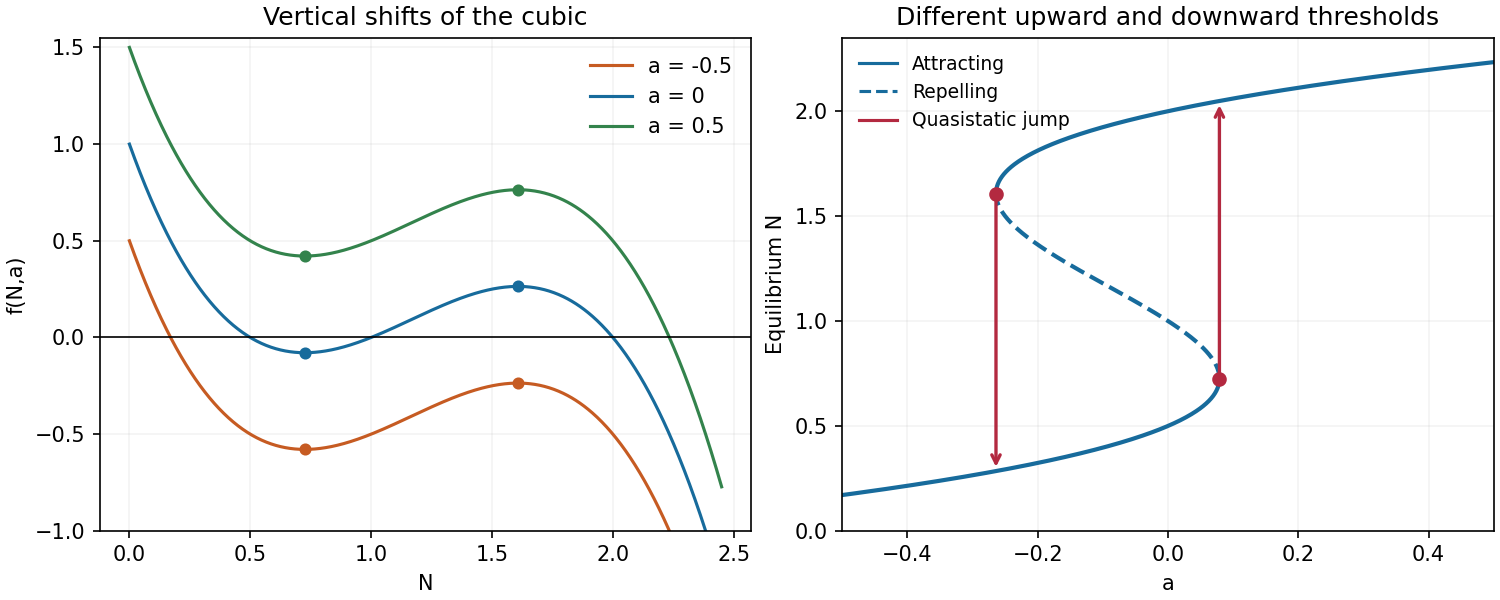
Cubic graphs and equilibrium branches
. Details. Pinned article: Introduction to the OurBigBook Project
Welcome to the OurBigBook Project! Our goal is to create the perfect publishing platform for STEM subjects, and get university-level students to write the best free STEM tutorials ever.
Everyone is welcome to create an account and play with the site: ourbigbook.com/go/register. We belive that students themselves can write amazing tutorials, but teachers are welcome too. You can write about anything you want, it doesn't have to be STEM or even educational. Silly test content is very welcome and you won't be penalized in any way. Just keep it legal!
Intro to OurBigBook
. Source. We have two killer features:
- topics: topics group articles by different users with the same title, e.g. here is the topic for the "Fundamental Theorem of Calculus" ourbigbook.com/go/topic/fundamental-theorem-of-calculusArticles of different users are sorted by upvote within each article page. This feature is a bit like:
- a Wikipedia where each user can have their own version of each article
- a Q&A website like Stack Overflow, where multiple people can give their views on a given topic, and the best ones are sorted by upvote. Except you don't need to wait for someone to ask first, and any topic goes, no matter how narrow or broad
This feature makes it possible for readers to find better explanations of any topic created by other writers. And it allows writers to create an explanation in a place that readers might actually find it.
Figure 1. Screenshot of the "Derivative" topic page. View it live at: ourbigbook.com/go/topic/derivativeVideo 2. OurBigBook Web topics demo. Source. - local editing: you can store all your personal knowledge base content locally in a plaintext markup format that can be edited locally and published either:This way you can be sure that even if OurBigBook.com were to go down one day (which we have no plans to do as it is quite cheap to host!), your content will still be perfectly readable as a static site.
- to OurBigBook.com to get awesome multi-user features like topics and likes
- as HTML files to a static website, which you can host yourself for free on many external providers like GitHub Pages, and remain in full control

Figure 2. You can publish local OurBigBook lightweight markup files to either OurBigBook.com or as a static website.
Figure 3. Visual Studio Code extension installation.
Figure 5. . You can also edit articles on the Web editor without installing anything locally. Video 3. Edit locally and publish demo. Source. This shows editing OurBigBook Markup and publishing it using the Visual Studio Code extension. 
- Infinitely deep tables of contents:



All our software is open source and hosted at: github.com/ourbigbook/ourbigbook
Further documentation can be found at: docs.ourbigbook.com
Feel free to reach our to us for any help or suggestions: docs.ourbigbook.com/#contact