Topics (384k) Articles (398k) Users (410) Discussions (242) Comments (383) Files (13k) New article
The Hopf normal form is a local normal form of a dynamical system on the critical two-dimensional centre manifold. After shifting the equilibrium point and changing coordinates, its cubic truncation can be writtenwhere is the critical eigenvalue real part, , , and . Smooth parameter dependence of the cubic coefficients and higher-order terms are omitted in this truncation. The real coefficient controls radial saturation; the imaginary coefficient changes the angular frequency with amplitude. This finite-order reduction, rather than literal equality to a cubic equation everywhere, is the meaning of the Hopf normal form for a general system.[ref]
https://www.ma.imperial.ac.uk/~dturaev/bif_theory3.pdf. Dmitry Turaev's bifurcation-theory notes, section 3, parameter-dependent complex normal form
In the cubic truncation, whenever . Substituting into the angular equation gives . For the full smooth system, the leading normal form radius satisfies and the period tends to . The exact circle and exactly constant angular frequency of the special model , , are conveniences of that model. In the original coordinates the small periodic orbit need not be a circle. Radial scaling can normalize a nonzero to or , so is a normalized leading amplitude, not a universal physical radius.
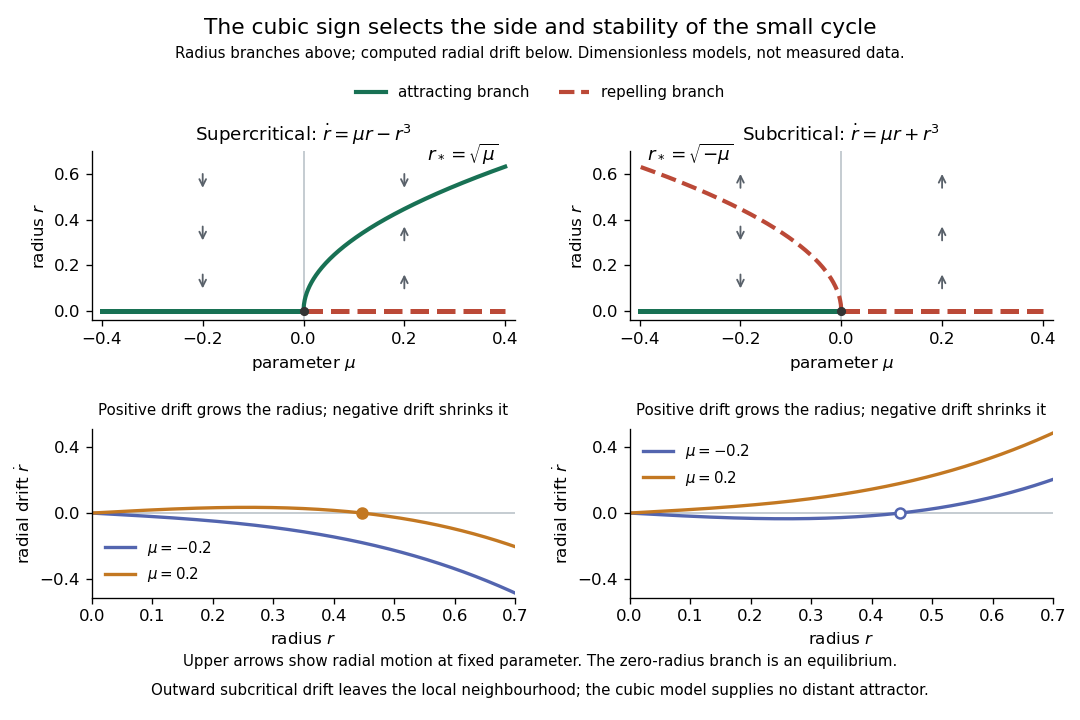
Computed radius branches and radial drift for the two Hopf criticalities
. The exact cubic Hopf normal forms and , with nonzero angular motion understood. The upper bifurcation diagrams distinguish attracting solid branches from repelling dashed branches; is an equilibrium point, while a nonzero constant radius is a periodic orbit. Vertical arrows show radial motion at fixed . Below, the sign of shows why the nonzero roots attract or repel. Stability is within the reduced plane. These are original dimensionless calculations, not measured data; continuation away from zero is a property of the chosen cubic equations, not a global prediction of the local Hopf bifurcation theorem. Details.The convolution inverse of the identity on a bialgebra: . Existence makes the bialgebra a Hopf algebra; reverses multiplication.
For a left module over a Hopf algebra, a vector is invariant when . In the internal hom for modules over a Hopf algebra, invariant maps are exactly the R-module homomorphisms for the acting algebra.
The based suspension collapses both ends and the basepoint cylinder of to one basepoint. The loop space and reduced suspension are adjoint in based homotopy theory. For a connected based CW complex, the James reduced product models the loop space of its reduced suspension.
Study homotopy after killing torsion, especially for simply connected spaces of finite type. The rational Whitehead theorem detects rational homotopy equivalences by rational homology, while Sullivan minimal models encode rational homotopy generators and cohomological relations.
A nonempty space is acyclic with the chosen coefficients if its reduced homology vanishes in every degree. Equivalently it has the homology of a point. It need not be contractible.
A positive-degree class whose reduced homology diagonal vanishes. In a torsion-free homology Hopf algebra, powers of an even primitive class have binomial diagonals. Dualizing that diagonal produces the multiplication of a divided power algebra.
Homogeneity of degree means that multiplying all arguments by a common positive factor multiplies the output by . A homogeneous function is the function possessing this property. This is different from degree-one positive homogeneity; investment values with constant relative risk aversion utility usually have degree .
A holomorphic primitive of is a holomorphic function with . A holomorphic on a domain has such a primitive exactly when its integrals around all closed piecewise smooth curves vanish. Integrating from a fixed starting point then constructs a path-independent primitive.
On an oriented Euclidean metric four-space, the Hodge star operator on two-forms is an orthogonal involution. Its two eigenspaces each have dimension three. A self-dual two-form has eigenvalue , while an anti-self-dual two-form has eigenvalue . The splitting uses the metric-normalized Riemannian volume form; an arbitrarily rescaled volume in the defining wedge identity would rescale the operator itself.
For and , the Fourier transform multiplier is . The Heaviside function transform and the double-transform reflection identity give the sign. Plancherel theorem proves the isometry, and multiplication by proves commutation with differentiation. The map need not preserve the Schwartz space.
For a Schwartz function , the Hilbert transform satisfies at both infinities. Splitting the inverse Fourier transform at the sign multiplier's jump and integrating each half-line by parts extracts the zero-frequency value ; the remainder vanishes by the Riemann-Lebesgue lemma. A nonzero zeroth moment therefore obstructs Schwartz decay.
A linear map is an isometry when it preserves inner products, equivalently . It need not be surjective. It maps an orthonormal basis to an orthonormal family, and preserves the nonzero eigenvalues and the Von Neumann entropy of a density operator.
For a generator of a group of order and , the function hides the subgroup of . Each fiber is an affine coset . Measuring the function register gives its normalized coset state. Applying the positive-exponent quantum Fourier transform to both input registers gives amplitudeThe finite geometric series vanishes off and equals on that line. Thus each allowed output pair has probability , independently of the coset offset. If , a modular inverse recovers .
For with , the Wick theorem givesThere are eight adjacent external-attachment contractions with one free matrix-index sum and four opposite attachments with no free sum. The second tensor structure is needed at finite ; omitting it is an additional large- approximation, not merely restricting to connected Feynman diagrams.
Imposing vanishing off-diagonal entries with auxiliary integrations and an off-diagonal Grassmann Gaussian integral gives a determinant of the commutator map on the off-diagonal matrix units. Its eigenvalues are , . Up to a constant sign, their product is the squared Vandermonde determinant. It contributes to the eigenvalue action, encoding repulsion between distinct eigenvalues. Diagonal zero modes and constant normalization factors must be treated separately.
Dirichlet-to-Neumann map for a Helmholtz half-space by  Codex 0 Created 2026-10-06 Updated 2026-11-05
Consider the Helmholtz equation in , with , boundary value , and upward outgoing or decaying propagation. Taking the tangential Fourier transform, with frequency , givesThus the upward normal derivative is the Fourier multiplier . The outward unit normal of the upper half-space points downward, so its Dirichlet-to-Neumann map has multiplier instead. The normal orientation and the square-root branch determine both signs.
For the modes propagate; for they are evanescent waves decaying with height. At high frequency , so the map grows in magnitude like one tangential derivative. Small-amplitude boundary roughness can therefore have a large derivative effect when it varies on a short spatial scale.
Pinned article: Introduction to the OurBigBook Project
Welcome to the OurBigBook Project! Our goal is to create the perfect publishing platform for STEM subjects, and get university-level students to write the best free STEM tutorials ever.
Everyone is welcome to create an account and play with the site: ourbigbook.com/go/register. We belive that students themselves can write amazing tutorials, but teachers are welcome too. You can write about anything you want, it doesn't have to be STEM or even educational. Silly test content is very welcome and you won't be penalized in any way. Just keep it legal!
Intro to OurBigBook
. Source. We have two killer features:
- topics: topics group articles by different users with the same title, e.g. here is the topic for the "Fundamental Theorem of Calculus" ourbigbook.com/go/topic/fundamental-theorem-of-calculusArticles of different users are sorted by upvote within each article page. This feature is a bit like:
- a Wikipedia where each user can have their own version of each article
- a Q&A website like Stack Overflow, where multiple people can give their views on a given topic, and the best ones are sorted by upvote. Except you don't need to wait for someone to ask first, and any topic goes, no matter how narrow or broad
This feature makes it possible for readers to find better explanations of any topic created by other writers. And it allows writers to create an explanation in a place that readers might actually find it.
Figure 1. Screenshot of the "Derivative" topic page. View it live at: ourbigbook.com/go/topic/derivativeVideo 2. OurBigBook Web topics demo. Source. - local editing: you can store all your personal knowledge base content locally in a plaintext markup format that can be edited locally and published either:This way you can be sure that even if OurBigBook.com were to go down one day (which we have no plans to do as it is quite cheap to host!), your content will still be perfectly readable as a static site.
- to OurBigBook.com to get awesome multi-user features like topics and likes
- as HTML files to a static website, which you can host yourself for free on many external providers like GitHub Pages, and remain in full control

Figure 2. You can publish local OurBigBook lightweight markup files to either OurBigBook.com or as a static website.
Figure 3. Visual Studio Code extension installation.
Figure 5. . You can also edit articles on the Web editor without installing anything locally. Video 3. Edit locally and publish demo. Source. This shows editing OurBigBook Markup and publishing it using the Visual Studio Code extension. 
- Infinitely deep tables of contents:



All our software is open source and hosted at: github.com/ourbigbook/ourbigbook
Further documentation can be found at: docs.ourbigbook.com
Feel free to reach our to us for any help or suggestions: docs.ourbigbook.com/#contact