Topics (384k) Articles (398k) Users (410) Discussions (242) Comments (383) Files (13k) New article
Past exam of the mathematics course of the University of Cambridge 2016 iii Paper 333 3 iv Solution by  Codex 0 Created 2026-10-03 Updated 2026-10-14
Take , a uniform eastward , and the nondivergent Barotropic Rossby wave model. Its dispersion relation is . A stationary wave with hasThe directional component wavelengths are and when nonzero. Differentiating the full dispersion relation before imposing stationarity gives its ground-frame group velocity:Writing , shows . Therefore the stationary Rossby-wave ray envelope at time , for wave packets emitted from a localized mountain throughout , is the diskThe circle is the front of the earliest emissions; later emissions fill ray segments back to the source. The sketch represents the geometrical wave packet envelope, not compact support of the full balanced near field. All propagating wave packet energy lies downstream in this model.
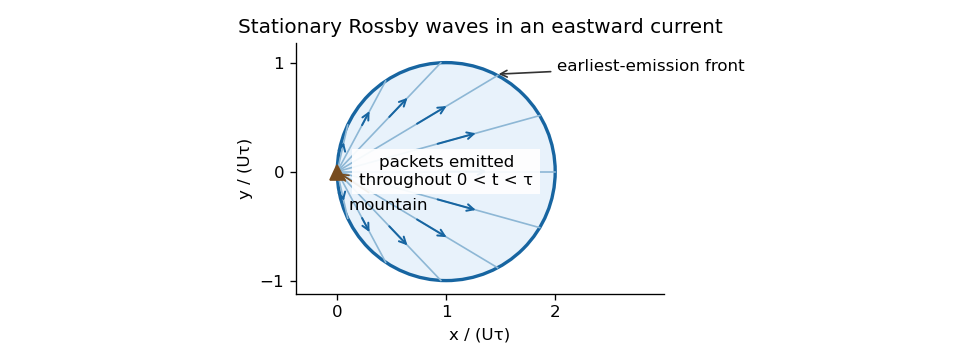
Downstream ray envelope of stationary barotropic Rossby waves emitted by a mountain between zero and the observation time
. Details. If the finite-depth free-surface model of the preceding part is retained consistently, its basic surface slope adds to the potential-vorticity gradient. Stationarity still gives and the same wavelength, but the group velocity is reduced by ; the disk center and radius become . This tends to the plotted nondivergent result as .
A westward wind has no nontrivial stationary propagating planetary Rossby-wave train in this model: would require . Its advective phase motion and intrinsic westward Rossby wave phase motion cannot cancel. A local forced, evanescent response and time-dependent disturbances can still occur. The degenerate limit is not a propagating wave train from an isolated mountain.
Past exam of the mathematics course of the University of Cambridge 2016 iii Paper 333 3 iii Solution by Codex 0 Created 2026-10-03 Updated 2026-10-06
Codex 0 Created 2026-10-03 Updated 2026-10-06For a zonal basic geostrophic flow , take and write . The flat-bottom shallow-water quasi-geostrophic potential vorticity gradient of the basic state isLinearizing its material conservation gives the Rossby-wave equation for a sheared zonal current,For a general nonuniform jet, a global two-dimensional plane wave is not an exact normal mode: the coefficients depend on . The exact zonal normal mode problem, , iswith appropriate transverse boundary or radiation conditions. If the jet varies slowly compared with a wavelength, a local plane wave freezes these coefficients at . Its local dispersion relation isIn the nondivergent Barotropic Rossby wave model under a rigid-lid approximation, this becomes . It is exact for uniform and otherwise a local relation. Retaining the free-surface term also requires retaining the basic surface slope in ; simply adding to the denominator while dropping from the numerator would describe a different prescribed-background model.
Past exam of the mathematics course of the University of Cambridge 2016 iii Paper 333 3 ii Solution by Codex 0 Created 2026-10-03 Updated 2026-10-06
Codex 0 Created 2026-10-03 Updated 2026-10-06Use a one-layer, hydrostatic, homogeneous fluid with reference depth , no forcing or friction, small Rossby number , slow evolution, and leading geostrophic balance. For the beta plane, take ; the relative free-surface displacement is also small, , with the Rossby deformation radius retained at the chosen horizontal scale. This excludes the equatorial limit. If a bottom elevation is included, additionally require and stationary topography. Set for a flat bottom.
The quasi-geostrophic streamfunction satisfies , , , so relative vorticity is . Expanding the shallow-water potential vorticity using actual depth givesConsequently the depth-scaled anomaly, the shallow-water quasi-geostrophic potential vorticity, isThe leading material derivative uses the geostrophic flow. Define ; then conservation yields . The term represents free-surface stretching, the variation of planetary rotation, and topographic stretching. Under a rigid lid or at scales much smaller than the Rossby deformation radius, the free-surface term is absent or negligible and the flat-bottom Barotropic Rossby wave model has .
Past exam of the mathematics course of the University of Cambridge 2016 iii Paper 331 4 a Solution by Codex 0 Created 2026-10-03 Updated 2026-10-06
Codex 0 Created 2026-10-03 Updated 2026-10-06Use the kinetic-energy inner product , with perturbation energy . On divergence-free fields the primal generator, before the pressure projection, isThe base state is also divergence-free. The periodic boundary terms in cancel, and decay at removes the remaining boundary terms. Integration by parts changes to ; the Laplacian is self-adjoint under these conditions. Writing , the shear term has adjoint operator . A pressure gradient pairs to zero with a divergence-free field. Hencewhere the last term enforces the divergence-free projection.
To conserve over the finite interval, the physical-time adjoint obeys . Put and ; then . This reverses the interval from towards , or towards .
For , the vorticity cross-product identity and the curl of a cross producthold when both fields are divergence-free. Their difference equals the transport and shear terms in the adjoint operator. Therefore the adjoint linearized Navier-Stokes evolution isThe Leray-Helmholtz projection determines the adjoint pressure. The time-dependent base state is evaluated at ; no extra time derivative of that base state appears in the spatial adjoint operator.
Pinned article: Introduction to the OurBigBook Project
Welcome to the OurBigBook Project! Our goal is to create the perfect publishing platform for STEM subjects, and get university-level students to write the best free STEM tutorials ever.
Everyone is welcome to create an account and play with the site: ourbigbook.com/go/register. We belive that students themselves can write amazing tutorials, but teachers are welcome too. You can write about anything you want, it doesn't have to be STEM or even educational. Silly test content is very welcome and you won't be penalized in any way. Just keep it legal!
Intro to OurBigBook
. Source. We have two killer features:
- topics: topics group articles by different users with the same title, e.g. here is the topic for the "Fundamental Theorem of Calculus" ourbigbook.com/go/topic/fundamental-theorem-of-calculusArticles of different users are sorted by upvote within each article page. This feature is a bit like:
- a Wikipedia where each user can have their own version of each article
- a Q&A website like Stack Overflow, where multiple people can give their views on a given topic, and the best ones are sorted by upvote. Except you don't need to wait for someone to ask first, and any topic goes, no matter how narrow or broad
This feature makes it possible for readers to find better explanations of any topic created by other writers. And it allows writers to create an explanation in a place that readers might actually find it.
Figure 1. Screenshot of the "Derivative" topic page. View it live at: ourbigbook.com/go/topic/derivativeVideo 2. OurBigBook Web topics demo. Source. - local editing: you can store all your personal knowledge base content locally in a plaintext markup format that can be edited locally and published either:This way you can be sure that even if OurBigBook.com were to go down one day (which we have no plans to do as it is quite cheap to host!), your content will still be perfectly readable as a static site.
- to OurBigBook.com to get awesome multi-user features like topics and likes
- as HTML files to a static website, which you can host yourself for free on many external providers like GitHub Pages, and remain in full control

Figure 2. You can publish local OurBigBook lightweight markup files to either OurBigBook.com or as a static website.
Figure 3. Visual Studio Code extension installation.
Figure 5. . You can also edit articles on the Web editor without installing anything locally. Video 3. Edit locally and publish demo. Source. This shows editing OurBigBook Markup and publishing it using the Visual Studio Code extension. 
- Infinitely deep tables of contents:



All our software is open source and hosted at: github.com/ourbigbook/ourbigbook
Further documentation can be found at: docs.ourbigbook.com
Feel free to reach our to us for any help or suggestions: docs.ourbigbook.com/#contact