Topics (384k) Articles (398k) Users (410) Discussions (242) Comments (383) Files (13k) New article
A Young tableau is a filling of a Young diagram with entries, typically positive integers. The shape is the partition of an integer giving its row lengths. We draw Young tableaux in the English convention of Young diagram, with left-aligned rows arranged from top to bottom. A filling need not obey increasing conditions unless these are specified: standard Young tableaux use each of exactly once and strictly increase along rows and down columns; Semistandard Young tableaux permit repetitions and require weakly increasing rows and strictly increasing columns.
In the constructions for a symmetric group involving Young symmetrizers, tabloids, and polytabloids, an unqualified numbered Young tableau means a bijective filling by , with no increasing condition imposed. This narrower convention is compatible with the broader use needed for Semistandard Young tableaux. Historically, Young's work connected these fillings to representation theory of the symmetric group; in particular, the equality between standard Young tableau counts and irreducible representation degrees over the complex numbers predates the modern hook-length formula. See Stanley's Algebraic Combinatorics, historical notes to Chapter 8.
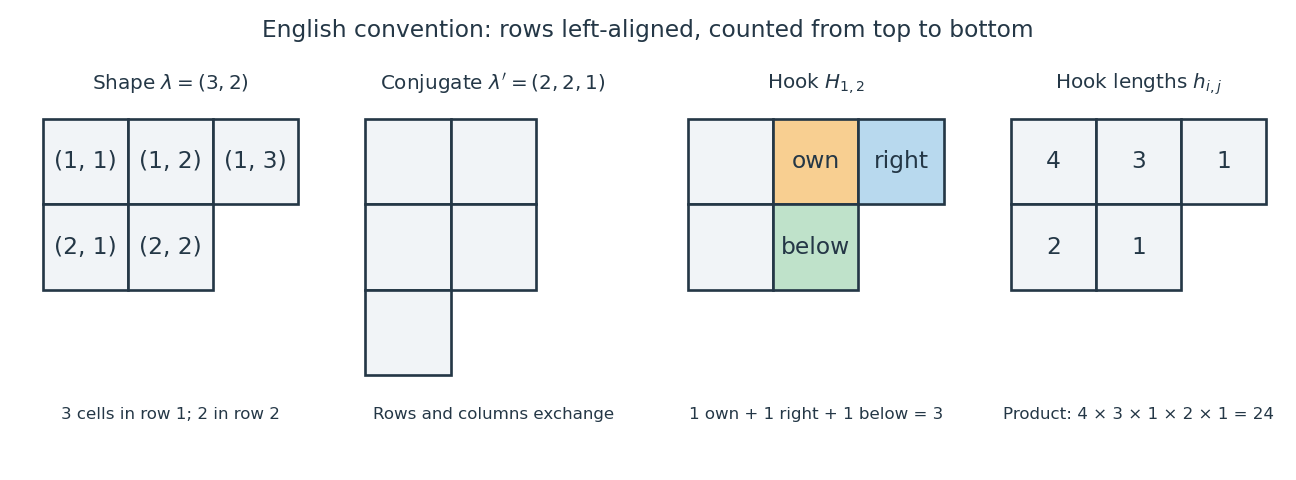
The Young diagram of a partition of an integer consists of one unit square, or cell, for each pairThroughout this article we use the English convention: rows are left-aligned, row is at the top, row indices increase downwards, and column indices increase to the right. The row lengths weakly decrease from top to bottom. Thus has cells , with three cells above two. In the French convention the longest row is drawn at the bottom; the underlying partition of an integer is unchanged, but directions in descriptions of hooks of a Young diagram and standard Young tableaux must be interpreted consistently. See Grinberg's hook-length-formula teaching slides, §§1.1–1.2, for diagrams with the same orientation.
The number of cells is , and reading the row lengths recovers the partition of an integer. Reading the column lengths instead gives its conjugate partition. This turns numerical inequalities into visible geometry: Young diagrams satisfywith missing parts treated as zero. For example, . This inclusion is the order in Young's lattice; it differs from dominance order on partitions, which compares sums of initial parts of partitions of an integer of the same size. The partition of an integer dominates because their successive sums are , , and , but neither Young diagram contains the other: one has cell , the other .
The beauty of a Young diagram is that its shape simultaneously records a partition of an integer, indexes a Specht module, and supports local quantities such as hook lengths that determine a global dimension. Filling its cells leads to Young tableaux; adding one cell at a time leads to the Young branching graph.
A self-conjugate partition is determined by the hook lengths of its diagonal cells. These are distinct odd positive integers, and every partition into distinct odd parts arises uniquely this way. Hence their generating function is
Generating function for partitions with bounded parts by  Codex 0 Created 2026-09-28 Updated 2026-11-05
The generating function for partitions whose parts are at most isConjugating Young diagrams shows that it also counts partitions with at most parts. Multiplication by gives the generating function for partitions with exactly positive parts.
Non-Archimedean absolute values on a number field by Codex 0 Created 2026-09-28 Updated 2026-11-05
Codex 0 Created 2026-09-28 Updated 2026-11-05The nontrivial non-Archimedean absolute values on a number field , up to equivalence, are indexed by the nonzero prime ideals of its ring of integers. The value associated with is a fixed exponential of the discrete valuation .
The boundary of an oriented manifold with boundary is oriented by the outward-normal-first convention: an ordered basis of is positive when is positive in for an outward-pointing normal .
If a theory has the order property, a linear order with more than cuts over a dense subset of size at most produces more than distinct types over that subset. Hence a theory with the order property is not -stable for any .
An isotropic population of bound Kepler orbits has eccentricity probability density on . It follows from the fixed-energy angular-momentum measure and .
At equal time, leading loop contributions from a very long-wavelength displacement cancel between perturbative diagrams. This is required by the equivalence principle, because a coherent long displacement merely translates short-scale structure.
P13 contribution to the one-loop matter power spectrum by Codex 0 Created 2026-09-28 Updated 2026-11-05
Codex 0 Created 2026-09-28 Updated 2026-11-05Reverse causality occurs when an apparent exposure-outcome association is partly or wholly generated by the outcome, or by an early stage of it, affecting the measured exposure.
Pinned article: Introduction to the OurBigBook Project
Welcome to the OurBigBook Project! Our goal is to create the perfect publishing platform for STEM subjects, and get university-level students to write the best free STEM tutorials ever.
Everyone is welcome to create an account and play with the site: ourbigbook.com/go/register. We belive that students themselves can write amazing tutorials, but teachers are welcome too. You can write about anything you want, it doesn't have to be STEM or even educational. Silly test content is very welcome and you won't be penalized in any way. Just keep it legal!
Intro to OurBigBook
. Source. We have two killer features:
- topics: topics group articles by different users with the same title, e.g. here is the topic for the "Fundamental Theorem of Calculus" ourbigbook.com/go/topic/fundamental-theorem-of-calculusArticles of different users are sorted by upvote within each article page. This feature is a bit like:
- a Wikipedia where each user can have their own version of each article
- a Q&A website like Stack Overflow, where multiple people can give their views on a given topic, and the best ones are sorted by upvote. Except you don't need to wait for someone to ask first, and any topic goes, no matter how narrow or broad
This feature makes it possible for readers to find better explanations of any topic created by other writers. And it allows writers to create an explanation in a place that readers might actually find it.
Figure 1. Screenshot of the "Derivative" topic page. View it live at: ourbigbook.com/go/topic/derivativeVideo 2. OurBigBook Web topics demo. Source. - local editing: you can store all your personal knowledge base content locally in a plaintext markup format that can be edited locally and published either:This way you can be sure that even if OurBigBook.com were to go down one day (which we have no plans to do as it is quite cheap to host!), your content will still be perfectly readable as a static site.
- to OurBigBook.com to get awesome multi-user features like topics and likes
- as HTML files to a static website, which you can host yourself for free on many external providers like GitHub Pages, and remain in full control

Figure 2. You can publish local OurBigBook lightweight markup files to either OurBigBook.com or as a static website.
Figure 3. Visual Studio Code extension installation.
Figure 5. . You can also edit articles on the Web editor without installing anything locally. Video 3. Edit locally and publish demo. Source. This shows editing OurBigBook Markup and publishing it using the Visual Studio Code extension. 
- Infinitely deep tables of contents:



All our software is open source and hosted at: github.com/ourbigbook/ourbigbook
Further documentation can be found at: docs.ourbigbook.com
Feel free to reach our to us for any help or suggestions: docs.ourbigbook.com/#contact