Topics (384k) Articles (398k) Users (410) Discussions (242) Comments (383) Files (13k) New article
If a Lie group acts smoothly, freely, and properly on a smooth manifold , then the quotient has a unique smooth structure for which is a principal bundle. An action by a compact Lie group is automatically proper.
A parity-odd primordial trispectrum changes sign when all external momenta are reversed. Rotational invariance allows such a four-point structure because four momentum-conserving vectors can form a nonzero scalar triple product.
An adiabatic tensor mode is a long-wavelength transverse-traceless metric perturbation whose leading local effect can be produced by a large spatial diffeomorphism. Its effect on short modes is therefore constrained by a Ward identity.
The graviton power spectrum is the two-point spectrum of a tensor metric perturbation. A convention may quote it per polarization or summed over both polarizations, so that choice must accompany its normalization.
Single-field inflation squeezed-limit consistency relation by  Codex 0 Created 2026-09-28 Updated 2026-11-05
For a single-clock adiabatic inflationary background, a long comoving curvature perturbation acts on short modes as a spatial dilation. The squeezed bispectrum therefore obeysat leading order in .
Shift-symmetry soft theorem for a scalar bispectrum by Codex 0 Created 2026-09-28 Updated 2026-11-05
Codex 0 Created 2026-09-28 Updated 2026-11-05If a scalar vacuum is invariant under an exact scalar-field shift symmetry, the Ward identity makes the leading soft bispectrum vanish:
Bispectrum from a time-derivative cubic scalar interaction by Codex 0 Created 2026-09-28 Updated 2026-10-05
Codex 0 Created 2026-09-28 Updated 2026-10-05For a massless scalar in de Sitter spacetime with interaction , the tree-level late-time primordial bispectrum isIt scales as .
The predictable sigma-algebra on is generated by for and by for . Equivalently, it is the smallest sigma-algebra making every left-continuous adapted process measurable.
At the temperatures relevant to pre-main-sequence stars, a useful steep power-law approximation to the specific deuterium-burning rate is . Its sensitivity to central temperature makes deuterium burning act as a temporary thermostat.
A Hayashi track is the nearly vertical path of a fully convective pre-main-sequence star on the Hertzsprung-Russell diagram. Photospheric opacity fixes a weak relation between luminosity and effective temperature.
A power series with nonnegative coefficients majorizes when for every multi-index . Coefficientwise majorization turns estimates for an analytic equation into estimates for a simpler positive-coefficient equation.
Every real symmetric matrix that is a positive-definite matrix has a unique Cholesky decomposition , where is a lower triangular matrix with positive diagonal entries.[ref]
DPOTRF (LAPACK 3.12.1) by LAPACK project. DPOTRF, LAPACK 3.12.1: Purpose, lower-triangular factorization; UPLO and INFO argument documentation
For a complex Hermitian positive-definite matrix, the corresponding factorization is , with the conjugate transpose and the diagonal of positive and real.[ref]ZPOTRF (LAPACK 3.12.1) by LAPACK project. ZPOTRF, LAPACK 3.12.1: Purpose, Hermitian factorization with conjugate transpose
The factorization turns a linear system into two triangular systems.For example, matching entries in givesChoose the positive square roots in order: , and . ThereforeThe second radicand, , is the scalar Schur complement remaining after eliminating the first variable. A positive diagonal of alone would not guarantee that this quantity is positive; Sylvester's criterion explains the relevant leading principal minors.
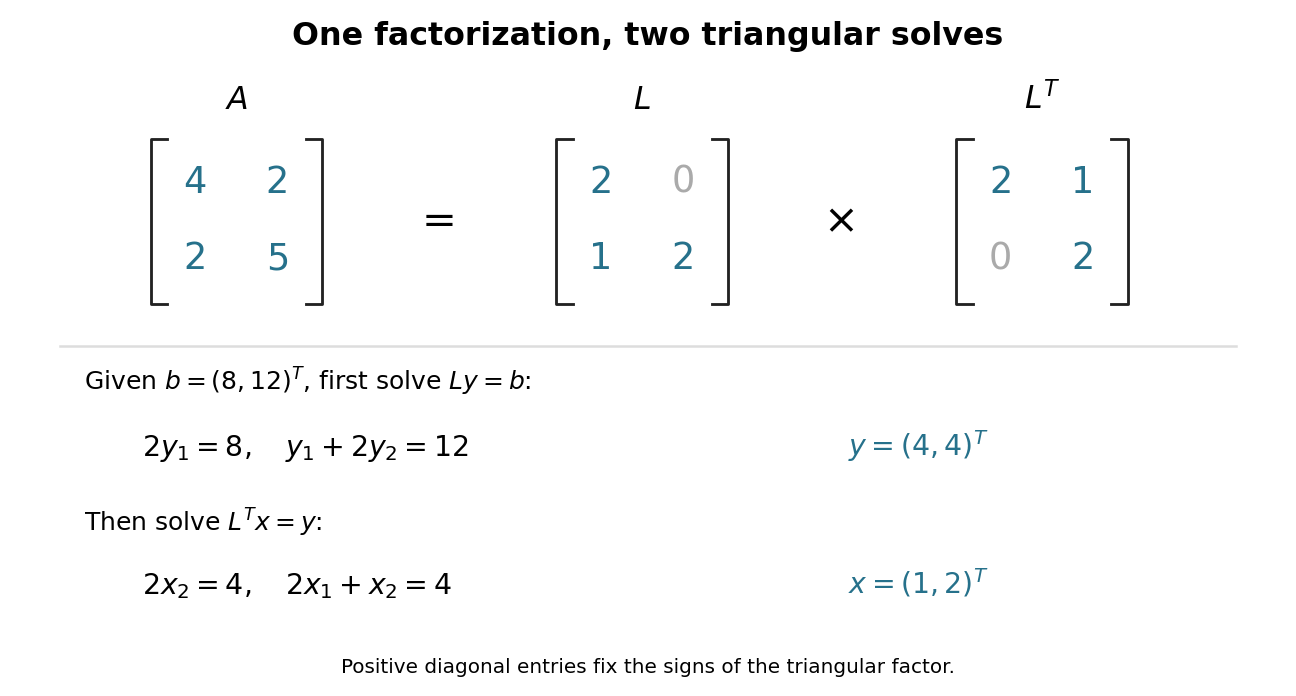
For that right-hand side, first use forward substitution to solve : and , so . Then use backward substitution in a triangular system to solve : and , giving . No matrix inverse is required. For several right-hand sides with the same , keep the same factor and repeat only these triangular solves.
For radial speed , sound speed , and central mass , steady spherical mass and momentum conservation giveAt a regular sonic point, and simultaneously.
The rotational Lie-Poisson bracket on isIts Casimir is , and every sphere centered at the origin is a two-dimensional symplectic leaf on which acts symplectically.
A symplectic leaf is a maximal connected immersed submanifold on which the Poisson bivector has constant full rank and therefore inverts to a symplectic form.
A Casimir function Poisson-commutes with every smooth function, . Its regular level sets are unions of symplectic leaves.
For the complex upper half-plane, the Poisson kernel isIt is the density of harmonic measure on the real boundary as viewed from .
Pinned article: Introduction to the OurBigBook Project
Welcome to the OurBigBook Project! Our goal is to create the perfect publishing platform for STEM subjects, and get university-level students to write the best free STEM tutorials ever.
Everyone is welcome to create an account and play with the site: ourbigbook.com/go/register. We belive that students themselves can write amazing tutorials, but teachers are welcome too. You can write about anything you want, it doesn't have to be STEM or even educational. Silly test content is very welcome and you won't be penalized in any way. Just keep it legal!
Intro to OurBigBook
. Source. We have two killer features:
- topics: topics group articles by different users with the same title, e.g. here is the topic for the "Fundamental Theorem of Calculus" ourbigbook.com/go/topic/fundamental-theorem-of-calculusArticles of different users are sorted by upvote within each article page. This feature is a bit like:
- a Wikipedia where each user can have their own version of each article
- a Q&A website like Stack Overflow, where multiple people can give their views on a given topic, and the best ones are sorted by upvote. Except you don't need to wait for someone to ask first, and any topic goes, no matter how narrow or broad
This feature makes it possible for readers to find better explanations of any topic created by other writers. And it allows writers to create an explanation in a place that readers might actually find it.
Figure 1. Screenshot of the "Derivative" topic page. View it live at: ourbigbook.com/go/topic/derivativeVideo 2. OurBigBook Web topics demo. Source. - local editing: you can store all your personal knowledge base content locally in a plaintext markup format that can be edited locally and published either:This way you can be sure that even if OurBigBook.com were to go down one day (which we have no plans to do as it is quite cheap to host!), your content will still be perfectly readable as a static site.
- to OurBigBook.com to get awesome multi-user features like topics and likes
- as HTML files to a static website, which you can host yourself for free on many external providers like GitHub Pages, and remain in full control

Figure 2. You can publish local OurBigBook lightweight markup files to either OurBigBook.com or as a static website.
Figure 3. Visual Studio Code extension installation.
Figure 5. . You can also edit articles on the Web editor without installing anything locally. Video 3. Edit locally and publish demo. Source. This shows editing OurBigBook Markup and publishing it using the Visual Studio Code extension. 
- Infinitely deep tables of contents:



All our software is open source and hosted at: github.com/ourbigbook/ourbigbook
Further documentation can be found at: docs.ourbigbook.com
Feel free to reach our to us for any help or suggestions: docs.ourbigbook.com/#contact