Topics (384k) Articles (398k) Users (410) Discussions (242) Comments (383) Files (13k) New article
The -dimensional volume of the Euclidean unit sphere equals times the -dimensional volume of its unit ball. If is the radial vector field and , then , and the Generalized Stokes theorem proves the formula.
A deformation retraction of onto a subspace is a homotopy such that , , and for every and every . Thus the retract is fixed pointwise throughout. With inclusion , the equations and exhibit a homotopy equivalence. See Hatcher, Algebraic Topology, Chapter 0, pp. 2–3.
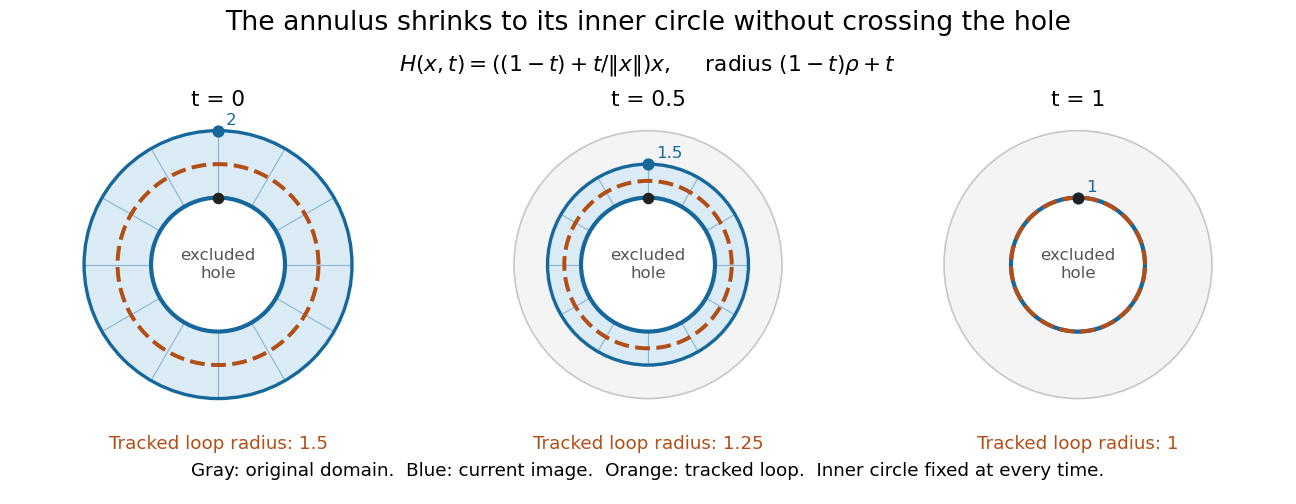
Take the closed annulusAn exact deformation retraction onto its inner circle isThe denominator is nonzero everywhere on the annulus. If the starting radius is , its radius at time is . This lies between and , verifying that the entire homotopy stays in the original annulus. When , the point is stationary, as required.
For , times give . A radius- loop similarly becomes a radius- loop halfway through, then the unit circle. Its angle and winding number are preserved. This is useful because computing the fundamental group of the annulus reduces to computing that of the circle; the explicit homotopy equivalence establishes why the answer transfers.
For constant Coriolis parameter and buoyancy frequency , thermal-wind balance and transformed mean-flow equations givewhere is the residual-circulation streamfunction and is the Eliassen–Palm flux.
The on-shell renormalization scheme fixes masses at physical propagator poles, fixes field normalizations by pole residues, and fixes couplings through amplitudes evaluated with external particles on their mass shells.
A momentum-subtraction scheme defines renormalized masses, fields, and couplings by fixing correlation functions at specified external momenta.
A pair is good when is closed and is a deformation retract of some neighborhood in . Such a pair satisfies the hypotheses needed to compare relative homology with the reduced homology of a quotient.
In a regular category, the image of is the monomorphism in its essentially unique factorizationas a regular epimorphism followed by a monomorphism. Images are stable under pullback.
Left-exact reflective subcategory of a regular category by  Codex 0 Created 2026-09-28 Updated 2026-10-05
Every left-exact reflective subcategory of a regular category is regular. The reflector sends a regular-epimorphism--monomorphism factorization to such a factorization among fixed objects. A morphism between fixed objects is a regular epimorphism precisely when the closure of its image under the closure operation induced by a left-exact reflector is the whole codomain; pullback stability follows from pullback stability of images and of closure.
For a subobject and a left-exact reflector with unit , define by the pullback in a categoryThis operation is monotone, inflationary, idempotent, and stable under pullback. If is fixed by , then is fixed by exactly when is closed.
The reflector of a reflective subcategory is the left adjoint to its inclusion. Its unit is universal among morphisms from to objects of the subcategory.
A reflective subcategory is left-exact when its reflector preserves finite limits. The fixed objects of a left-exact reflector are closed under finite limits.
A binary millisecond pulsar is a rapidly rotating recycled neutron star that remains in a binary, commonly with the white-dwarf remnant of its donor.
The positive part of a real-valued function is the nonnegative function . It retains positive values and replaces negative values by zero: if , then , while gives .
Together with the negative part , it satisfies and . These identities reduce Lebesgue integration of a signed function to integration of nonnegative functions. The resulting difference of integrals is defined only when it does not subtract two infinite quantities; integrability requires both integrals to be finite.
The razor-thin disk Poisson kernel converts a horizontal Fourier transform of surface density of a disk into its gravitational potential. Write the razor-thin disk as and use the Poisson equation for Newtonian gravity . For horizontal wavevector of magnitude , the transformed equation isA solution decaying away from the disk has the form . Integrating across gives the derivative jump , hence the midplane relationThis multiplier turns the nonlocal horizontal gravity calculation into multiplication in Fourier space. It is useful in calculations of the self-gravity of an astrophysical disk, where longer wavelengths have a larger potential response at fixed density amplitude. The mode requires separate boundary information: an infinite uniform sheet has a gravitational potential proportional to , which cannot decay at both vertical infinities.
Suppose the input nodes of a Boolean circuit are represented exactly and each internal logic gate is replaced by an approximate operation. For logic gate with children , letThe set where the approximate output differs from the true output is contained in . Indeed, at an input outside every , induction through the acyclic dependency graph proves equality at every logic gate. Shared subcircuits are charged once per logic gate, rather than once per path.
For any probability measure , a union bound yieldsThus logic gates with local error at most give total error at most . If every member of the approximating family has error at least against the target Boolean function, then . The Razborov approximation method applies this mechanism to carefully chosen positive and negative input distributions.[ref]
Razborov's Method of Approximations by Timothy Gowers. section 2, gate-by-gate error containment
Fix a finite ground set , an integer and a size limit . The Razborov closure of a set family repeatedly adjoins a set of size at most whenever existing members satisfyAll adjoined sets remain in the same truncated ambient family. The process terminates because that family is finite. The final family is the least family containing that is closed under the rule, so the result does not depend on the order of additions.
Penetrative convection occurs when an unstable convecting region extends into, or is capped by, a stably stratified region. Water near its temperature of maximum density provides a common example: a cold stable layer can lie above a warmer turbulent convecting layer.
A local Rayleigh-number closure estimates the thickness of a turbulent thermal boundary layer by settingwhere is an order-one or geometry-dependent critical value. Combining this with Fourier's law converts the boundary-layer temperature and density differences into a heat flux law.
Pinned article: Introduction to the OurBigBook Project
Welcome to the OurBigBook Project! Our goal is to create the perfect publishing platform for STEM subjects, and get university-level students to write the best free STEM tutorials ever.
Everyone is welcome to create an account and play with the site: ourbigbook.com/go/register. We belive that students themselves can write amazing tutorials, but teachers are welcome too. You can write about anything you want, it doesn't have to be STEM or even educational. Silly test content is very welcome and you won't be penalized in any way. Just keep it legal!
Intro to OurBigBook
. Source. We have two killer features:
- topics: topics group articles by different users with the same title, e.g. here is the topic for the "Fundamental Theorem of Calculus" ourbigbook.com/go/topic/fundamental-theorem-of-calculusArticles of different users are sorted by upvote within each article page. This feature is a bit like:
- a Wikipedia where each user can have their own version of each article
- a Q&A website like Stack Overflow, where multiple people can give their views on a given topic, and the best ones are sorted by upvote. Except you don't need to wait for someone to ask first, and any topic goes, no matter how narrow or broad
This feature makes it possible for readers to find better explanations of any topic created by other writers. And it allows writers to create an explanation in a place that readers might actually find it.
Figure 1. Screenshot of the "Derivative" topic page. View it live at: ourbigbook.com/go/topic/derivativeVideo 2. OurBigBook Web topics demo. Source. - local editing: you can store all your personal knowledge base content locally in a plaintext markup format that can be edited locally and published either:This way you can be sure that even if OurBigBook.com were to go down one day (which we have no plans to do as it is quite cheap to host!), your content will still be perfectly readable as a static site.
- to OurBigBook.com to get awesome multi-user features like topics and likes
- as HTML files to a static website, which you can host yourself for free on many external providers like GitHub Pages, and remain in full control

Figure 2. You can publish local OurBigBook lightweight markup files to either OurBigBook.com or as a static website.
Figure 3. Visual Studio Code extension installation.
Figure 5. . You can also edit articles on the Web editor without installing anything locally. Video 3. Edit locally and publish demo. Source. This shows editing OurBigBook Markup and publishing it using the Visual Studio Code extension. 
- Infinitely deep tables of contents:



All our software is open source and hosted at: github.com/ourbigbook/ourbigbook
Further documentation can be found at: docs.ourbigbook.com
Feel free to reach our to us for any help or suggestions: docs.ourbigbook.com/#contact