Acidic permanganate-iron balance
ID: acidic-permanganate-iron-balance

An increase in oxidation state records oxidation; a decrease records reduction. Thus raises the iron oxidation state by one, while lowers the manganese oxidation state from to . Five iron ions supply the five-Electron inventory required per permanganate ion.
In an acidic chemical solution, the complete half-reactions areFirst balance oxygen with four water molecules, then hydrogen with eight protons, and finally electric charge with five Electrons. Multiply the iron half-reaction by five and add; the exchanged Electrons cancel:Both sides contain one manganese, four oxygen, eight hydrogen and five iron chemical atoms, with net electric charge . The notation represents the acidic aqueous proton inventory; it does not imply bare protons moving independently of water. These half-reactions and their sum are the acidic balance used in the documented permanganate-iron titration.[ref]
Iron Tablet Determination Analytical Competition (Royal Society of Chemistry resource). Iron Tablet Determination Analytical Competition, “Setting the Scene”: both half-reactions and the overall equation
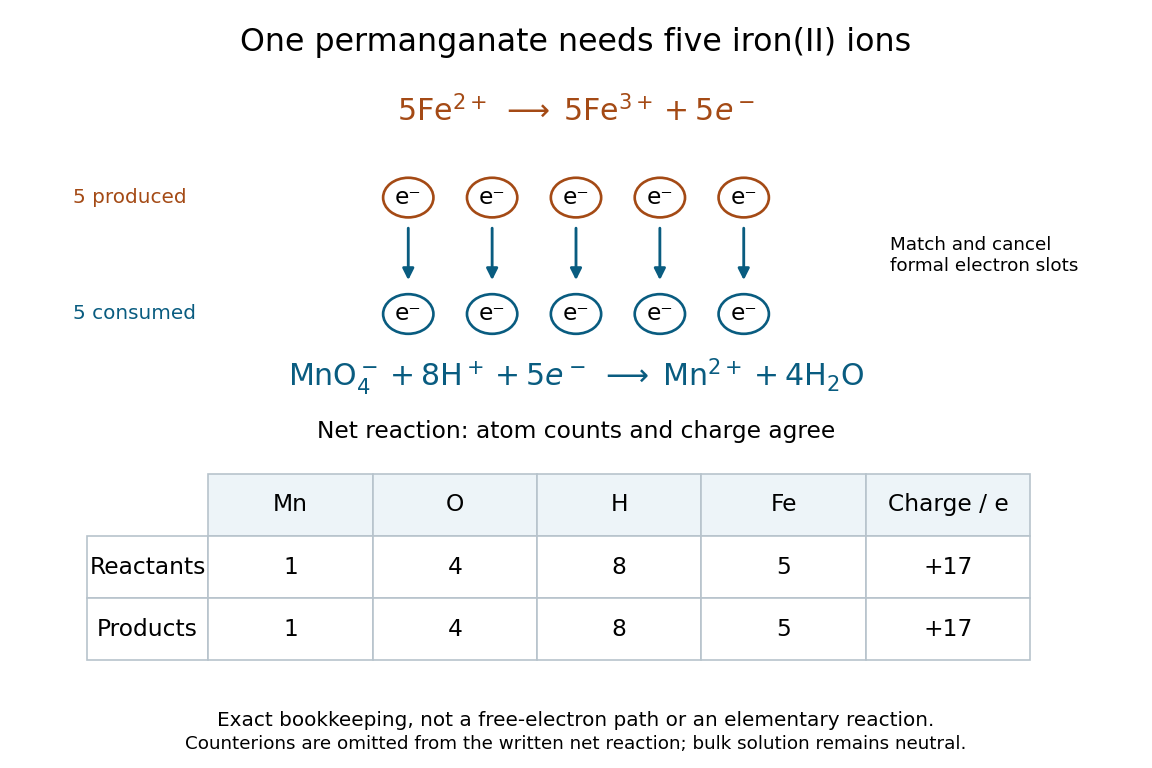
Acidic permanganate-iron balance: five exchanged Electrons and conserved chemical atom and electric charge inventories
. Original exact stoichiometry diagram. Matching five formal Electron slots is a bookkeeping operation, not a picture of free Electrons in the chemical solution. The lower table verifies the net chemical equation; its is the net electric charge number of the written reacting species, not the bulk chemical solution. Details.
The coefficients predict amounts consumed, not a collision of five ions or an elementary reaction. Bulk chemical solution also contains compensating counterions, which are omitted from this net chemical equation. The hydrogen and oxygen oxidation states are unchanged; balancing their inventories remains essential even though they do not account for the exchanged Electrons.
New to topics? Read the docs here!