BCS quasiparticle spectrum
ID: bcs-quasiparticle-spectrum

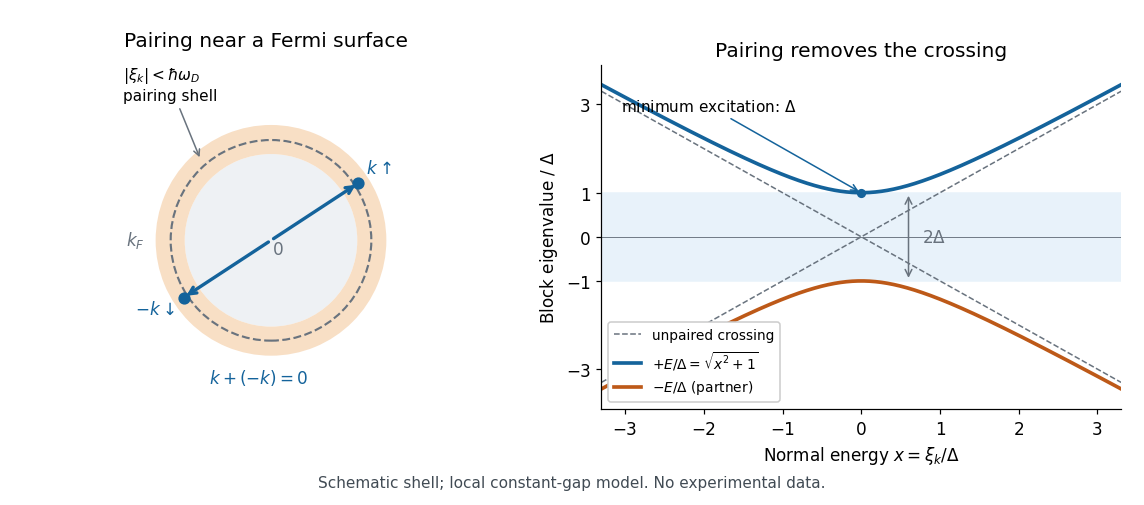
The BCS quasiparticle spectrum is the positive excitation energy obtained by diagonalizing the paired particle-hole block. Here the weak coupling shell model has : the minimum lies inside the pairing shell, and states outside it cost more. To derive it for a uniform isotropic real , measure the normal-state energy from the chemical potential, , and use the same sign convention as the BCS coherence factors:Its eigenvalues are , where . The positive is the cost of creating a quasiparticle above the BCS ground state. The lower branch is its particle-hole partner in this doubled matrix description, not an excitation that lowers the ground state energy without bound.
The location and value of the minimum follow directly:The unique minimum as a function of is , at the normal-state Fermi surface. On an isotropic three-dimensional Fermi surface it occurs for every direction of , rather than at a unique point of momentum space. Near that minimum,Farther away, when . For the illustrative example, a state at costs rather than the minimum .

New to topics? Read the docs here!