
No cyclic heat engine exchanging heat only with two fixed thermal reservoirs at positive absolute temperatures can exceed the thermal efficiency of an engine whose cycle is a reversible thermodynamic process between them. All such reversible engines have the same thermal efficiency, regardless of their working substance. Let be heat absorbed from the hot thermal reservoir and the magnitude rejected to the cold one. ThenThe work convention is the one in the first law of thermodynamics: is net output by the engine. Use absolute thermodynamic temperatures, such as values in kelvin; ratios of readings in degree Celsius are invalid because their zero is shifted.
For , and , the maximum thermal efficiency is . A reversible engine delivers and rejects . The thermal reservoirs have entropy changes and , which cancel. The engine's own entropy change is zero over its thermodynamic cycle.
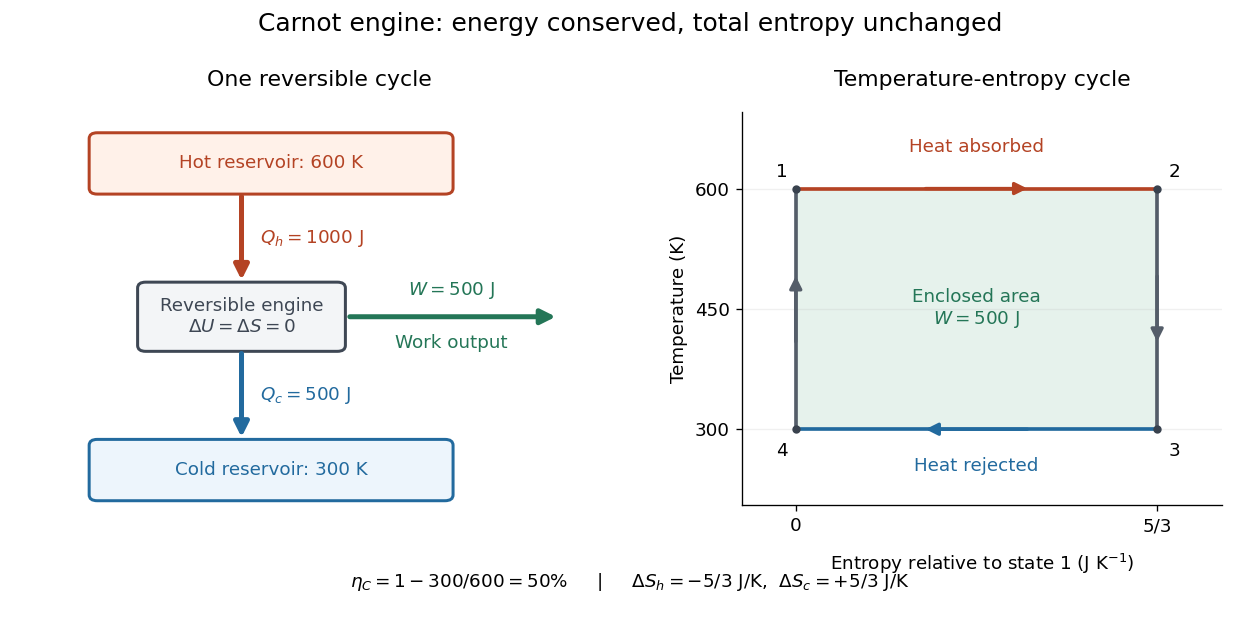

A short derivation now becomes transparent: the Second law of thermodynamics gives , and the first law of thermodynamics gives . Together they yield the bound and, more precisely,At fixed , every extra unit of total entropy production reduces output by units of energy. [ref]
Fixed thermal reservoirs are essential. Finite bodies cool and warm, so their initial temperature ratio cannot be used throughout an entire extraction process. As a computed contrast, the bodies with equal constant heat capacity in the entropy example would reach if a reversible engine extracted work until their temperatures matched. Zero total entropy change gives this geometric mean; the first law of thermodynamics then gives . Direct contact reaches and extracts no work.
Carnot's 1824 book asked whether the useful output of machines driven by heat was fundamentally limited and whether changing the working substance could improve that limit. Its reversible comparisons are the historical setting of Carnot's theorem. Carnot used the then-current caloric picture, treating heat as conserved in its passage through an engine; the modern balance should not be read back into that text.[ref]
New to topics? Read the docs here!