A heat engine uses a repeating thermodynamic cycle to turn part of an incoming heat transfer into net outgoing work. In the two-thermal reservoir model, the hot thermal reservoir supplies heat at fixed temperature , and the cold thermal reservoir receives heat of magnitude at fixed temperature . A Stirling engine makes the repeated motion visible; the abstract energy budget applies independently of its particular mechanism.[ref]
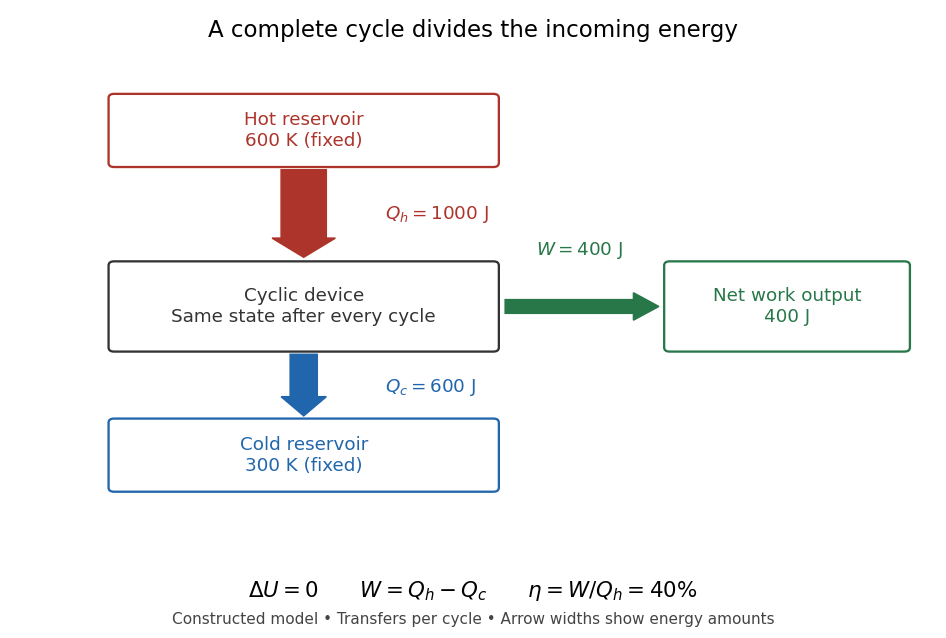
3.2 Generalized Representation of Thermodynamic Cycles. §3.2, Figure 3.3: two reservoirs and net work output
Choose the entire cyclic device as a closed system, with no net change in bulk kinetic energy or potential energy. Count heat entering as positive and net work delivered as positive, as in the first law of thermodynamics. Thus enters with a plus sign and , although a positive magnitude, enters with a minus sign. Assume these two heat transfers and the net work are the only transfers across the boundary. Over one complete thermodynamic cycle, all stored energy, including internal energy , returns to its starting value:The device does not accumulate heat from cycle to cycle. More precisely, heat is a transfer, while internal energy is what can be stored; even a component that temporarily stores internal energy must return to its initial state for this boundary to be cyclic.[ref]
For engine operation, and . Its thermal efficiency isUse net work, after subtracting any work supplied during compression or required by auxiliaries included in the chosen device. For periodic operation, average power satisfies and , with the rates averaged over complete thermodynamic cycles.[ref]
For a stipulated model at and , let and per thermodynamic cycle. Then and . At two thermodynamic cycles per second, these become incoming heat transfer, outgoing heat transfer, and net power. These are constructed values, not measurements.
Different signs describe different tasks. With the same directions of heat transfer, gives : a device transmitting heat without net work output. If , net work is supplied to that device. A refrigerator or heat pump instead extracts heat from the cold side and delivers heat to the hot side, using positive input work and the balance . Their useful output is heat transfer, measured by a coefficient of performance. Finally, a one-time isothermal expansion can have and while leaving the volume changed: it is not a complete thermodynamic cycle. A warming device also fails the cyclic assumption, and a fuel-consuming device requires an accounting of matter crossing its boundary.
For two fixed thermal reservoirs at positive thermodynamic temperatures, the Second law of thermodynamics strengthens the energy balance toEquality requires the overall operation to be a reversible thermodynamic process, including its heat transfer to the thermal reservoirs. The Carnot cycle explains how the reversible benchmark is constructed, and Carnot's theorem explains its universality and the entropy production penalty. Use kelvin values, never ratios of degree Celsius readings. The example above lies below the bound: its total entropy production is per thermodynamic cycle.
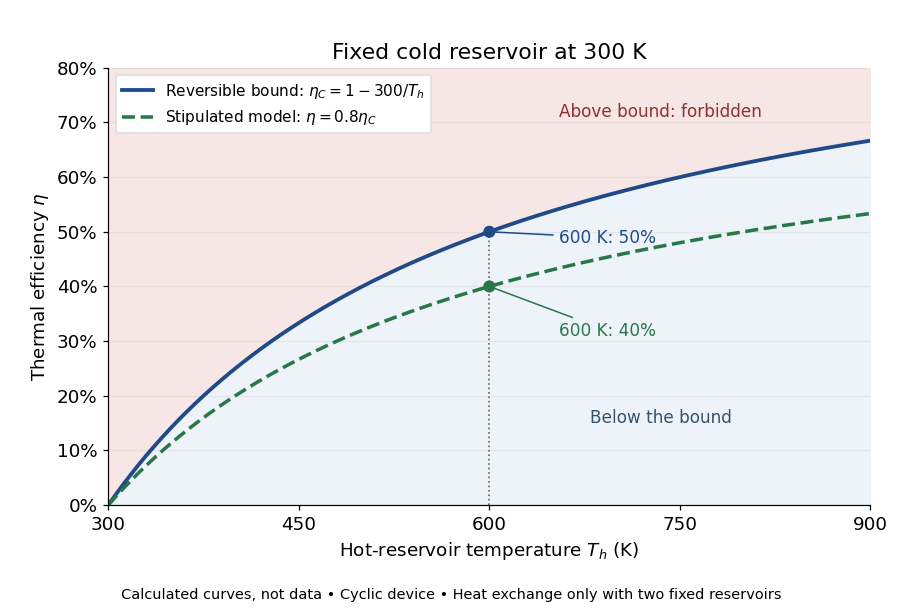
This is useful before building a machine: warmer cooling surroundings reduce the possible thermal efficiency, even if the mechanism is unchanged. A small observed thermal efficiency does not by itself test the Second law of thermodynamics; heat leaks, friction, incomplete recovery of work, and the measurement boundary can all reduce the reported ratio. A meaningful comparison requires the actual thermal reservoir temperatures, matched heat and net work measurements, and the hypotheses of Carnot's theorem. Finite bodies whose temperatures change are treated separately there.
The practical question already appears in the 1824 Réflexions sur la puissance motrice du feu et sur les machines propres à développer cette puissance by Sadi Carnot: pp. 6–8 ask whether machines driven by heat have a fundamental limit and whether changing the working substance can improve their output. Pages 9–11 describe heating and cooling in real machines, but use the historical caloric theory, rather than the modern first law of thermodynamics balance. The historical discussion under Carnot's theorem explains that distinction.
A vapour-power cycle using a liquid pump, high-pressure heat addition, turbine expansion and low-pressure condensation. Ideal components are reversible apart from heat transfer through finite temperature differences. With states numbered pump inlet, pump outlet, turbine inlet and turbine outlet, the net thermal efficiency is . Liquid pumping avoids the impractical compression of a wet two-phase mixture in a steam realization of the Carnot cycle. Named after William John Macquorn Rankine.
Consider an ideal-gas cycle with constant heat-capacity ratio : expand isobarically from to , cool isochorically, then compress reversibly and adiabatically to the initial state. With , closure gives and . The heat input is and the rejected heat magnitude is . Thus . Reservoir temperatures determine feasibility and entropy generation but need not coincide with the gas temperatures at heat-exchange endpoints.
The heat input to a cycle sums positive transfers of heat into its working substance. It is not the net heat over the entire cycle, which equals net work. A single geometric branch can contain both heat absorption and rejection, so grouping the branch into one net transfer can overestimate a heat engine's thermal efficiency.
An ideal cyclic heat engine producing no entropy overall. Between two equilibrium reservoirs its efficiency reaches the Carnot bound; finite reservoir temperatures can be treated as varying through successive reversible cycles.
A Stirling engine repeatedly heats and cools a confined gas, whose expansion and compression drive a moving mechanical load. This makes it a particularly accessible example of a heat engine: both the repeating motion and the two regions exchanging heat can be observed.
In the published Demonstration experiments with a Stirling engine by Christopher G Deacon and others, an electrical heater warms one end of a cylinder and flowing water cools the other at . A moving displacer shuttles gas through copper wool that temporarily stores and returns internal energy. A laser spot traces a closed pressure-volume path on a screen: mechanical motion controls one coordinate, pressure the other. Calibrating both scales converts the enclosed area to work per thermodynamic cycle; multiplying by rotation frequency gives gas-cycle power. At heater input, the paper reports gas-cycle power, while a separate Prony brake measures shaft output. The cold-side temperature is controlled and two higher heater settings are compared. The gas has a nonuniform temperature, and heater energy also escapes to the room: neither output/input ratio measures for an ideal two-thermal reservoir engine. These observations demonstrate work production and losses, not a direct measurement of the bound in Carnot's theorem. The inspected apparatus, readouts and results are on pp. 180–182, Figures 1–3 and Table 1.
For an ideal working gas and , two isotherms at produce net work . Without a regenerator, isochoric heating requires additional external heat , giving the displayed thermal efficiency, strictly below Carnot efficiency. A perfect reversible regenerator recovers this heat and attains the bound instead. Reversing the unregenerated cycle gives cooling coefficient of performance ; positive cooling requires a sufficiently large expansion ratio.
A Prony brake measures shaft power using a resisting band: its force difference gives torque , and rotation gives , where is angular velocity. The Stirling engine experiment above uses this independent load measurement to distinguish shaft output from gas-cycle work.
Heat-engine calorimetry measures heat transfers so that observed work can be compared with the correct energy input. Measuring motion alone cannot supply the denominator of thermal efficiency.
The institutional Laboratory 16: Stirling Engine describes a modern teaching arrangement: an ethanol lamp drives a Stirling engine coupled to an electrical output device, which supplies a resistor immersed in water in a calorimeter. The prescribed readouts include fuel mass consumed, the pressure-volume loop, electrical readings, and water temperature. The sequence separates fuel input, gas-cycle work, electrical output, and Joule heating of the water. Warming of the water is the final useful output; it is not the engine's rejected . The handout distinguishes warm-up from steady operation and asks students to compare the final warming with direct heating by the lamp. It gives a procedure, not a table of measured efficiencies. Its pp. 1–3 therefore establish an apparatus and measurement design without supplying a new experimental result.
For a proposed calibration, use a known input of electrical work to determine the effective heat capacity of the water, vessel and immersed parts; stir to make the measured temperature representative. A matched run with no input estimates exchange with the room. For constant and no phase transition, the resulting model iswhere is the signed net heat lost to the room during the measurement. Here is supplied electrical work when the resistor lies inside the calibration boundary; for a separate external heat input it is the received heat. These are proposed controls, not controls reported in that handout. Slow cooling, changing material properties and imperfectly matched room exchange limit this inference; the approach to thermal equilibrium and heat capacity matter as much as the thermometer reading.
To measure the actual engine-input , one must instrument its hot-side transfer separately, or close a calibrated energy balance around a specified heater boundary. A heater's electrical work includes changes in its stored internal energy and heat transfer that bypasses the engine. At periodic operation a cold-side flowing-water measurement can instead estimate , if mass flow rate and specific heat capacity at constant pressure are known, with negligible storage and other heat exchange in that measurement boundary. It measures only the rejection captured by that stream. Include all remaining transfers before using the residual to infer . This measurement discipline makes a comparison with Carnot's theorem meaningful.
Articles by others on the same topic



A heat engine is a device that converts thermal energy (heat) into mechanical work by utilizing the temperature difference between a hot source and a cold sink. The fundamental concept of a heat engine is based on the principles of thermodynamics, particularly the laws governing energy transfer and conversion. ### Key Components of a Heat Engine 1. **Heat Source**: The area or medium providing thermal energy (e.g., combustion of fuel, nuclear reaction).