Change of variables formula
ID: change-of-variables-formula

The change of variables formula expresses an integral in coordinates that make its integrand or its region simpler. Three ingredients change together: the region, the function being integrated, and the element of area or volume. The last change is measured by the absolute Jacobian determinant; forgetting it amounts to counting transformed cells as though their sizes had stayed the same.
In one dimension, substitution is the integrated chain rule. If is continuously differentiable on and is continuous on its image, thenThese are directed definite integrals: if decreases, the transformed endpoints reverse. This identity does not require to be injective, because an antiderivative composed with already accounts for any backtracking.[ref]
For a concrete computation, set , so . The endpoints become :The numerator is precisely the derivative of the expression in the denominator. Substitution reveals the familiar natural logarithm hidden inside this rational function. Keeping the original endpoints after changing the integrand would describe a different integral.
For the elementary two-dimensional theorem, let be a diffeomorphism between open sets in the plane, let be a bounded region with piecewise smooth boundary, and let be continuous on , with the displayed integrals finite. ThenHere is the Jacobian matrix. The diffeomorphism assumption means a bijection with a continuously differentiable inverse, and ensures a nonzero Jacobian determinant. This excludes overlapping sheets; the more general area formula handles multiplicity.[ref]
Take and the linear mapIts inverse is . The square becomes a parallelogram with vertices : base two, height one, area two. Consequently . A nonconstant integrand changes too: .
The direction of the map matters when selecting the factor. Here goes from the new coordinates to the original coordinates, so the factor is two. Its inverse has Jacobian determinant , appropriate for converting area in the opposite direction. Writing down the map before computing its Jacobian matrix prevents a reciprocal-factor error.
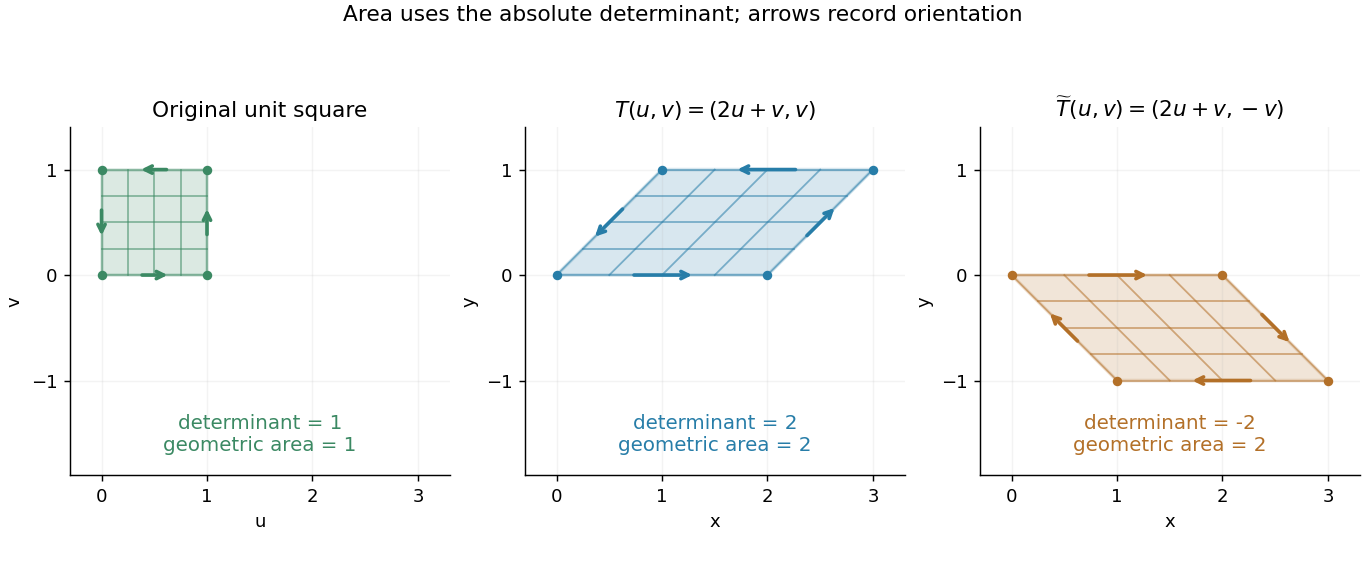
A unit square becomes a parallelogram of area two; reflection changes the determinant sign but preserves area
. Details. 
Now reflect the image vertically: has Jacobian determinant , but still produces area two. The sign records reversal of the orientation of a vector space; ordinary area uses its absolute value. For oriented differential forms, the pullback of a differential form instead retains the signed determinant.[ref]
https://math.mit.edu/classes/18.952/spring2013/docs/book.pdf. MIT 18.952 notes: Integration of forms, Chapter 3
The geometric beauty is that a nonlinear differentiable map has a local linear approximation: tiny rectangles behave approximately like these parallelograms. Summing their scaled contributions gives the change of variables formula. In polar coordinates this factor is , explaining ; equal angular steps cover more area farther from the origin. Choosing suitable coordinates can simplify both the boundary and the integrand.[ref]
New to topics? Read the docs here!