
A chemical formula uses symbols of chemical elements and numerical subscripts to record composition. In the molecular formula of water, the subscript counts two hydrogen chemical atoms, and the omitted subscript after means one oxygen chemical atom. A molecular formula describes one molecule; a chemical formula need not describe a discrete molecule.
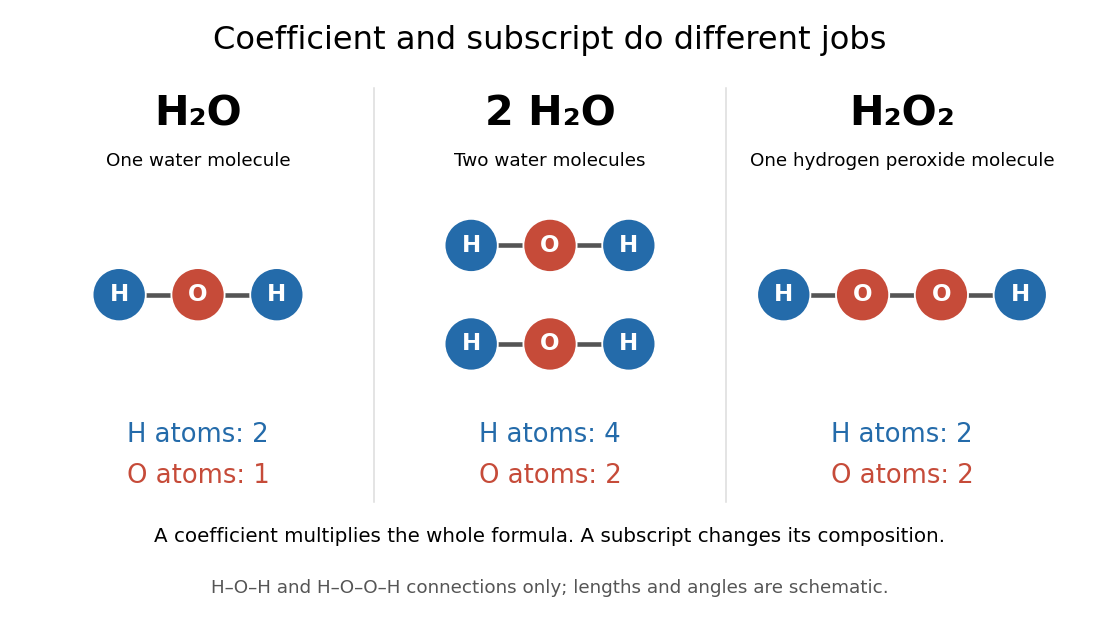
Read a preceding coefficient separately from the subscripts. One contains two hydrogen and one oxygen chemical atom; contains four hydrogen and two oxygen chemical atoms distributed between two water molecules. In , the second subscript instead puts two oxygen chemical atoms into each hydrogen peroxide molecule. Thus : the coefficient scales the whole chemical formula, while a subscript specifies its composition. See Flowers et al., Chemistry 2e, §2.4: chemical formulas.

For crystalline , the chemical formula specifies a ratio of sodium ions to chlorine ions . Its formula unit is the accounting entity; the ordinary crystal is an extended arrangement of ions, rather than a collection of discrete molecules. Specifying the entity matters when assigning an amount of substance. See formula unit and 2.6 Ionic and Molecular Compounds (§2.6: ionic and molecular compounds).
A molecular formula gives an atom inventory, not the full arrangement of chemical bonds or the molecular geometry. For example, counts six carbon, twelve hydrogen, and six oxygen chemical atoms in a glucose molecule, but does not specify the pattern shown by its Fischer projection. Different structures can share a molecular formula. This compact inventory is useful for chemical equation accounting precisely because it leaves the structural detail to other representations.
The choice of letters has an early explanation in Jöns Jacob Berzelius, Essay on the Cause of Chemical Proportions (1813–1814), §III, transcribed by Carmen Giunta: letters made chemical signs easier to write and print, and formulas compressed information about composition. His numerical notation differed from modern subscripts; the lasting idea was to make proportions readable in ordinary text.
New to topics? Read the docs here!