Cholesky decomposition as a sum of squares
ID: cholesky-decomposition-as-a-sum-of-squares

For any real vector , a Cholesky decomposition gives the quadratic form identitySince is an invertible matrix, this squared Euclidean norm is positive whenever . The factorization thus certifies positive definiteness and gives coordinates in which the quadratic form is a sum of ordinary squares. For the matrix above,The level set is an ellipse; the linear map sends it to the unit circle. The points and go to and , respectively.
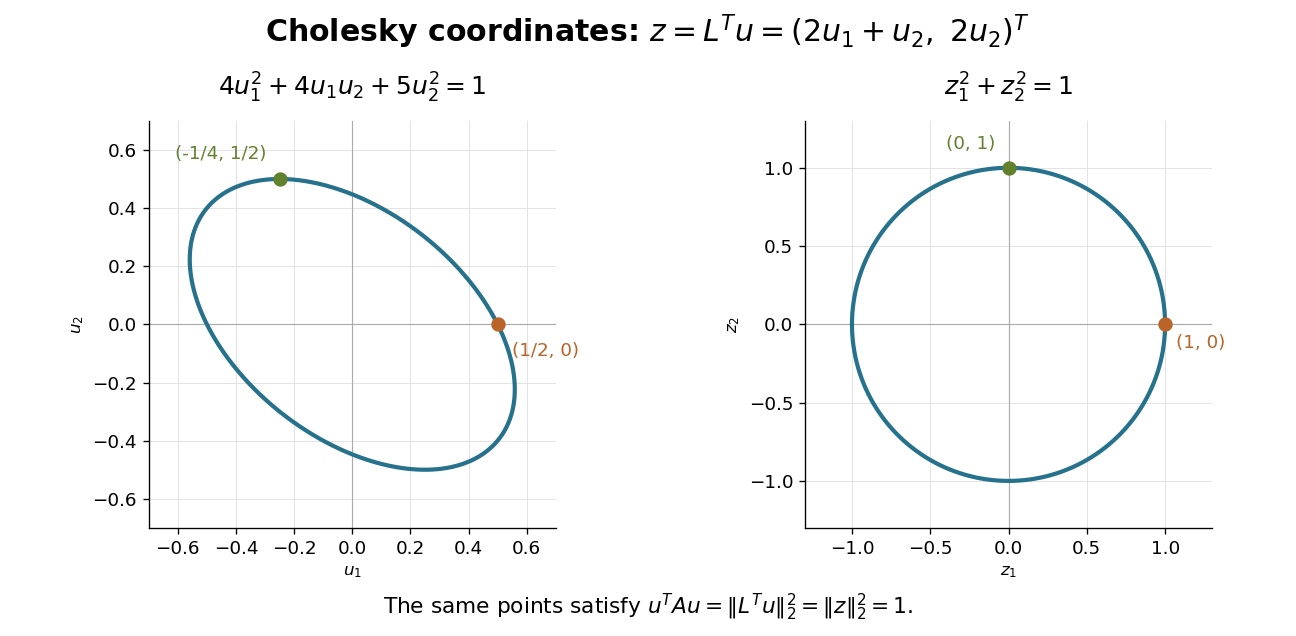

The same factor works in the reverse direction for Gaussian random vectors. If has independent unit-variance, zero-mean Gaussian random variables as coordinates, has covariance matrix . In this example and : their variances are and , while their covariance is . This is a concrete way to generate specified correlations from independent draws.
A triangular factor is not generally a square root of a matrix in the sense . Here . The Cholesky decomposition uses the product with the transpose, which is also what makes the quadratic form a squared Euclidean norm.
New to topics? Read the docs here!