Consecutive first-order reaction mechanism
ID: consecutive-first-order-reaction-mechanism

A consecutive first-order reaction mechanism passes material through a reaction intermediate. Consider a stipulated chemical reaction network , with constant positive rate constants, fixed temperature and volume, uniform mixing, and no reverse or competing chemical reactions. All three labels carry one conserved unit of material. Set and . The law of mass action givesAdding the three rate equations proves . Each step has a first-order reaction rate law; this does not make all three concentrations simple exponential decays.
For , the exact solution isTo derive the middle expression, substitute the first into the first-order linear differential equation for I and multiply by the integrating factor . Then , which can be integrated directly with the stated initial condition. The material balance supplies P without another integration.
The apparent division by zero at equal rate constants is removable. For , the same integrating factor givesThis is also the limit of the unequal-rate constant expression. Initially , so reaction product formation begins with zero slope despite immediate reactant loss. By contrast, a direct first-order reaction with the same has and nonzero initial slope. Their A traces agree exactly; their P traces do not.
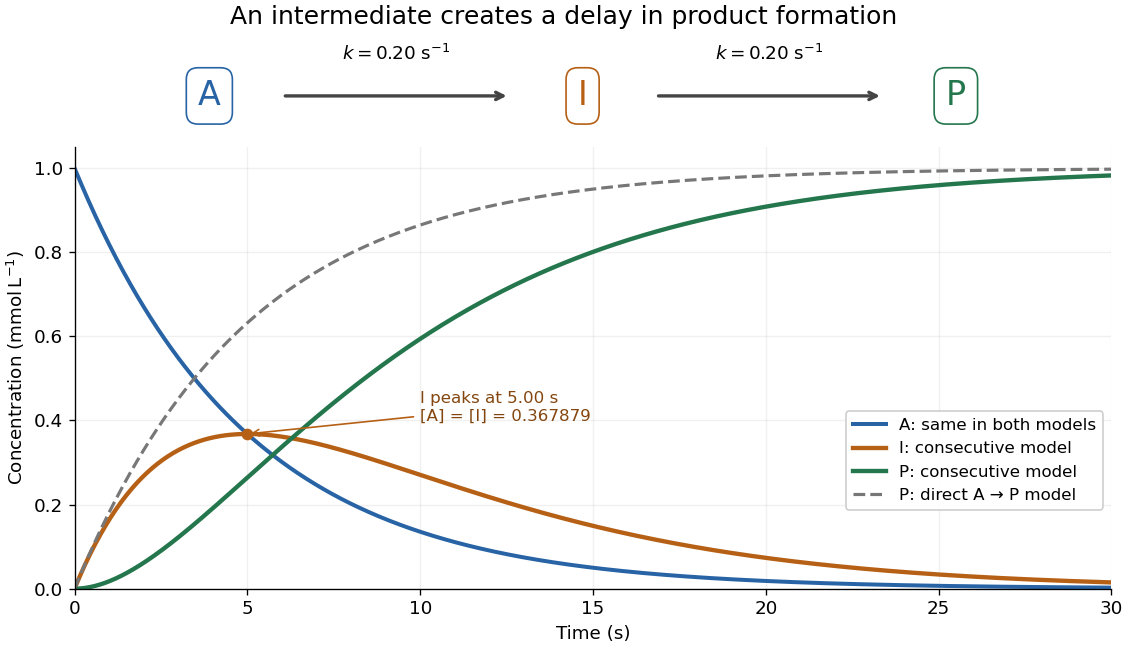
An accumulating reaction intermediate delays reaction product formation in a consecutive first-order reaction mechanism
. Original chosen model with and . Solid curves follow the exact three-species rate equations; the dashed P curve is a separate direct A-to-P model with the same A trace. These are model predictions, not measurements or an identified molecular reaction mechanism. Details.
For the chosen equal-rate constant example, I peaks at , because . At that time and ; the direct model would already have . The peak means formation and consumption of I are momentarily equal, not that the whole system has reached chemical equilibrium.
More generally the peak is at , which is positive for either ordering of the two positive rate constants and tends to as they coincide. When , a brief initial adjustment can be followed by and approximately equal formation and consumption reaction rates. The exact solution states when this small-intermediate approximation can be reasonable. It is inappropriate for the illustrated equal-rate constant case: at the peak, over one third of the conserved material is I. Such timing matters if the goal is to collect a useful reaction intermediate before it becomes the final reaction product.
New to topics? Read the docs here!