
Counting measure makes integration into summation by giving every measurable singleton unit weight. On any measurable space , it is the measure defined byThus , a finite set has its usual cardinality, and every infinite set has the same value in the extended real number line. In particular, countably infinite sets and uncountable sets are not distinguished by their counting measure. Taking to be the power set makes every subset measurable; restricting the same rule to a smaller sigma-algebra is also allowed. [ref]
https://www.math.ucdavis.edu/~hunter/measure_theory/measure_notes_ch1.pdf. John K. Hunter, Measure Theory, Example 1.11: counting measure
Why is this a countably additive measure? For pairwise disjoint measurable sets ,If the union is finite, only finitely many are nonempty, and finite cardinality adds. If the union is infinite, either one is infinite or infinitely many are nonempty; in both cases the nonnegative series on the right is infinite. For example, and have counting measures and , and their union has counting measure . The singletons for positive natural numbers give the infinite case: .
With the power set as sigma-algebra, counting measure is a finite measure exactly when is finite, and a sigma-finite measure exactly when is at most countable. For the latter assertion, enumerate by measurable singletons; conversely, every finite-measure set is finite, and a countable union of finite sets is countable. Specifying the sigma-algebra matters: if and , counting measure is not a sigma-finite measure, since the only measurable finite-measure set is the empty set.
For a finite or countably infinite set equipped with its power set, every nonnegative function is a measurable function, andThe supremum allows an infinite result and avoids choosing an order for the terms. On a finite set, expand as a simple function using singleton indicator functions. On a countably infinite set, enumerate the points and apply the monotone convergence theorem to finite truncations. Real or complex functions are integrable functions for counting measure exactly when ; then their integral equals the absolutely convergent sum. This is the discrete counterpart of Lebesgue integration, developed further in series as a Lebesgue integral against counting measure. [ref]
https://www.math.ucdavis.edu/~hunter/measure_theory/measure_notes_ch4.pdf. John K. Hunter, Measure Theory, Example 4.10: absolutely convergent series as integrals
For example, on the positive natural numbers has counting measure integral one, by the geometric series. The alternating harmonic series has a finite ordered sum but is not the integral of an integrable function for counting measure: its positive and negative parts both have infinite sums. Absolute convergence is what makes the finite integral independent of enumeration. In particular, the Lp spaces for counting measure on are the l-p sequence spaces, with their sums replacing continuous integrals.
Compare three measures on the same Borel sigma-algebra of the real numbers: counting measure , Dirac measure , and Lebesgue measure .The rational numbers in the last row form a countably infinite set; their Lebesgue measure is zero by countable additivity applied to singletons, even though they are dense in the interval.
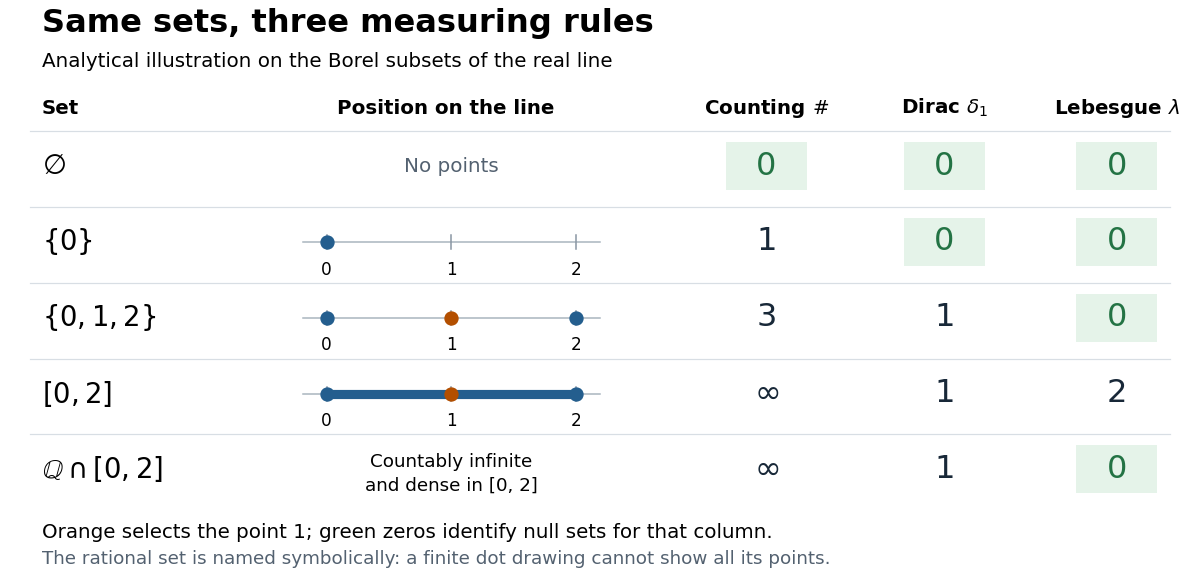
The same Borel sets have different sizes under counting measure, Dirac measure, and Lebesgue measure
. Original analytical comparison on the real numbers, with the selected point marked in orange. Drawings show the finite sets and the interval; the rational numbers are named symbolically because finitely many plotted points cannot depict that infinite dense set. Green zero entries mark the null sets for each column's measure. Details.
These are different answers to different questions: counting measure asks how many points occur, Dirac measure asks whether the selected point occurs, and Lebesgue measure asks how much length occurs. A null set therefore depends on its measure. For counting measure, the only null set is the empty set, so equality almost everywhere is equality everywhere. For , a measurable set is a null set exactly when it misses ; for Lebesgue measure, even the infinite set is a null set. Integrating an indicator function recovers each table entry through . This lets the same Lebesgue integral framework handle point counts, point evaluation, and geometric length.
New to topics? Read the docs here!