Data processing inequality
ID: data-processing-inequality

For finite discrete random variables, suppose is a Markov chain: the final channel uses only , so and have conditional independence given . In terms of the joint probability mass function,and hence . Then the two data processing inequalities areAll mutual informations here use base-two logarithms. Thus deterministic or randomized processing cannot increase the information shared with an unprocessed variable.[ref]
https://web.stanford.edu/class/cs229t/scribe_notes/12_05_final.pdf. Stanford CS229T/STATS231, Theorem 2.1 and its chain-rule proof
For a concrete cascade, take a fair bit and Bernoulli random variables with probabilities , of being one. Assume are jointly independent random variables, and pass through two binary symmetric channels:The second noise is independent of both and , so this is a Markov chain. Both and are fair bits. The net exclusive or error is one exactly when one noise flips the bit and the other does not:Using the binary entropy , the three mutual informations are fully determined:All numbers are in bits. The two losses are and . Thus the cascade retains less information about the original source than either individual channel shares between its own input and output.
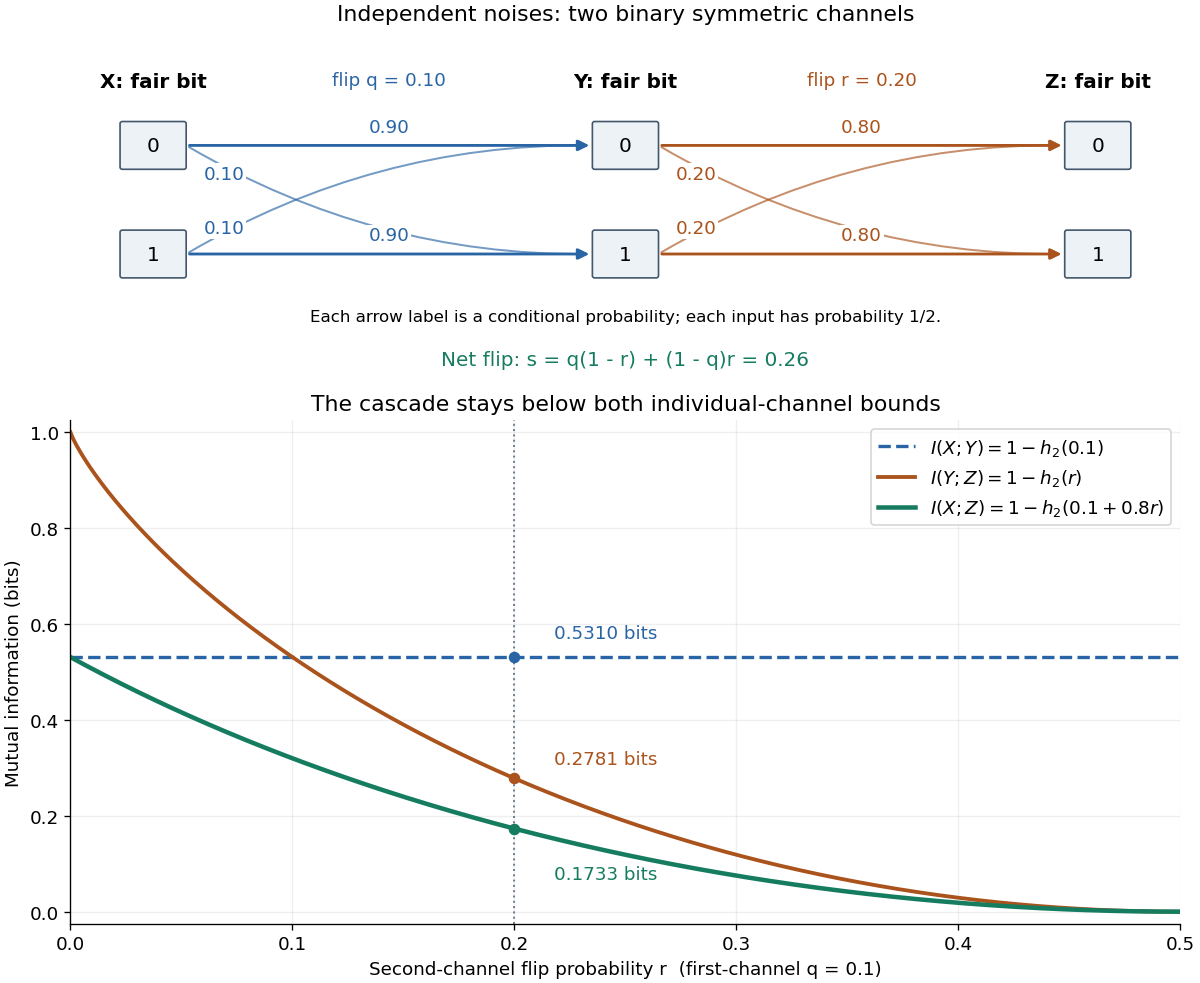

With fixed and , the effective error is . At , and ; at , is independent of the previous variables and . The diagram plots these endpoints and the computed example.
The data processing inequality is useful for testing what a proposed decoder or data summary could possibly reveal: if its only input is , even randomized processing cannot provide more mutual information about than already contains. The Markov chain hypothesis matters. In the exclusive or example from conditional mutual information, allowing a processor to use both and reveals exactly; that processor has additional input, so the conclusion for processing alone does not apply.
The chain rule for mutual information proves both inequalities and identifies their exact gaps. First expand the information about in the two observation orders:Therefore . Next use as the variable being learned:Symmetry of mutual information gives . Both signs follow from the nonnegativity of conditional mutual information; the first gap also gives equality in data processing inequality.
New to topics? Read the docs here!