For finite discrete random variables, conditional mutual information measures the average reduction in uncertainty about from observing , when is already known. With base-two logarithms, it is measured in bits:The second expression follows from the chain rule for conditional entropy and makes the symmetry in visible. Equivalently, compute the mutual information separately in each conditional probability distribution and then average:Here is the Kullback-Leibler divergence, also computed with base-two logarithms; zero-probability terms contribute zero. The Gibbs inequality gives , with equality exactly when and have conditional independence given : the conditional joint probability mass function factors for every of positive probability.[ref]
For a fully computed example, take independent random variables that are fair bits, and let , where is exclusive or. The complete joint probability distribution has only these four positive entries:
Table 1. .
Every pair has probability , so . But . Given , the pairs each have conditional probability , while both conditional marginals are fair. ThusGiven , the pairs give the same calculation. ThereforeThe conditional entropy calculation tells the same story: because either value of leaves fair, whereas because . Learning the exclusive or does not reveal either bit alone; it reveals whether they agree, so learning one then determines the other.
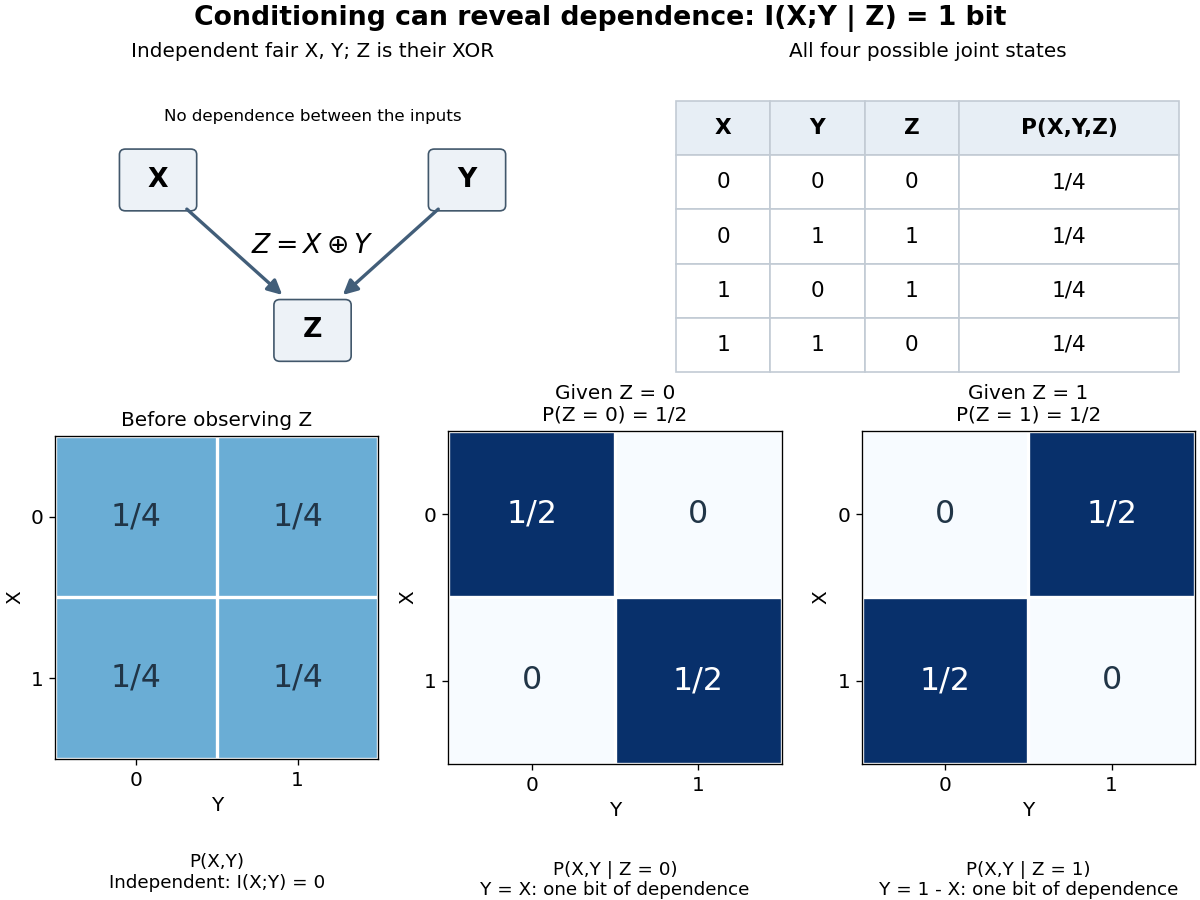
This example distinguishes conditional independence from ordinary independence. It also disproves the claim that conditioning always reduces mutual information, despite conditioning reduces entropy. There is no general ordering between and : the example above increases it from zero to one, while taking and for a fair bit decreases it from one to zero. The chain rule for mutual information explains why both are possible.[ref]
Conditional mutual information is useful for asking whether an additional observation tells us anything after information already available has been accounted for. Its zero case expresses conditional independence exactly; in a Markov chain, this is the step that turns the chain rule for mutual information into the data processing inequality.
Articles by others on the same topic


Conditional mutual information (CMI) is a measure from information theory that quantifies the amount of information that two random variables share, given the knowledge of a third variable. It extends the concept of mutual information by introducing a conditioning variable, allowing us to understand relationships between variables while controlling for the influence of the third variable.