Dialysis (biochemistry)
ID: dialysis-biochemistry

Dialysis exchanges small solutes between a sample and an external bath through a semipermeable membrane, while retaining suitably large macromolecules, such as proteins. The transport is passive diffusion: random motion carries permeant molecules both ways, with net transport down their concentration gradient. The bath is the dialysate. At equal permeant solute concentrations, microscopic exchange continues but net exchange stops.[ref]
Dialysis: an overview, Pierce Biotechnology technical note. Dialysis: an overview, Tech Tip 20, p. 1, Dialysis is Diffusion Through a Semi-Permeable Membrane
For example, a protein sample containing excess sodium chloride can lose the small ions to a low-salt dialysate without deliberately transferring the protein. Conversely, components of a new buffer solution can enter from the bath. This is useful before studying enzyme kinetics: changing the surrounding chemical solution can remove an interfering small solute while keeping the enzyme available for the next experiment.
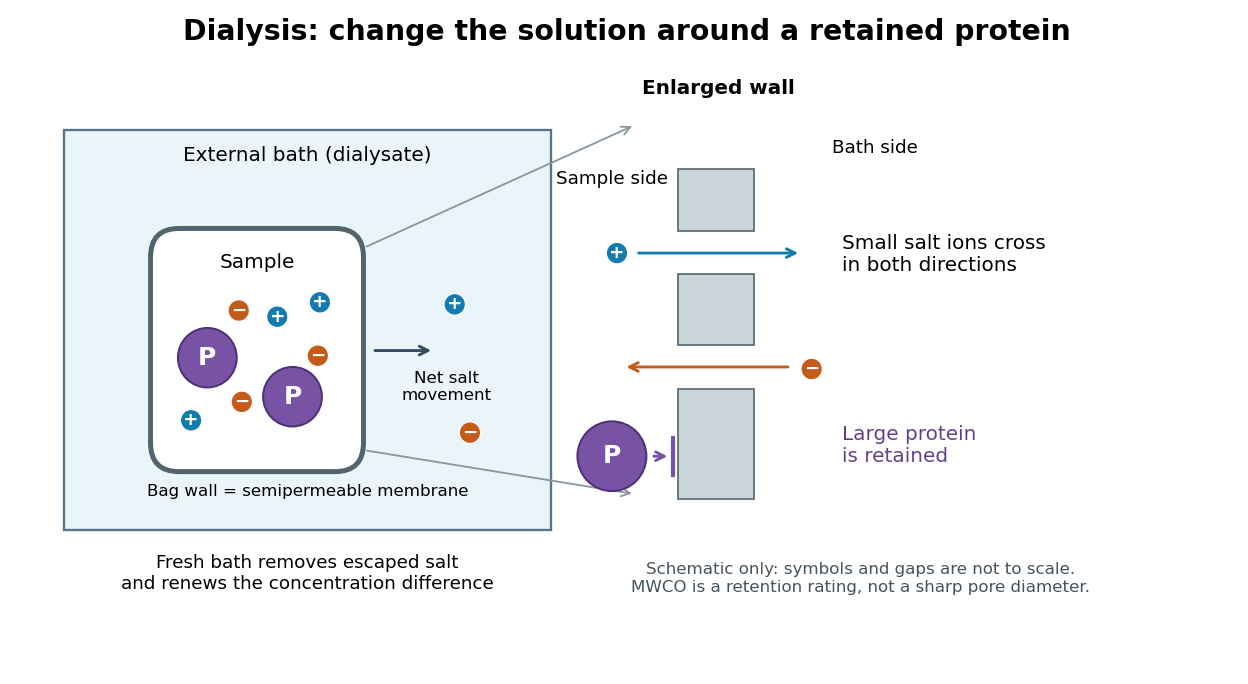

The striking feature is that the retained protein does not have to be captured and released again to change its surroundings. However, retention is conditional on the semipermeable membrane and the particular macromolecule, and dialysis is poorly suited to separating proteins of nearly the same size. The molecular weight cut-off is a nominal retention rating, not a sharp geometrical boundary.
New to topics? Read the docs here!