Electron microscope resolution
ID: electron-microscope-resolution

Electron microscope resolution concerns distinguishable specimen detail under a specified contrast criterion. It depends on diffraction, lens defects, Electron energy spread, specimen motion and detection. A smaller de Broglie wavelength permits finer detail in principle, but neither wavelength nor magnification is the instrument's measured resolution.
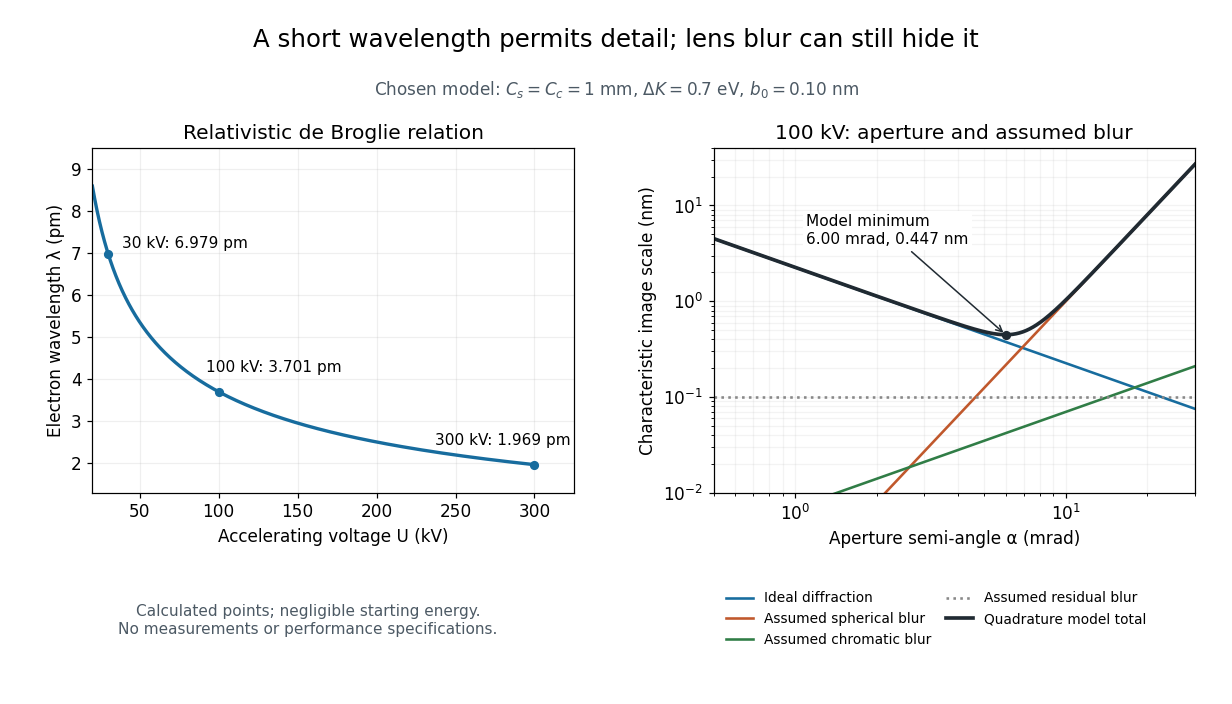
For an Electron accelerated from negligible initial kinetic energy through a positive electric potential difference , combine , the relativistic energy-momentum relation and the de Broglie wavelength:Here is the Planck constant, the Electron mass, the elementary charge, and the speed of light. This includes the relativistic correction omitted by the low-voltage electron accelerating-voltage wavelength approximation. With and SI defining values of , calculated wavelengths are approximately , and at , and respectively. The rounded mass agrees with the recommended value.[ref]
For a circular aperture admitting a small semi-angle , the Rayleigh criterion suggests a diffraction-limited resolution scale . At and , this gives , already much larger than the wavelength. This is an ideal aperture estimate. Transmission electron microscopy with coherent illumination and a particular specimen requires its own image-contrast analysis; this scale alone is not a universal two-feature resolution test.
An original illustrative blur model adds competing effects:Define as a characteristic transverse blur from the electron-lens analogue of spherical aberration, and as one from energy-dependent focusing, the analogue of chromatic aberration. The coefficients have units of length, is a chosen characteristic kinetic energy spread, and is a fixed residual blur. Adding their squares is a declared heuristic, not a measured point spread function or a rigorous resolution theorem. The model omits contrast transfer, specimen scattering and signal statistics, so its minimum is only an estimate within its assumptions.
Choose , and at . At , the four contributions are about , , and , giving . At , the diffraction contribution falls to but the assumed spherical aberration contribution grows to . Thus opening the aperture indefinitely worsens this model's image. All these values are calculations with chosen parameters, not observations of any microscope.

New to topics? Read the docs here!