Let an Electron start with negligible kinetic energy and move through an increase in electric potential. Its electric charge is , where is the elementary charge, so the decrease in potential energy is . In a field-free region after acceleration,This is an Electron formula, not a universal conversion from voltage to wavelength. It assumes negligible initial kinetic energy, negligible losses, and , where is the speed of light. It describes the de Broglie wavelength outside the crystal; the potential energy inside a material can change the local kinetic momentum.
For , take , , and . The rounded Electron mass is consistent with the 2022 recommended constants.[ref]
CODATA Value: electron mass by National Institute of Standards and Technology. CODATA electron mass: numerical value and 2022 adjustment label
The electronvolt is an energy unit: must be converted to joules before combining it with in SI units. Dimensional analysis checks both steps:The resulting velocity is about , or , so the nonrelativistic assumption is consistent. For a larger accelerating voltage, the relativistic energy-momentum relation gives , with , while still holds. At the relativistic wavelength is shorter by about .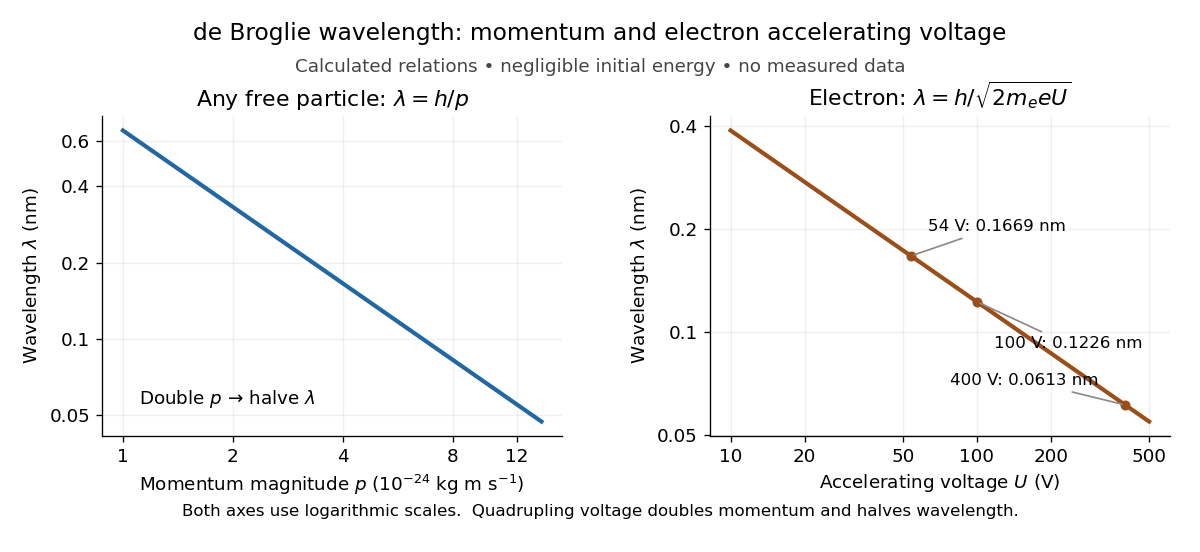

Articles by others on the same topic
There are currently no matching articles.