
Energy flow tracks energy entering an ecosystem, passing through organisms and leaving its boundary. To see its quantitative effect, assume net production at one trophic level is and assume a transfer efficiency at each of two successive steps. Here measures the energy incorporated into new living material per unit area per day, after that level's own cellular respiration; it is not a count of organisms or a standing stock. The joule supplies the energy unit, with .
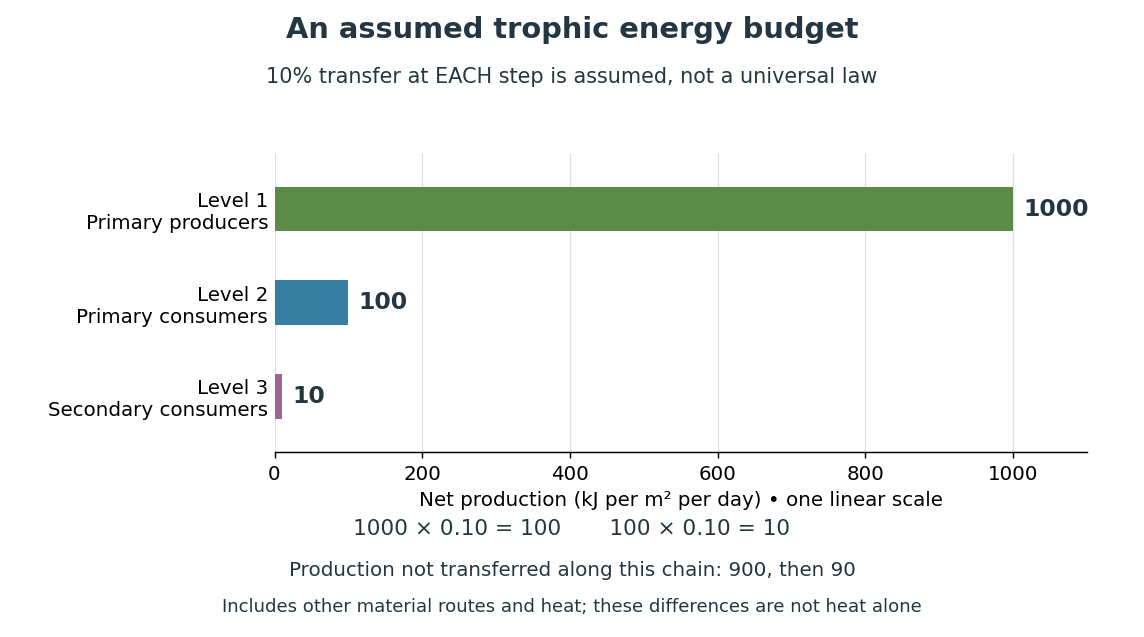

Only , or one percent, of the initial production reaches level 3 in this toy food chain. The first step leaves and the second outside the next level's new production. These differences can include uneaten material, wastes, and energy released as heat during cellular respiration; their separate amounts have not been assigned. Detritus can still carry energy to decomposers. The 10 percent efficiency is an assumption, not a universal law: transfer efficiencies vary with the organisms, food and conditions. The production ratio also differs from the fraction of an individual meal converted into growth. See Clark, Douglas and Choi, Biology 2e, 46.2: production and transfer efficiency.
The shrinking budget explains why supporting another trophic level requires enough production below it. It does not prove an exact maximum length for every food chain, particularly when a food web imports resources or has branching diets. Lindeman's 1942 paper grouped feeding relationships into trophic levels, compared transfers and cellular respiration, and emphasized the ecosystem as a unit connecting living and nonliving components. That viewpoint made different organisms comparable through a common energy budget. See Lindeman, The Trophic-Dynamic Aspect of Ecology (1942).
Material recycling and energy flow describe different bookkeeping. Carbon, nitrogen and phosphorus can be reused through chemical reactions and transfers between organisms and their surroundings. Energy transferred as heat is conserved, but is no longer the same store of chemical energy available to a consumer; photosynthetic primary producers need continuing light input. A decomposer helps recycle material and also releases heat through metabolism. Thus loss from one feeding budget means transfer into other forms or routes, never destruction of energy. See Clark, Douglas and Choi, Biology 2e, 46.3: material cycles. Conservation of energy applies to the whole accounting.
New to topics? Read the docs here!