Cellular respiration transfers energy from chemical fuels into usable forms including ATP. Oxidation of the fuel is coupled to reduction of an electron acceptor; the energy transfer can support ATP synthesis. Plants carry out cellular respiration as well as photosynthesis. Their biological cells need usable energy in darkness too, and a seed can draw on stored fuel during germination.[ref]
Biology 2e by Mary Ann Clark and others. Biology 2e, §7.1, Electrons and Energy and ATP in Living Systems: redox and energy carriers
[ref]Follow three different accounts: carbon moving from fuel to products, electrons moving to an electron acceptor, and energy becoming available for cellular work. They are connected, but an oxygen uptake measurement alone does not identify the fuel or count the ATP made. The pea seed respirometry experiment makes this distinction visible with simple apparatus.
Respiratory carbon loss by organisms using organic matter produced by others. It includes important decomposer fluxes and must be distinguished from autotrophic respiration.
Respiratory carbon loss by primary producers. Subtracting it from gross primary production gives net primary production.
Aerobic respiration uses molecular oxygen as the final electron acceptor. For complete oxidation of glucose, the net material balance isThis records the overall conversion of glucose, molecular oxygen, carbon dioxide and water; it is not one enzyme-catalyzed step, and it omits the separate ATP accounting. For an original stoichiometry check, each side contains six carbon, twelve hydrogen and eighteen oxygen chemical atoms. If exactly of glucose undergoes this complete conversion, the equation requires of molecular oxygen and yields each of carbon dioxide and net water. This is an equation-based calculation, not an observed seed measurement.
The molecular oxygen is reduced to water, rather than being the source of the carbon dioxide's carbon. A formal redox electron balance, using acidic half-reaction notation, makes the roles explicit:Adding and cancelling gives the net equation above. Both half-reactions conserve chemical atoms and electric charge. The electrons balance a net transfer; they are carried through cellular intermediates, rather than released as a pool of free electrons. The final respiratory reduction can be written . These equations are bookkeeping, not a tracing experiment that assigns every product oxygen chemical atom to its original molecule.[ref]
Biology 2e by Mary Ann Clark and others. Biology 2e, §7.4, Electron Transport Chain, Figure 7.12: oxygen reduction to water
Glycolysis converts glucose into two pyruvate molecules, with a net two ATP and reduced NADH; it does not directly consume molecular oxygen. Pyruvate processing and the citric acid cycle, also called the TCA cycle, release carbon dioxide and supply reduced carriers. Thus releasing carbon dioxide and consuming molecular oxygen occur at different stages.[ref]
Biology 2e by Mary Ann Clark and others. Biology 2e, §7.2, Outcomes of Glycolysis; §7.3, Breakdown of Pyruvate and Citric Acid Cycle
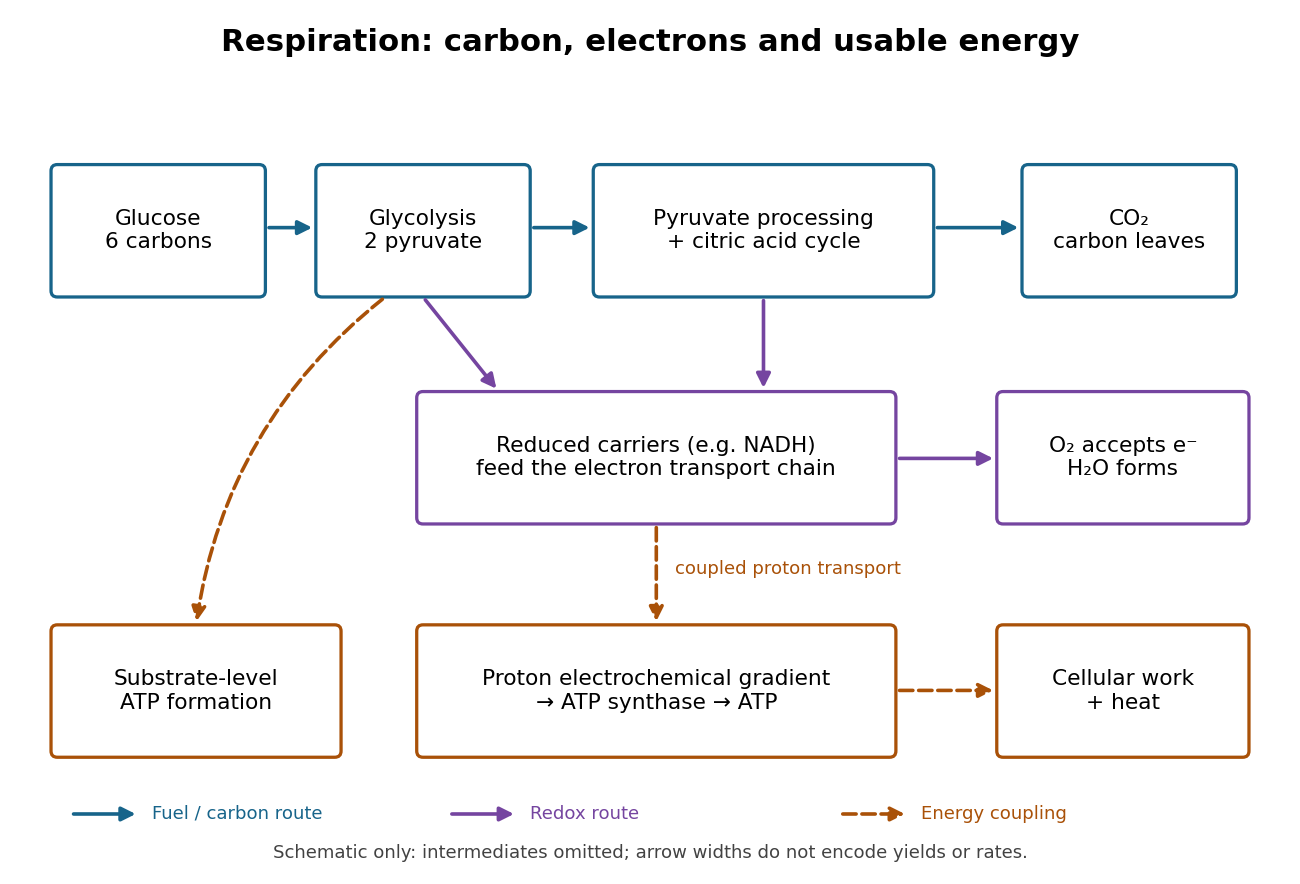
An electron transport chain reoxidizes carriers such as NADH. Coupling some of its redox steps to proton transport establishes an electrochemical gradient; ATP synthase can use that gradient to form ATP from adenosine diphosphate and inorganic phosphate. This is oxidative phosphorylation. A separate route, substrate-level phosphorylation, transfers a phosphate group from a reacting substrate to adenosine diphosphate. In typical eukaryotic biological cells, the respiratory chain occupies the inner membrane of a mitochondrion.[ref]
Biology 2e by Mary Ann Clark and others. Biology 2e, §7.1, Substrate Phosphorylation; §7.4, Electron Transport Chain and Chemiosmosis, Figures 7.12–7.14
The useful achievement is controlled transfer: fuel oxidation can replenish an ATP supply that supports active transport and synthesis. ATP is a reusable chemical carrier, not newly created energy; ATP hydrolysis and the coupled cellular process have their own net free energy balance. Some fuel energy is dissipated as heat.[ref]
Biology 2e by Mary Ann Clark and others. Biology 2e, §7.1, ATP in Living Systems and Energy from ATP; §7.4, ATP Yield
There is no universal yield of or ATP per glucose. Actual ATP recovery depends on carrier transfer routes, coupling and diversion of intermediates to other metabolism. In particular, an oxygen uptake rate cannot be converted into an ATP production rate by assuming one fixed multiplier.[ref]
Biology 2e by Mary Ann Clark and others. Biology 2e, §7.4, ATP Yield: shuttle differences and use of intermediates
Anaerobic respiration uses a respiratory electron transport chain with a final electron acceptor other than molecular oxygen. External acceptors can include sulfate, depending on the organism. “External” distinguishes a supplied terminal acceptor from the fuel-derived organic intermediates used in fermentation; it does not mean that the reduction must take place outside the biological cell. In fermentation, regeneration of carriers such as NADH to their oxidized form permits glycolysis to continue without a respiratory electron transport chain. Both routes can operate without molecular oxygen, but they are different mechanisms.[ref]
Biology 2e by Mary Ann Clark and others. Biology 2e, §7.5, opening distinction, Anaerobic Cellular Respiration and Figure 7.16
A respirometer measures gas changes associated with cellular respiration. In the absorber-based pea seed respirometry apparatus, the changing gas inventory is inferred from a liquid boundary's displacement. A respirometer is therefore a physical measurement coupled to a biological process, not a direct ATP counter.
The ratio of outward carbon dioxide transfer to inward oxygen transfer measured at the mouth. It can differ from the cellular respiratory quotient during transient changes in body gas stores.
The University of Oklahoma K20 Center's handout describes three sealed vial-and-pipette respirometers in each temperature bath: soaked, germinating peas; nongerminating peas plus inert plastic beads; and beads alone. Displaced water establishes equal occupied volumes. Absorbent cotton holds potassium hydroxide, which removes carbon dioxide; nonabsorbent cotton separates it from the peas. The source equilibrates the vials before submersion and again before the initial reading. Colored water makes the boundary visible in each calibrated pipette. Readers then record positions every five minutes for twenty minutes.[ref]
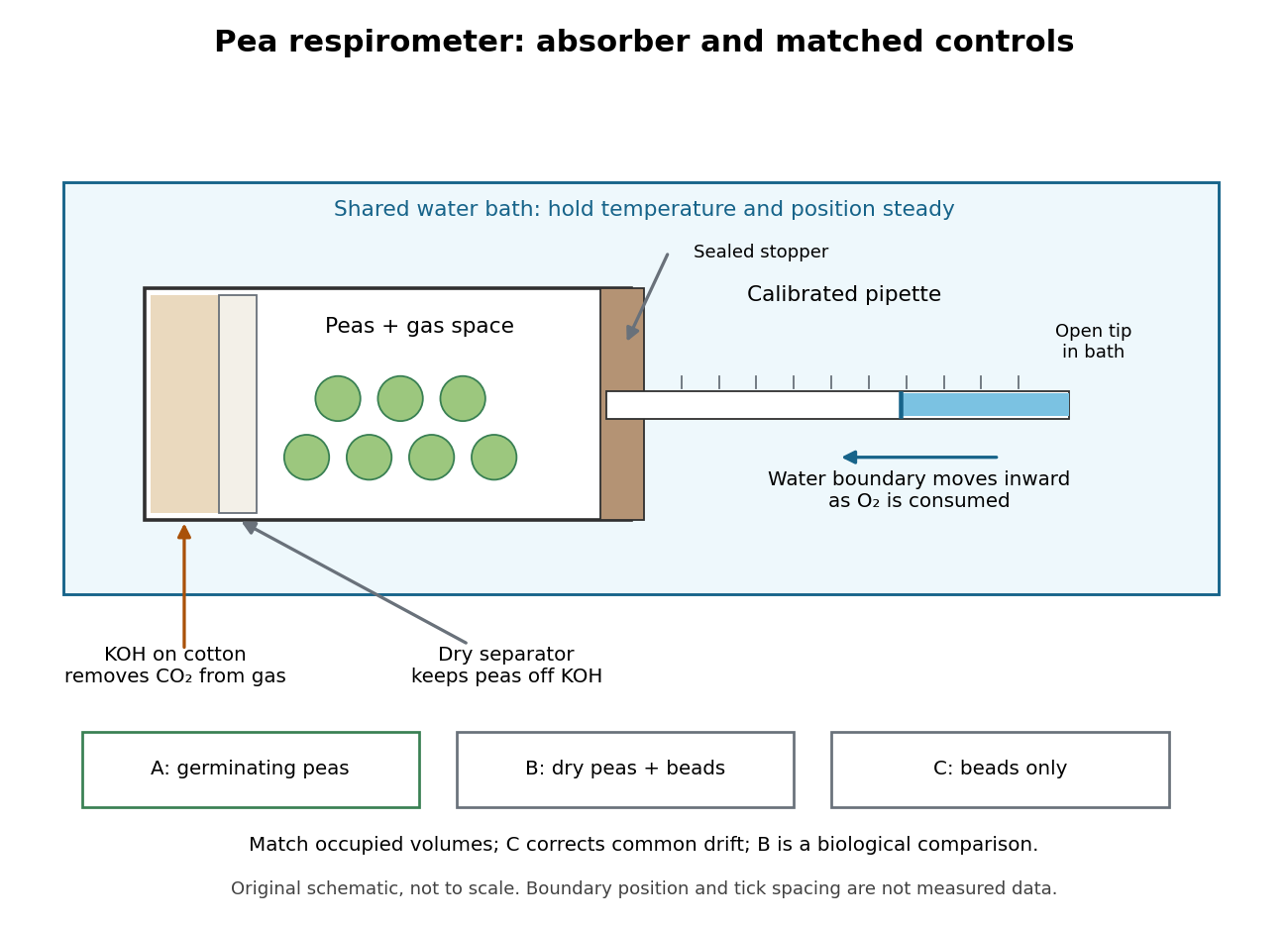
Bath temperature, vial position and seal integrity matter. The beads-only respirometer detects common temperature or atmospheric pressure drift; its change is subtracted from each pea reading. Nongerminating peas provide a biological comparison, not an assumption of zero cellular respiration. A larger corrected uptake slope for germinating peas would support greater molecular oxygen consumption by that sample under the tested conditions.[ref]
Cell Respiration by the K20 Center. Cell Respiration, pp. 1, 3–4 and 6: living dormant seeds, position/leaks, corrected differences and slope
Equal displaced volumes help match the gas spaces; they do not establish equal living mass or equal developmental state. Comparing uptake per seed and uptake per dry mass asks different questions. Leaks, incomplete carbon dioxide absorption, gas dissolution and changing water-vapour contributions can distort the respirometer inference. A blank correction cannot repair a sample-specific leak. These are consequences of the respirometer gas balance, rather than measurements reported in the handout.
For an original idealized mathematical model, let be the amount of substance of molecular oxygen consumed since the initial reading and the carbon dioxide produced. Suppose a fraction of that carbon dioxide is removed from the gas, all other gas inventories remain fixed, and temperature and gas pressure stay constant. The ideal gas law gives the positive gas contractionwhere is the molar gas constant and the gas volume. With complete absorption, , the contraction reflects molecular oxygen uptake regardless of the amount of carbon dioxide made. For a uniform pipette bore of area , an inward boundary displacement gives . A graduated pipette can instead supply the displaced volume directly.
Let denote sample contraction and the matched blank contraction. Define with both taken relative to their own initial readings. Under the preceding assumptions,The slope of corrected volume against time estimates uptake over the chosen interval. The approximate sign acknowledges that a liquid boundary also responds to hydrostatic and capillary pressure, while the gas can exchange water vapour. A fixed-volume apparatus would instead show a pressure decrease; its ideal conversion is after complete absorption and appropriate blank correction.
The ideal gas law also exposes drift without any biology: for fixed gas inventory, . A one-percent rise in absolute temperature at fixed pressure produces a one-percent expansion. Matching the initial gas spaces makes such common changes easier to subtract. Subtracting unmatched blanks can leave a physical signal that looks biological.
The respiratory quotient compares carbon dioxide production with molecular oxygen consumption over the same interval. Complete glucose oxidation in the net equation above gives . In the ideal respirometer gas balance with no absorber, , that conversion gives : substantial cellular respiration can occur without any net gas contraction. A zero contraction therefore does not by itself demonstrate zero metabolism.
Other fuels, incomplete conversion and concurrent synthesis can alter the ratio. Absorber-based respirometry isolates molecular oxygen uptake by deliberately removing the other gas signal; it cannot independently determine the respiratory quotient or identify glucose as the consumed fuel. Separate carbon dioxide measurement would supply the missing account.


