Faraday's law of induction
ID: faraday-s-law-of-induction

Faraday's law of induction relates a changing magnetic field to circulation of the electric field. For a fixed oriented surface with boundary , choose the positive direction around by the right-hand rule: the fingers follow while the thumb follows the chosen unit normal. The fixed-loop electromagnetic electromotive force isThe final derivative of magnetic flux is an ordinary time derivative, with the surface held fixed. Reversing both the unit normal and the boundary direction reverses both signs. The loop may be an imagined path: the field law does not require a wire or an electric current. [ref]
https://www.feynmanlectures.caltech.edu/II_17.html#Ch17-S1. Feynman lectures, II.17.1: electric-field circulation and induction
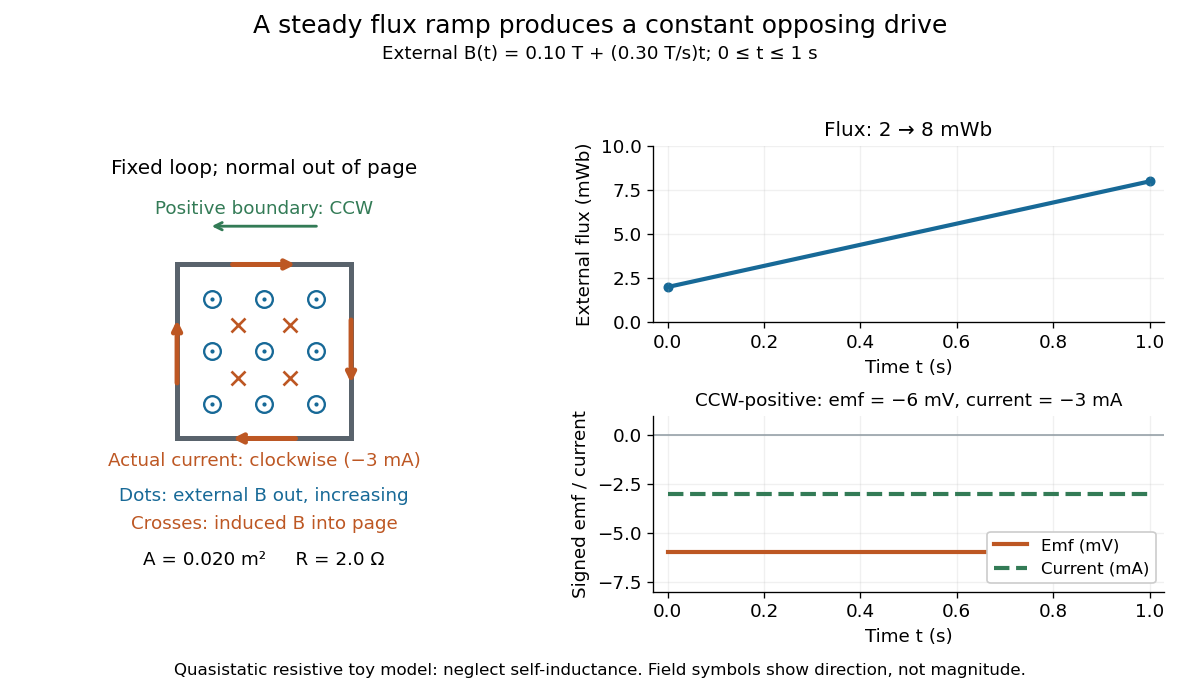
.For a computed example, a fixed single-turn loop has area and out-of-page unit normal. Prescribe an external uniform magnetic field in that direction with for . ThenIn a quasistatic resistive model with electrical resistance , neglect the loop's self-inductance and its own contribution to changing magnetic flux. Ohm's law givesThe magnetic flux rises from to while the induced electromotive force stays constant: it measures the rate of change, rather than the amount of magnetic flux. The negative sign means clockwise electric current; its magnetic field through the loop points into the page, as explained by Lenz's law. The toy model describes the interval of steady ramping, excluding switching transients at its ends.
For a moving conducting loop , the electromagnetic electromotive force instead includes the Lorentz force contribution from the local velocity of each conductor segment:This form assumes a thin-wire model with a well-defined closed contour and spanning oriented surface that move compatibly, a magnetic field satisfying Gauss's law for magnetism, and conductor speeds small compared with the speed of light. Ideal sliding contacts such as those in motional electromotive force can be treated piecewise. Arbitrary changes of electrical connections require checking the actual contour and conductor velocities; differentiating the flux through an arbitrary chosen moving path is insufficient. The velocity here describes conductor motion, not the charge carriers' drift along the wire. [ref]
https://www.feynmanlectures.caltech.edu/II_17.html#Ch17-S2. Feynman lectures, II.17.2: limits of the flux rule
.A short derivation of the fixed-loop integral statement applies Stokes theorem to the local curl equation and differentiates under the fixed surface integral. For the moving loop, the magnetic flux transport for a moving circuit adds the swept-area term to . Combining these two identities gives the moving-loop statement. This derives the integral forms from the local field law; it is not a proof of that empirical law from mathematics alone.
The useful unity is geometric: changing the magnetic field, the enclosed area, or the orientation can change magnetic flux and hence produce an electromotive force. A coil's multiple turns are accounted for by magnetic flux linkage, rather than by multiplying a single-turn flux without checking which flux each turn receives. [ref]
https://openstax.org/books/university-physics-volume-2/pages/13-1-faradays-law. OpenStax University Physics 2, §13.1: flux changes and coils
.Faraday's report read on 24 November 1831 describes opposite momentary responses when a neighboring circuit is connected and disconnected, with no continuing response while its steady electric current is maintained. These are concrete experimental roots of the changing-flux idea. The report predates the modern Maxwell equations notation used above. [ref]
https://www.gutenberg.org/files/14986/14986-h/14986-h.htm. Faraday, Experimental Researches in Electricity, First Series (1831), §§10–11, reprinted in volume I
.
Faraday's law of induction is a fundamental principle of electromagnetism that describes how a changing magnetic field can induce an electromotive force (EMF) in a circuit. Formulated by Michael Faraday in the 19th century, the law can be stated in two primary ways: 1. **Mathematical Formulation**: The induced EMF (ε) in a closed loop is proportional to the rate of change of the magnetic flux (Φ) through the loop.


New to topics? Read the docs here!