Heisenberg uncertainty relation
ID: heisenberg-uncertainty-relation

The Heisenberg uncertainty relation constrains the standard deviations of position and momentum in one preparation:On the real line, the position operator acts by multiplication, and the momentum operator is , with the reduced Planck constant. Their canonical commutation relation and the Robertson uncertainty principle give the bound on normalized quantum states satisfying the moment and product-domain assumptions above; Schwartz functions are a convenient sufficient class. Thus making a preparation more sharply localized in position forces a wider momentum distribution, even for ideal measurement in quantum mechanics.
An explicit saturating example is the normalized Gaussian wave packet, for ,The wavefunction is a probability amplitude; its squared magnitude is the probability density function, by the Born rule. That density is a normal distribution of mean zero and standard deviation , rather than a density whose width is read directly from the amplitude's exponent. With the unitary, negative-exponent convention for the Fourier transform, its momentum amplitude isThe Gaussian integral evaluates this Fourier transform. Consequently is another normal distribution, with mean zero and standard deviationFor example, in dimensionless units with , give . The Gaussian wave packets all saturate the same bound: narrowing one density broadens the other. More precisely, choose a reference length and set , ; then , and the plotted widths are and .
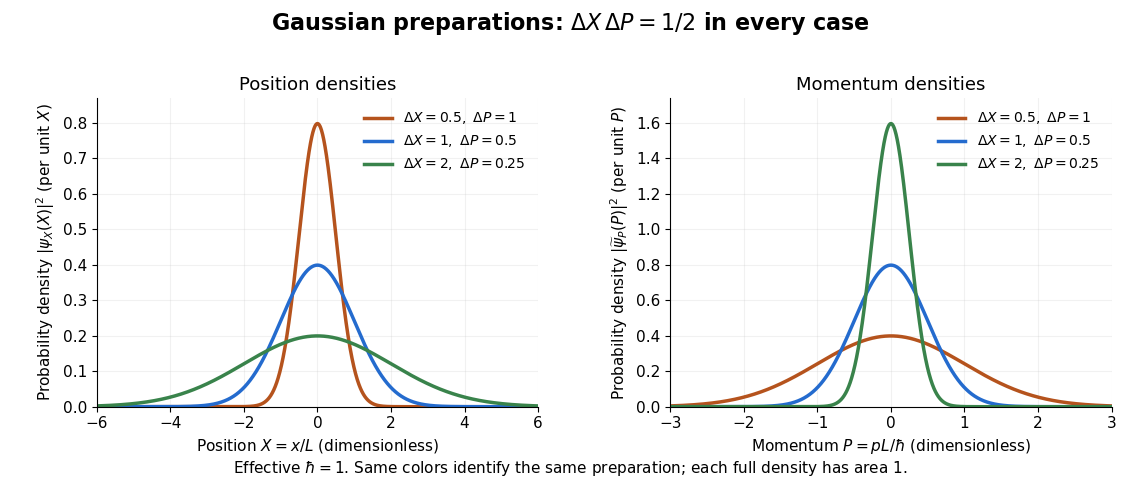
Position and momentum probability densities for three minimum-uncertainty Gaussian preparations: dimensionless widths 0.5, 1, and 2 in position give reciprocal momentum widths 1, 0.5, and 0.25
. Details. 
The Heisenberg uncertainty relation connects localization to the cost in kinetic energy. In a quantum harmonic oscillator with mass and angular frequency , the variance contribution to the expectation value of the energy is bounded using the arithmetic-geometric mean inequality:The mean-dependent contributions are nonnegative. The Gaussian eigenstate for a quadratic potential with and zero means reaches this ground state energy. This is why the tradeoff is more than a limitation on preparation: it predicts an unavoidable positive minimum energy.
Heisenberg's original article appeared in March 1927 as "Über den anschaulichen Inhalt der quantentheoretischen Kinematik und Mechanik", Zeitschrift für Physik 43, pp. 172–198. Its abstract discusses simultaneous imprecision of canonically conjugate quantities and explanatory thought experiments. The precise standard deviation formulation here distinguishes preparation spreads from a slogan about measurement disturbance. [ref].
New to topics? Read the docs here!