Ideal binary Gibbs-Duhem cancellation
ID: ideal-binary-gibbs-duhem-cancellation

An ideal solution has molar chemical potentialswhere is the molar gas constant and the stars denote pure-component reference values at the same temperature and pressure.[ref]
Thermodynamics and Chemistry by Howard DeVoe. Thermodynamics and Chemistry, §9.4.2, printed pp. 249–250, equations 9.4.5 and 9.4.8; definition of an ideal mixture
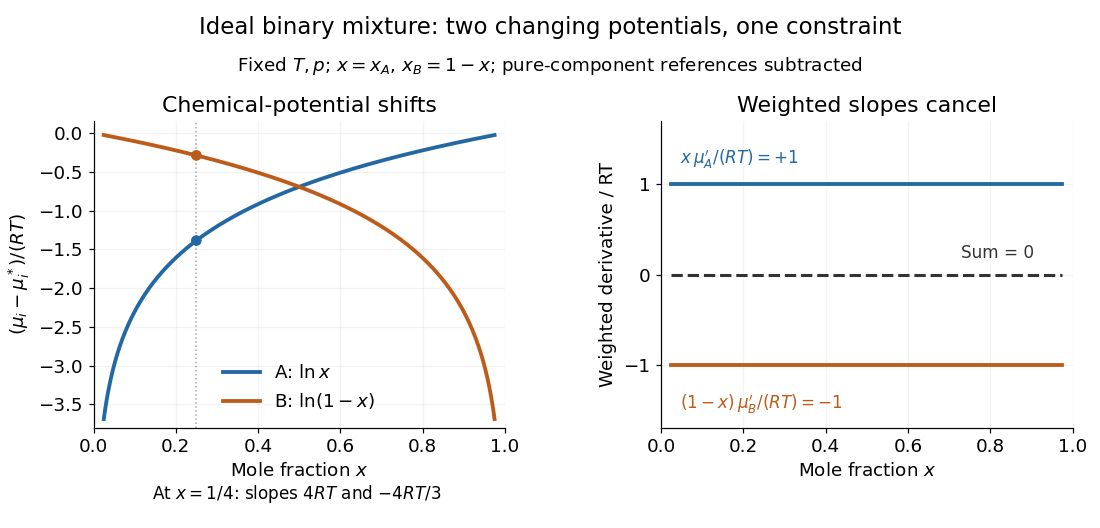
Hold temperature and pressure fixed. The derivatives with respect to are and , soEach chemical potential changes, yet their composition-weighted slopes cancel exactly. At , the two slopes are and ; multiplying by and gives and . Near either pure-component endpoint the dilute component's slope diverges, but its weighted contribution remains finite. The endpoint chemical potential itself requires a limiting interpretation because its logarithm diverges.

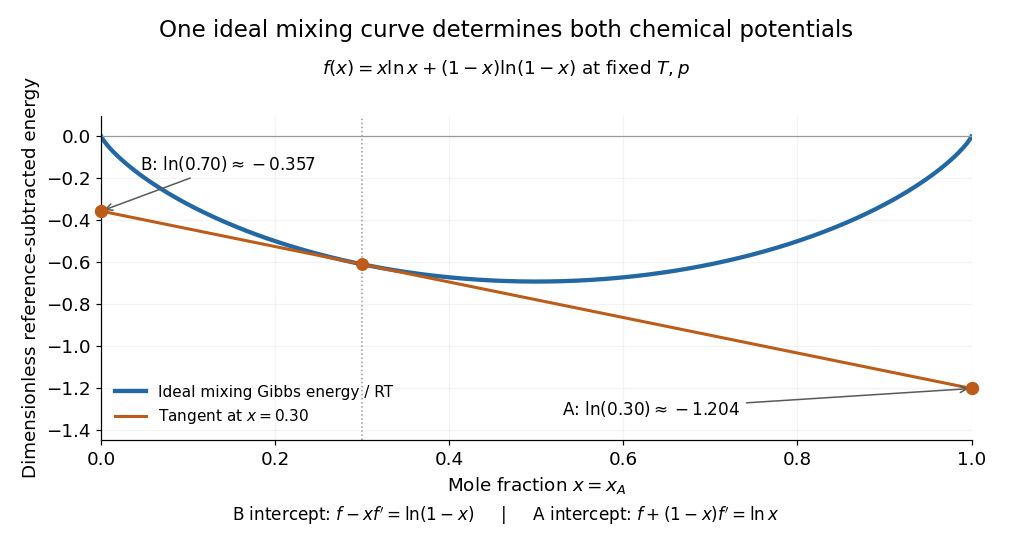
The same constraint has a geometric explanation. Subtract the pure-component reference contribution from the molar Gibbs free energy and divide by to obtainIts derivative is . At fixed total amount of substance, exchanging a little B for A changes the Gibbs free energy with slope . Consequently the tangent to at has interceptsat horizontal coordinates and , respectively. The two chemical potentials come from the same curve: choosing two unrelated functions would generally destroy this tangent construction.

New to topics? Read the docs here!