Maximum elastic recoil energy fraction
ID: maximum-elastic-recoil-energy-fraction

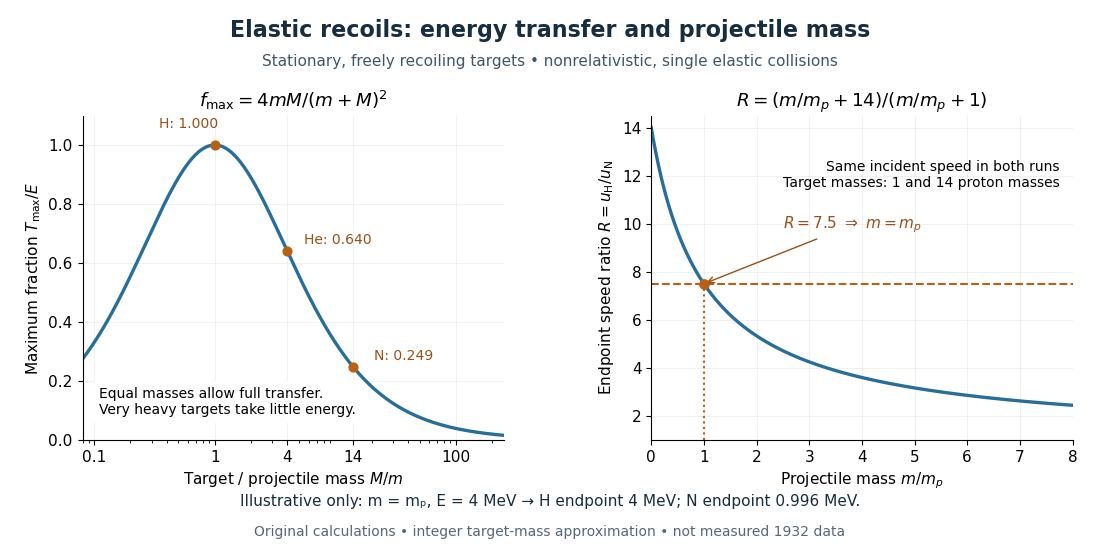
Let a projectile have mass , incident speed , and incident kinetic energy . The stationary target has mass . In a head-on elastic collision, the signed outgoing projectile velocity and target velocity obey momentum conservation and conservation of energy:Factor the second equation and eliminate . The nontrivial collision branch has , henceThis is the maximum over scattering angles, not the energy of every recoil. To see the bound without assuming a head-on event, set the recoil momentum magnitude to and its laboratory angle to the incident direction to . Conservation of energy with outgoing projectile momentum givesThus for a nonzero recoil, and the endpoint occurs at .
For an original numerical example, stipulate and , with the proton mass. Approximate hydrogen, helium and nitrogen target masses by , and respectively. Their maximum fractions and recoil energies areThese stipulated values illustrate the approximation ; they are not measurements from 1932. With , the incident ratio gives , consistent with the nonrelativistic limit used here. A million electronvolts is an energy unit, whereas a mass expressed in requires the factor when inserted into an energy equation.
The hydrogen endpoint permits essentially complete transfer because the projectile and target masses match. For a very heavy target, , the fraction approaches , which is small: the target can take substantial momentum with little kinetic energy. The exact inequality follows from , which implies .

New to topics? Read the docs here!