
A membrane protein is a protein associated with a biological membrane. Its association, orientation and mobility are separate properties: being embedded does not imply spanning, and spanning does not imply moving freely. Membrane proteins supply routes for membrane transport and recognition for signal transduction.[ref]
Cell Membranes. Cooper, The Cell: A Molecular Approach, 2nd edition, Cell Membranes, opening paragraph and Membrane Proteins
An ion channel supplies a pathway for ions; a carrier protein changes which side can reach a bound solute; a cell-surface receptor connects an external ligand to intracellular signal transduction. These examples distinguish passage from communication: a signal can cross the boundary as a change of protein activity without the ligand itself crossing.[ref]
Membrane Proteins. Alberts and others, Molecular Biology of the Cell, 4th edition, Membrane Proteins Can Be Associated with the Lipid Bilayer in Various Ways: association reflects function
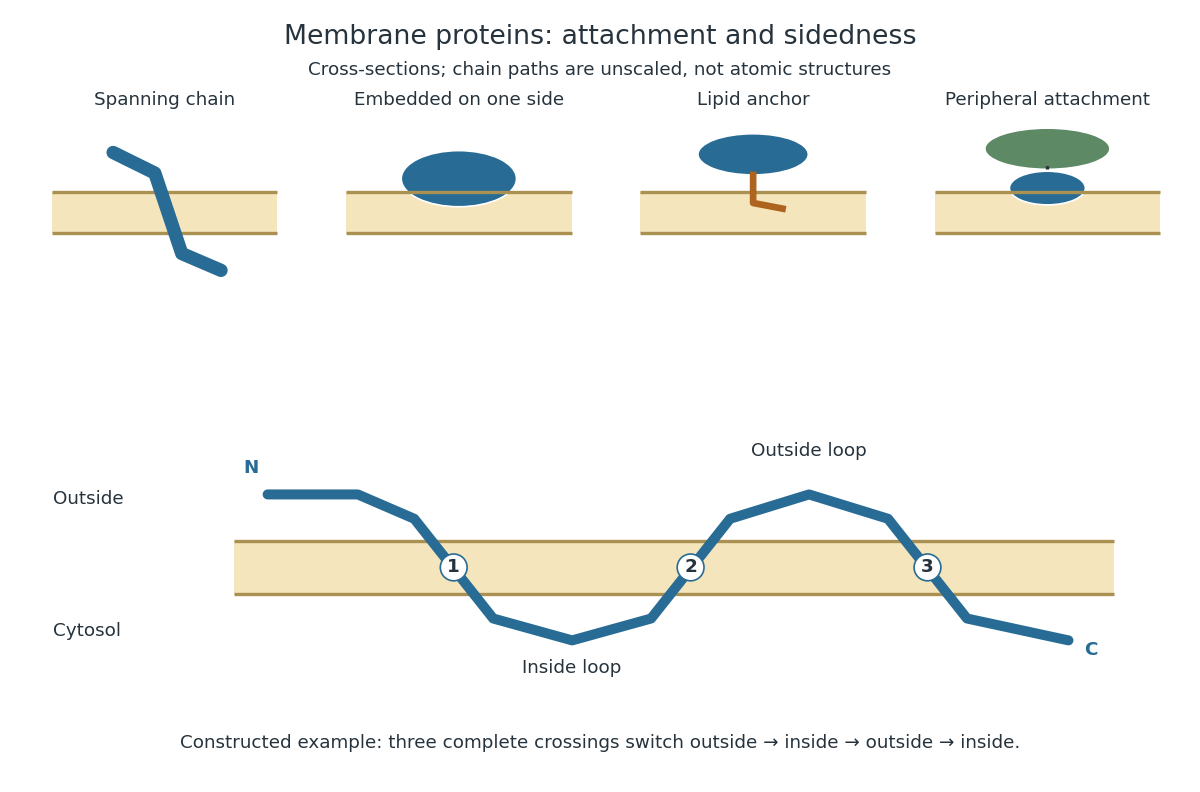
Membrane association and the orientation of a spanning chain
. Original schematic cross-sections of a lipid bilayer, followed by a constructed three-crossing polypeptide chain. Colored paths represent placement, not atomic protein structures. The N-terminus starts outside; each complete crossing switches sides, leaving the C-terminus inside. Drawn dimensions are unscaled. Details.
The same boundary can therefore retain substances and communicate selectively with its surroundings. Membrane topology tells us which parts can meet a given ligand; lateral mobility of membrane proteins tells us whether two parts can approach each other along the boundary. A diagram of a cell membrane becomes more useful when it answers both questions.
New to topics? Read the docs here!