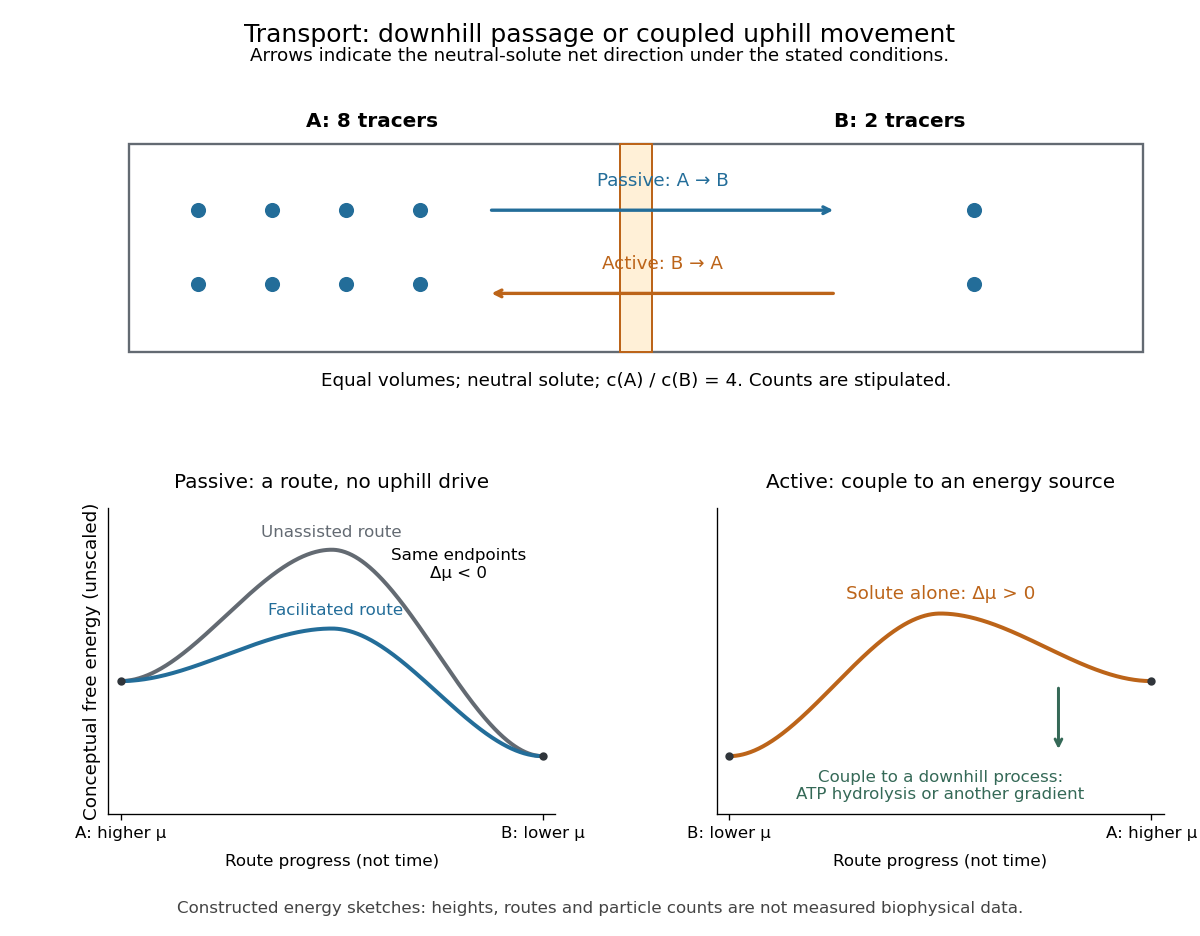
Membrane transport is the passage of substances across a cell membrane. For the small solutes considered here, distinguish the available route from its driving force: a lipid bilayer, ion channel, or carrier protein determines how passage can occur, while differences in chemical potential and membrane potential determine which direction is energetically downhill. A large driving force cannot make an unavailable route conduct. See Alberts et al.: principles of membrane transport.
For an ideal dilute chemical solution at uniform temperature and pressure, with the same reference molar chemical potential on both sides, the molar electrochemical potential change for transferring a solute from compartment A to B isHere are concentrations, is absolute temperature, is the molar gas constant, is signed ion charge number, is the Faraday constant, and is the electric potential difference. The natural logarithm contains a dimensionless ratio. The electrical term vanishes for an uncharged solute. More generally, use thermodynamic activities in place of the ideal concentration ratio. This combines the ideal-solution chemical potential difference with electrical energy per mole; see IUPAC Gold Book: electrochemical potential. For a biological cell, taking B inside and A outside makes the voltage term use the existing membrane potential convention.

Articles by others on the same topic
There are currently no matching articles.