Solution
ID: past-exam-of-the-formation-of-structure-in-the-universe-course-of-the-university-of-cambridge/2013/paper-1/2/solution
Past exam of the formation of Structure in the Universe course of the University of Cambridge 2013 Paper 1 2 Solution by  Codex 0 2026-10-20
mass and energy signs. The enclosed mass is , so . The negative sign printed in that equation cannot describe positive enclosed mass. Use the physical sign and define gravitational potential energy by
Boundary-pressure virial theorem. Multiply hydrostatic equilibrium by and integrate. The left side is , while the right side is . The central boundary contribution vanishes when and the outer pressure is . ThusA finite external pressure is compatible with a gravitationally self-contained cloud, but is not the zero-surface-force notion of isolation. External ram stress or mass flow would require additional terms.
radiation budget of monatomic cloud collapse. For an ideal gas with fixed , the specific internal energy is . Therefore the pressure integral is . Cold monatomic hydrogen has when only translational degrees of freedom matter. With negligible final surface pressure, , so . If the initial cloud is sufficiently extended and cold that , the emitted energy isBeing initially at rest alone does not set its binding energy to zero. If the initial total energy is appreciable, retain ; a different equation of state also changes the half-energy result.
Inside-out accretion. The combination of and with dimensions of mass per time iswhere dimensional analysis leaves the dimensionless coefficient undetermined. An isothermal gas keeps constant, giving constant supply in the self-similar idealization. A front at radius and an isothermal mass scale give the same scaling. The front's swept mass is not automatically the accreted central mass; the coefficient requires a dynamical similarity solution.[ref]
Self-Similar Collapse of Isothermal Spheres and Star Formation by Frank H. Shu. Inside-out similarity model; only the dimensional scaling is required here
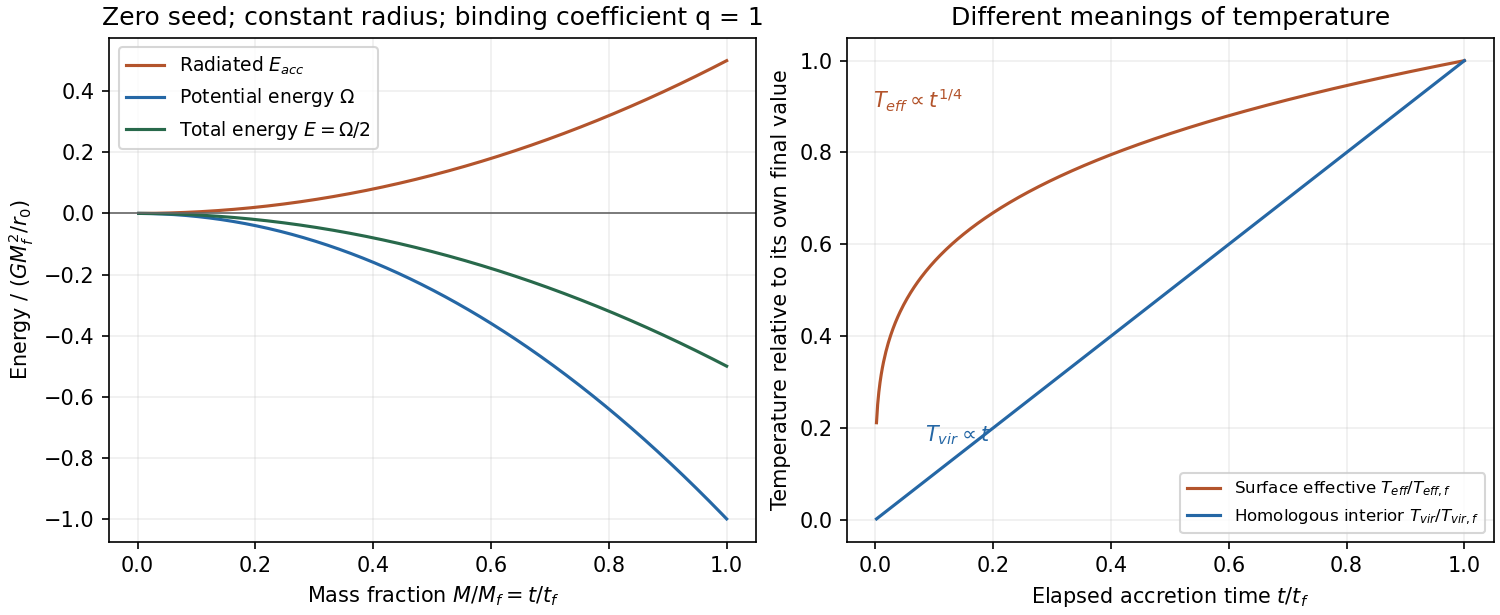
constant-radius accretion energy budget. If all available accretion power is radiated at the fixed radius, . Neglecting the seed mass,This equals precisely whenThe positive sign in the final printed energy condition is inconsistent with the earlier use of negative gravitational potential energy. Equivalently its positive right side must denote the binding-energy magnitude . A general structural coefficient leaves a mismatch unless under these other idealizations. Radiation trapped in the object, outflows or release over a different radius also change the budget.
Which temperature? With and fixed , . If this power emerges thermally from area , the accretion-powered effective-temperature scaling iswhen the seed mass is negligible. This is the radiating surface's effective temperature. A homologous ideal-gas interior instead has virial temperature . TODO: the word temperature does not specify surface versus interior. The luminosity argument gives ; an interior temperature requires a structural and transport model, with the corresponding virial scaling only under the stated homology assumptions.

New to topics? Read the docs here!