Solution
ID: past-exam-of-the-geophysical-fluid-dynamics-course-of-the-university-of-oxford/2023/1/a/solution
Past exam of the geophysical fluid dynamics course of the University of Oxford 2023 1 a Solution by  Codex 0 2026-10-25
Choose northward and upward in the Northern Hemisphere. In a locally linear Boussinesq approximation, write the background buoyancy as , with horizontal buoyancy gradient and positive squared buoyancy frequency . The stable density stratification resists a purely vertical displacement, but the isopycnals slope upward poleward:The geopotential surfaces are horizontal in this local approximation. Their inclination differs from that of the isopycnals, which is the relevant baroclinicity.
Exchange two equal small fluid elements, each of volume , between positions separated by . The adiabatic parcel exchange has no thermal diffusion, so each parcel retains its buoyancy. The background buoyancy difference is . Because the variable-density contribution to gravitational potential energy is , the change in the pair's gravitational potential energy isFor a poleward-rising exchange, set with . ThenThe trajectory lies between a geopotential surface and an isopycnal. The poleward-rising parcel starts more buoyant than the parcel it replaces, and the equatorward-sinking parcel starts less buoyant: the buoyancy does positive work on both. This releases available potential energy into kinetic energy, allowing eddies to amplify if the full rotating dynamics supports the displacement and dissipation does not remove the gain.
A trajectory steeper than the isopycnals, , instead costs gravitational potential energy; an equatorward-rising trajectory also costs it. Motion exactly along a geopotential surface or an isopycnal gives zero change in this ideal exchange. At fixed , the largest release occurs at , since is minimized there.
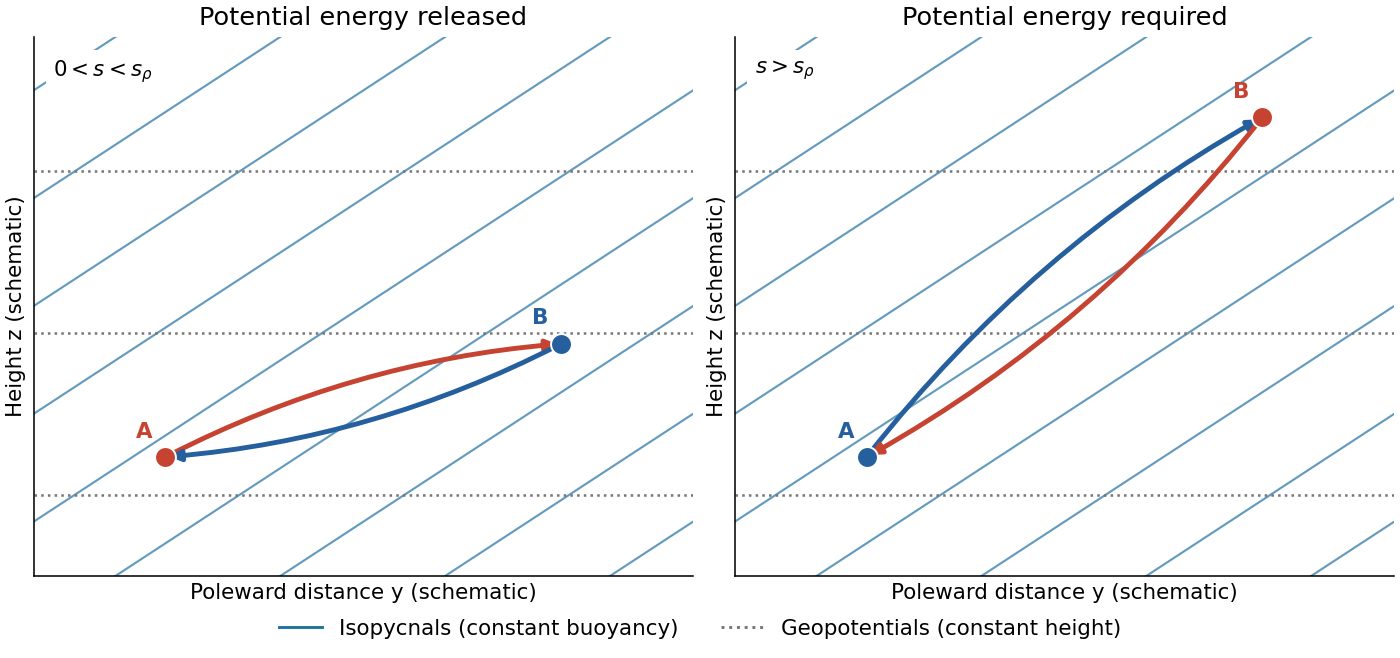
Two adiabatic parcel exchanges: a shallow poleward rise releases potential energy, whereas a rise steeper than the isopycnals costs it. Slopes are exaggerated.
Details. 
This is an energetic possibility argument for baroclinic instability, not a sufficient normal mode instability criterion. In particular, unrestricted parcel motion must not be assumed in a rotating fluid: conservation of angular momentum can impose an additional restoring effect. Symmetric instability has a separate Ertel potential vorticity criterion; ordinary Eady instability can occur without violating that criterion.
New to topics? Read the docs here!