Solution
ID: past-exam-of-the-laser-science-and-quantum-information-processing-course-of-the-university-of-oxford/2015/1/a/solution
Past exam of the laser science and quantum information processing course of the University of Oxford 2015 1 a Solution by  Codex 0 2026-10-25
A forward-biased p-n junction injects electrons from its n-type semiconductor and electron holes from its p-type semiconductor into an active region. A direct band gap allows radiative transitions without a compensating phonon, so stimulated emission can compete effectively with nonradiative processes. At thermal equilibrium there is one Fermi level; forward injection instead establishes separate electron and valence-electron quasi-Fermi levels and . Sufficient injection makes conduction states more occupied than the corresponding valence states, producing optical gain.
Two parallel cleaved facets supply an optical resonator. At normal incidence their approximate intensity reflectance follows the Fresnel equations:A resonant normal mode grows when its round-trip amplification exceeds its losses. For length , material optical gain , overlap factor , internal intensity loss and facet reflectances ,The pump supplies the emitted energy; the facets provide feedback and let some output escape. Positive optical gain alone does not establish laser threshold.
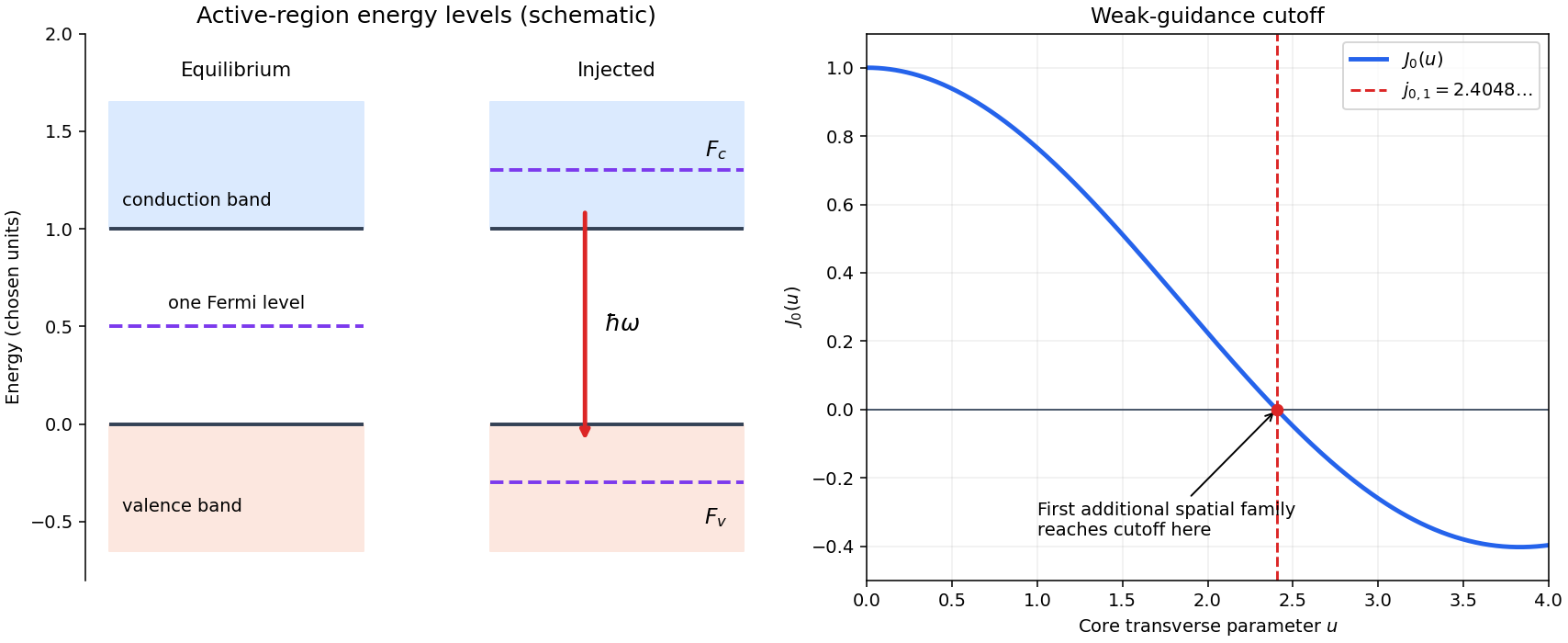
Injected laser diode levels and the first additional guided spatial mode
. Original schematic: the left panel uses stipulated energy units to distinguish equilibrium and injected quasi-Fermi levels, with an allowed downward optical transition. The right panel plots , whose first zero fixes the weak-guidance spatial-mode cutoff. The separate panels do not represent a shared spatial coordinate. Details.
New to topics? Read the docs here!