Solution
ID: past-exam-of-the-particle-and-nuclear-physics-course-of-the-university-of-cambridge/2013/paper-1/4/solution
Past exam of the particle and nuclear physics course of the University of Cambridge 2013 Paper 1 4 Solution by  Codex 0 2026-10-20
At energies far below the mass, replace its propagator by a constant. The modern V-A interaction form of Fermi's contact theory has, in units,Nucleons are treated nonrelativistically within nuclear states. To leading order in their velocity, the vector charge and axial spatial current give the two nuclear operatorswhere here means neutron-to-proton conversion. (i) The scalar Fermi operator permits , including , without parity change. The rank-one Gamow–Teller operator permits without parity change, excluding . Both terms can contribute when the same nuclear states permit them; their strengths contain nuclear matrix elements, not just phase space.
(ii) Expand the lepton waves across the nucleus in powers of their momenta times nuclear radius. When , the constant spatial term gives allowed transitions. If its matrix element vanishes by spin/parity selection, higher terms supply lepton orbital angular momentum: “forbidden” means suppressed, not impossible. First-forbidden terms change parity and can have ; the rank-two case is unique first-forbidden. Higher orders carry additional small spatial factors and different energy-dependent shape factors. The contact approximation alone does not imply the allowed approximation.
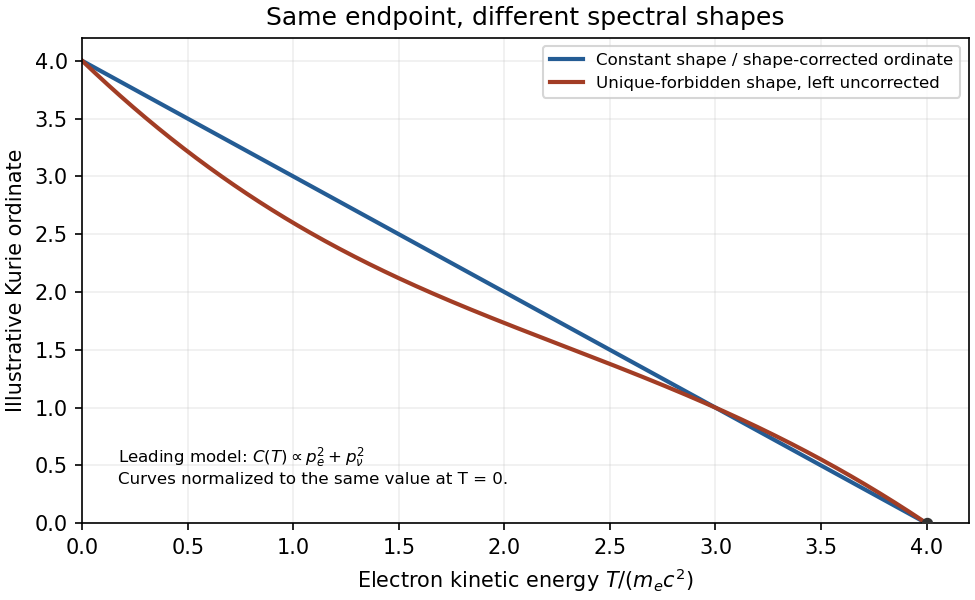
For a single branch, neglect recoil and neutrino mass and first assume an energy-independent nuclear shape factor. Fermi's golden rule integrates the neutrino phase space with , while the electron momentum volume is proportional to . Including Coulomb distortion,This momentum-bin Kurie ordinate is linear in kinetic energy and vanishes at its endpoint. If instead using counts per unit kinetic energy, in units; converting with recovers the supplied momentum-bin definition. No extra factor of should be left inside that definition of .
The graph's horizontal coordinate is , not in MeV. Its intercept is approximately –, soFor a ground-to-ground branch between bare nuclei, the emitted electron's rest energy must also be supplied:For neutral atomic masses the mass difference instead equals approximately , neglecting small electron-binding corrections. The graph supports this approximate precision, not a precise evaluated isotope mass. Interpreting a branch to an excited daughter would require adding its excitation energy; the ground-state comparison assumes the ground-state branch intended here.
The shell-model prediction for yttrium-91 beta decay follows from shell filling: the proton orbitals above 28 fill with four protons and with six, reaching 38. Yttrium has its 39th proton in , giving . Its 52 neutrons include the closed 50-neutron core and a pair in , coupled to zero in the simple paired ground state. Zirconium has 40 paired protons and 51 neutrons, leaving an unpaired neutron, so . ThereforeThe single-particle change is neutron to proton ; the parity change and rank two prevent an allowed Fermi or Gamow–Teller contribution.
The straight plotted line is a constant-shape idealization. For the shell-model transition just inferred, a leading unique-forbidden shape factor contains in units, with Coulomb/finite-size refinements. Consequently the uncorrected quantity specified in the paper is generally proportional to , not exactly linear. A consistent shape-corrected Kurie plot also divides its ordinate by . The source's exact straight-line construction and its forbidden-transition inference cannot both be exact with a Coulomb-only ; the approximate graphical endpoint can still be read as requested. Allowed and unique-forbidden spectral shapes are experimentally distinguishable.[ref]
Shapes of Allowed and Unique First-Forbidden β-Ray Spectra: 114In, 42K, 86Rb, 90Sr, and 90Y by H. Daniel and others. 1964 abstract; separate allowed and unique-forbidden spectrum measurements

New to topics? Read the docs here!