Solution
ID: past-exam-of-the-particle-and-nuclear-physics-course-of-the-university-of-cambridge/2015/paper-1/2/b/solution
Past exam of the particle and nuclear physics course of the University of Cambridge 2015 Paper 1 2 b Solution by  Codex 0 2026-10-20
The common energetic principle behind nuclear fission and nuclear fusion is the nuclear binding energy. If the products are more tightly bound in total than the reactants, their smaller rest mass releasesThe two binding-energy expressions assume that the same numbers of protons and neutrons are counted on both sides; emitted free nucleons have zero nuclear binding. The energy appears mainly as product kinetic energy, with radiation and subsequent decays contributing according to the reaction.
The binding energy per nucleon rises rapidly through light nuclei, has a broad maximum in the iron/nickel region, and decreases more slowly for heavier nuclei. Combining suitable light nuclei can therefore increase their total binding, whereas splitting a sufficiently heavy nucleus into moderately heavy fragments can do the same. This is an energy comparison, not a rule that every fusion or fission channel is exothermic: the actual nuclear masses fix the sign of .
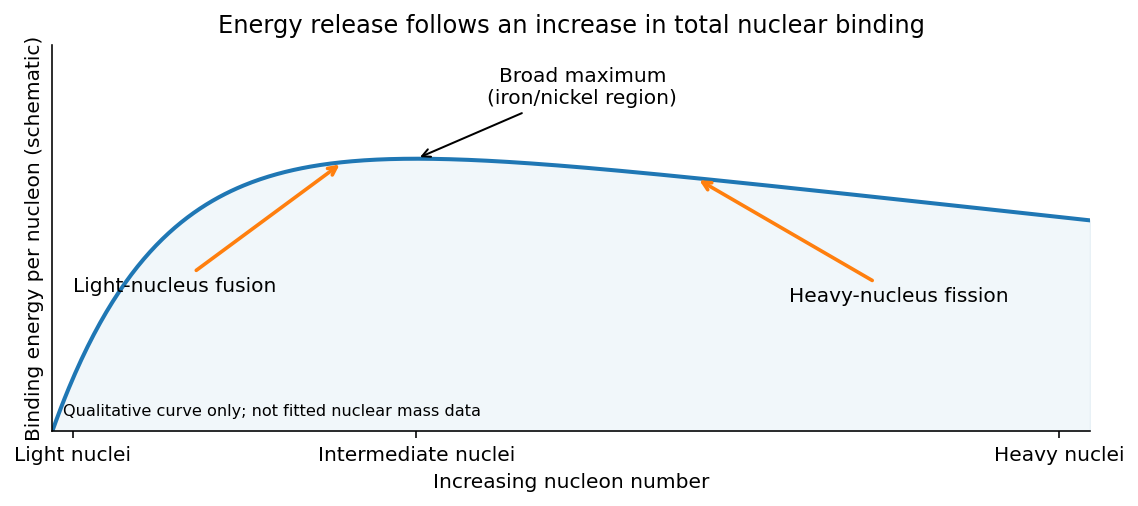
Schematic binding-energy trend explaining why light-nucleus fusion and heavy-nucleus fission can release energy
. Details. 
In nuclear fission, the liquid-drop model illustrates the competition between attractive short-range nuclear cohesion and long-range proton repulsive Coulomb interaction. Deformation increases surface area and costs surface energy, but separating the charge can reduce nuclear Coulomb energy. Their competition creates a fission barrier. An excited nucleus may pass over the barrier; spontaneous fission can occur through quantum tunnelling. The resulting fragments are often excited and neutron-rich, so they may emit prompt neutrons and photons and undergo later beta decay. The typical total energy released by a heavy-nucleus fission is of order a few hundred MeV, rather than an electronic-scale energy. Its size follows from an approximately MeV-per-nucleon binding gain summed over a heavy nucleus. A neutron from one fission can induce another; a nuclear chain reaction is the repeated physical process, distinct from the energy-release condition for one event.
In nuclear fusion, the initial charged nuclei repel one another. Exothermicity does not remove this entrance Coulomb barrier. A reaction requires sufficient overlap of their wavefunctions, achieved by energetic encounters and quantum tunnelling. For nonresonant low-energy charged-particle fusion, a useful separation isThe astrophysical S factor isolates the nuclear part from much of the rapidly varying Coulomb penetration probability. In a thermal population, the competition between the decreasing high-energy population and increasing penetration produces the Gamow peak. This explains how fusion can proceed below the classical barrier without requiring the mean thermal energy to equal its height.
Both processes conserve total energy, charge, baryon number and angular momentum. Their very different entrance barriers and mass ranges explain why a favorable value by itself does not specify a reaction rate. Short-range attraction gives approximately saturated nuclear binding, while surface, Coulomb, symmetry and pairing terms account for the broad trend and its isotope-dependent departures.
New to topics? Read the docs here!