Solution
ID: past-exam-of-the-physics-b-course-of-the-university-of-cambridge/2010/paper-2a/section-d/d14/solution
Past exam of the physics B course of the University of Cambridge 2010 Paper 2A Section D D14 Solution by  Codex 0 2026-10-20
A normal mode has all displacement coordinates proportional to a common time dependence, with fixed relative amplitudes. For a nonzero frequency the time dependence is sinusoidal. A zero-frequency mode is a free displacement or uniform drift rather than an oscillation.
Use the printed mass ordering . Displacements are measured from the unstretched equilibrium positions, givingEquivalently,This is the generalized eigenvalue problem for normal modes of three masses connected by two equal springs. Substitute to obtain . Reflection symmetry gives an antisymmetric vector and symmetric vectors . The former has . For a symmetric vector, the end and centre equations give and . Their solutions are , , or , . HenceThese are all three eigenmodes. The last two keep the centre of mass fixed and are orthogonal in the mass-weighted inner product. The general zero-mode contribution is , accounting for both a centre-of-mass shift and a conserved total momentum. There are no fixed end springs in this system.
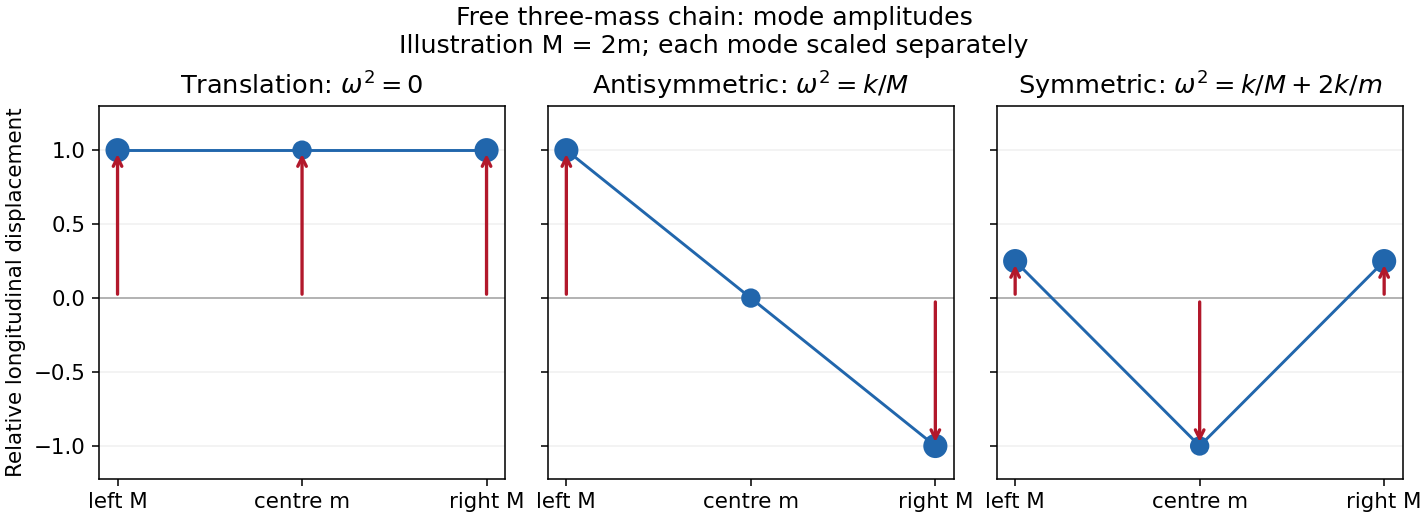
Free-chain mode shapes
. Details. 
The original amplitude profiles illustrate ; the symmetric internal shape is rescaled for display. The formula above gives every positive mass ratio.
Two further physical examples are standing-wave modes of a string fixed at both ends, with spatial shapes and frequencies , and electrical normal modes of two coupled LC circuits, in which the capacitor charges oscillate at fixed relative amplitudes. Independent normal mode coordinates simplify both systems in the same way as the spring-chain eigenvectors.
New to topics? Read the docs here!