Solution
ID: past-exam-of-the-soft-condensed-matter-course-of-the-university-of-cambridge/2016/paper-1/2/b/solution
Past exam of the soft condensed matter course of the University of Cambridge 2016 Paper 1 2 b Solution by  Codex 0 2026-10-20
The Flory interaction parameter measures the excess cost of unlike segment contacts. In a simple lattice with coordination number , contact energies and temperature ,A positive Flory interaction parameter penalizes unlike contacts; a negative value favors them. Mixing still depends on the balance with entropy of mixing, rather than the sign of alone.
For two polymers of degrees of polymerization , let be the volume fraction of species . The binary Flory-Huggins polymer blend has mixing free energy per lattice siteThe logarithmic terms favor mixing. Their factors and arise because an entire chain translates as one object; connecting many segments greatly reduces the mixing entropy per segment. Hence long polymers can demix for a much smaller positive Flory interaction parameter than small molecules.
For composition-independent , the local stability criterion isPositive curvature means stability to small composition fluctuations, zero curvature locates the spinodal, and negative curvature means spontaneous growth of fluctuations. Actual two-phase coexistence is determined by the common-tangent construction, or equality of both species' chemical potentials; its boundary is the binodal. A locally stable but globally unfavourable homogeneous mixture can lie between the binodal and spinodal.
Setting the second and third derivatives of to zero givesFor the symmetric Flory-Huggins polymer blend, and . For a polymer solution with and long chains of species , , consistent with the theta solvent limit. An effective Flory interaction parameter can depend on temperature and composition; in the simple energetic case , heating encourages mixing, but that temperature trend is not universal.
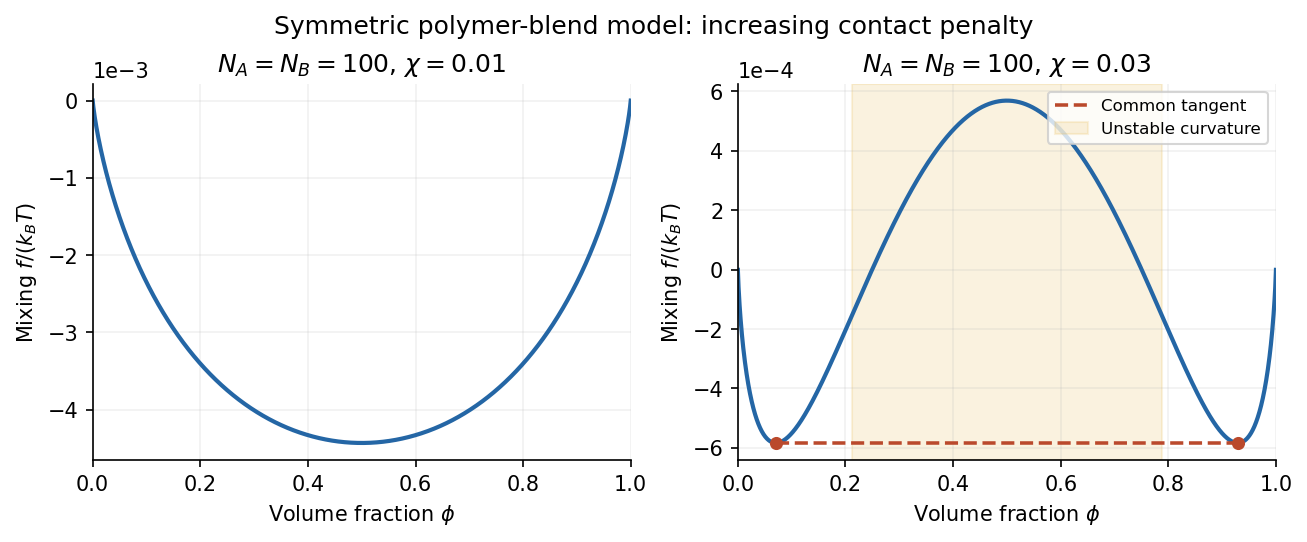

The original illustration uses stipulated . At the mixing free energy is convex, whereas at a central unstable region appears. The horizontal common-tangent construction in the latter case joins the symmetric coexisting compositions; its contacts differ from the spinodal boundaries. These are model curves, not supplied experimental data.
New to topics? Read the docs here!