
Picard iteration replaces a tentative trajectory by the accumulated integral of its proposed rate. For an initial value problem , , define the Picard map and its starting function byHere is the constant starting trajectory; the same symbol without its argument denotes the initial state. A fixed point of solves this integral equation, and the fundamental theorem of calculus gives the original ordinary differential equation.
For , , successive integrals giveAt , the first five values are , while . The fourth polynomial misses by about . On , every omitted term of the exponential series is nonnegative and increasing, so the largest error occurs at . The tail tends to zero, giving uniform convergence to the exponential function on this interval.
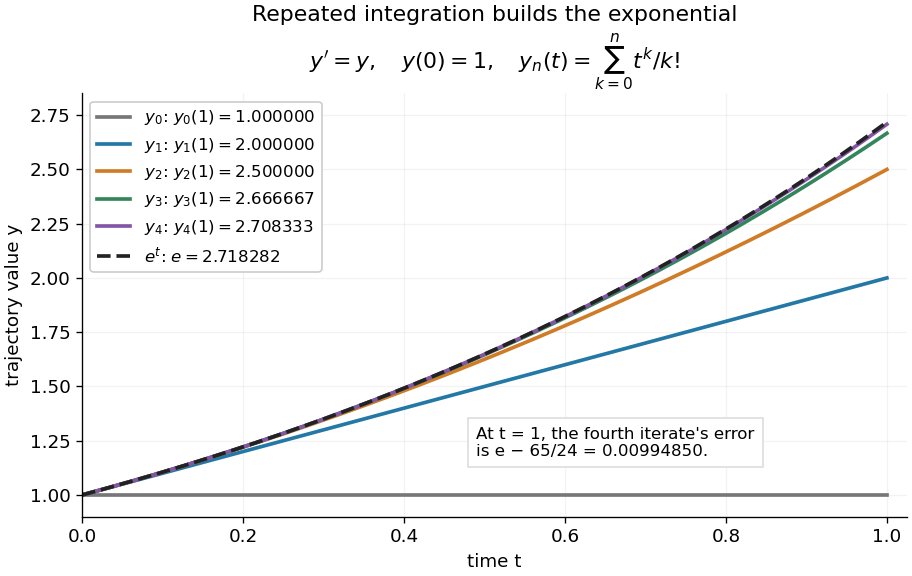
Picard iteration builds the exponential solution by repeated integration
. The first five polynomials approach the exponential function on . Endpoint values are listed in the legend; the last error is approximately . Details.
The beauty of Picard iteration is that each proposed trajectory supplies a better rate history for the next one. For this example, one integration adds exactly the next term of the exponential series. In general, the integrals may be difficult to compute, but the construction still explains local existence and uniqueness.
The short contraction mapping argument needs two independent controls. Choose a time-state cylinder on whichThe second bound is the uniform local Lipschitz condition. Set with , and . In the function space of continuous functions , use the supremum norm . On its closed ball , direct integral estimates giveThus the map preserves the closed ball and is a contraction mapping there. This closed ball is a complete metric space, so the contraction mapping theorem gives convergence to exactly one fixed point. Any other local solution of a differential equation stays in the same ball after shortening its interval, and hence agrees there.
For , take , so in the state ball and , . Choosing gives and , with the actual solution satisfying . The plotted interval is longer than this simple guarantee: the explicitly computed exponential series converges there anyway. The condition is sufficient for this one-step contraction mapping argument, rather than a necessary lifespan bound.
New to topics? Read the docs here!