A contraction mapping on a nonempty complete metric space has exactly one fixed point , and the sequence converges to from every . The same constant must satisfy for all . The statement applies to metric spaces, including closed subsets of a Banach space; neither linearity nor a vector space structure is required.[ref]
https://maths.dur.ac.uk/users/norbert.peyerimhoff/analysis0708/dirknotes.pdf. Dirk Schütz, Analysis III/IV, page 13: contraction mapping theorem
The force of the result is that existence, uniqueness, and a practical approximation procedure arrive together. Repeated application produces corrections bounded by a geometric series, hence a Cauchy sequence; completeness supplies its limit. The Lipschitz continuity of makes that limit a fixed point. Two different fixed points would have their positive distance multiplied by at most while remaining unchanged, which is impossible.
Suppose all distances lie in , is continuous, for positive , and . The ratio is uniformly bounded below one near zero, and its maximum on the remaining compact scalar interval is also below one. Thus one constant works on the entire bounded set. If the set is complete and the map preserves it, Banach's theorem gives a unique fixed point. Compactness of the set itself is not required.
For a globally Lipschitz nonlinearity of constant , the map taking to the zero-Dirichlet Poisson solution with load is a contraction in the gradient norm if the displayed inequality holds. Poincaré gives the factor from the Sobolev input to , and testing the linear Poisson equation gives another factor back to the gradient norm. The condition yields a unique weak solution without requiring . With the optimal Poincaré constant it reads .
Successive steps satisfy . Summing the remaining steps with the triangle inequality gives a bound available before the iteration starts:After computing a new step, the contraction mapping gives the often sharper boundEquivalently, the residual at any satisfies . These estimates convert visible step sizes into guaranteed distances to an unknown fixed point. When is close to one, the factor can be large: a small step alone needs interpretation through the contraction constant.
Use radians and take on the closed interval . This is a complete metric space with distance , and . The mean value theorem and give a contraction mapping with . Both the interval and its preservation matter; a small derivative by itself would not ensure that all subsequent approximations stay in the chosen space.
Starting at gives , , , and . The cosine is decreasing here, so successive iterates alternate around the unique fixed point . The contraction iteration error bound needs no prior knowledge of this numerical value. At step 40, and the latest-step bound is below , certifying error below one millionth for exact iteration. The initial-step bound requires 91 iterations for the same tolerance. The observed step-40 error is only about ; the guarantees allow less favorable behavior than this example actually exhibits.
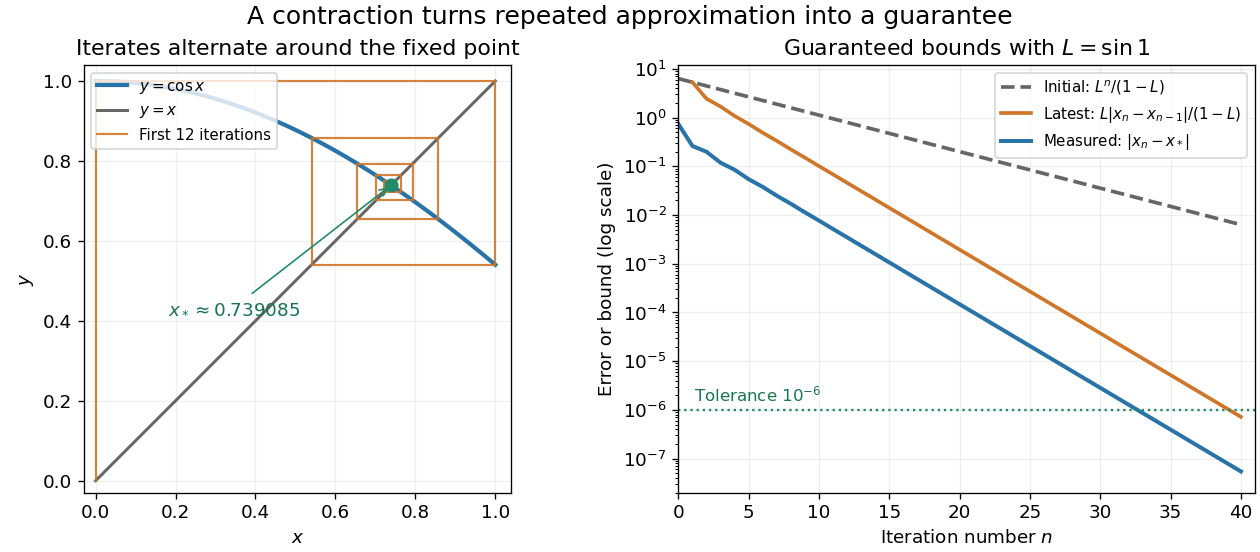

This is the beauty of the contraction mapping theorem: a uniform local improvement controls the entire infinite process. Completeness is essential. On the incomplete interval , the contraction mapping keeps every iterate inside but has no fixed point there; its missing limit is zero. Banach's 1922 paper developed abstract methods for different spaces of functions with applications to integral equations, a motivation still visible whenever repeated approximation is used to construct a function.[ref]
https://www.impan.pl/en/publishing-house/journals-and-series/fundamenta-mathematicae/all/3/0/92453/sur-les-operations-dans-les-ensembles-abstraits-et-leur-application-aux-equations-integrales. Stefan Banach, Sur les opérations dans les ensembles abstraits et leur application aux équations intégrales, Fundamenta Mathematicae 3 (1922), 133–181
Let be differentiable on a neighbourhood of a closed radius- ball in a Banach space, with on that ball. If , the mean-value estimate gives and . The contraction mapping theorem supplies exactly one fixed point in , and its distance from is at most .
// Target: dynamical-systems.bigb
For two contraction mappings of a nonempty complete metric space, their fixed points obey . Rearranging proves the displayed bound whenever the uniform metric is finite. It establishes continuity of the fixed-point map at each without assuming a contraction constant shared by all maps near .
For contraction mappings , compare their fixed points using on both arguments, then bound the change from to by the uniform metric. The resulting inequality gives the displayed estimate. Continuity at only needs its own contraction constant , even if nearby maps have constants approaching one.
A metric space is complete if and only if every contraction mapping of every nonempty closed subset into itself has a fixed point. For the converse, a nonconvergent Cauchy sequence contains a rapidly approaching subsequence whose point set is closed and whose shift is a contraction without a fixed point. Requiring the property only on the whole space is a different, weaker condition.
On the maximum product metric, the displayed map is nonexpansive when is a contraction mapping. If the space has two distinct points, changing only the second input coordinate shows that one step preserves some nonzero distance exactly, so it is not itself a strict contraction. Two iterations apply to both coordinates and therefore contract with the same constant as . This provides a direct example of a map whose iterate is contractive although the map is not.
A contraction constant for a function on a metric space is a single that bounds the ratio for every distinct pair. Pointwise strict inequalities do not imply such a common constant. For a differentiable function on an interval, the mean value theorem shows that supplies a contraction constant.
The same self-map can be a contraction mapping for one metric but not for a bilipschitz equivalent metric. On three points with distances , , the map , has Lipschitz constant . For the discrete metric, its Lipschitz constant is one. The metrics satisfy , so they preserve topology and completeness but not the strict numerical contraction condition. A contraction mapping theorem fixed-point proof therefore needs the specified metric and its contraction constant.
Suppose are contractions of one complete metric space with a common constant , and depends continuously on for each fixed . Their fixed points depend continuously on , because for a fixed parameter ,
If a self-map of a nonempty complete metric space has an iterate that is a contraction mapping, the contraction mapping theorem gives a unique fixed point of . The maps commute, so , and uniqueness forces . Conversely every fixed point of is fixed by . Thus is the unique fixed point of .
Let be a self-map of a nonempty closed subset of a Banach space, with the displayed bounds. Then has a unique fixed point and every orbit converges to it. Indeed, makes the orbit Cauchy by summing successive increments. The first bound makes continuous, so the limit is fixed. Since , the bounds also imply uniqueness. The tail sum gives for . A Volterra integral equation supplies factorially decreasing bounds even when the first iterate is not a contraction mapping.
For the Newton map near a simple root ,Bounds and make on a sufficiently small closed interval around . The contraction mapping theorem then gives the unique local fixed point.
Articles by others on the same topic
There are currently no matching articles.