Positioning repeatability
ID: positioning-repeatability

Positioning repeatability describes the scatter of positions reached when a motion system repeatedly returns to the same commanded position under specified conditions. It is an application of measurement repeatability, a form of measurement precision. A system may return to almost the same wrong position each time, so small scatter does not establish measurement accuracy.[ref]
International vocabulary of metrology by JCGM. VIM3 entries2.15,2.20 and2.21: precision and repeatability conditions
The approach direction belongs in the test description. Unidirectional positioning repeatability keeps it fixed; bidirectional positioning repeatability includes returns from both directions. To measure the assembled stage, independently observe its final position rather than only the motor's rotary encoder count. Physik Instrumente describes a static test that lets the platform stop before reading it, using an interferometer for displacement and an autocollimator for angular error, with two reflecting mirrors on the stage.[ref]
How to Consistently Verify the Performance of Nanopositioning Motion Control Equipment by Physik Instrumente. §§3.1–3.2, static readout, direction convention and paired-mirror apparatus
For an original numerical example, repeatedly command . Suppose an independent position readout with known measurement calibration gives the errors , in micrometres,Each direction has the same sample standard deviation,Yet their arithmetic means are 0 and . The magnitude of their mean difference, a positioning reversal error at this target, is 2.0 micrometres, far larger than the within-direction scatter. Pooling all eight values gives a sample standard deviation of ; that statistic mixes the directional shift with the smaller return-to-return variation.
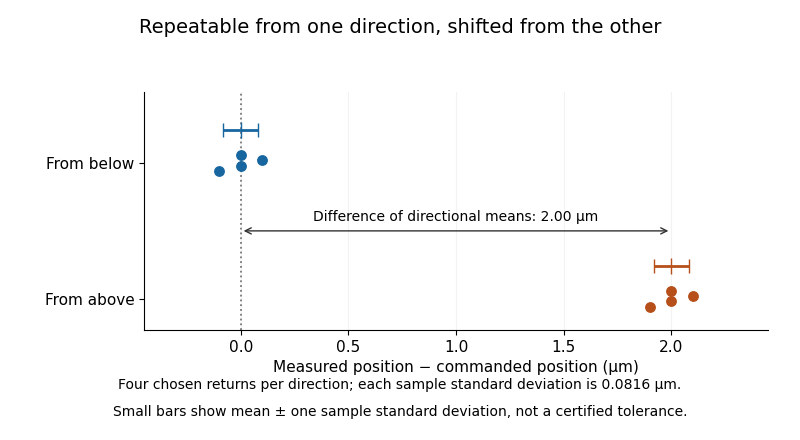
Two tightly repeated return positions separated by approach direction
. Original chosen errors at one target. Four trials per direction; small bars show mean plus or minus one sample standard deviation. The figure is not measured product performance. Details.
The calculation uses a declared sample standard deviation, not an unspecified manufacturer's tolerance or a universal repeatability convention. A positioning specification must state its approach directions, target positions, settling/readout procedure, load, environmental conditions, statistic and measurement uncertainty. A single target does not establish performance over the travel range. The manufacturer's method explicitly separates directional means from scatter and combines information from multiple targets when forming axis-level specifications.[ref]
Backlash is one possible cause of direction-dependent behavior, while thermal expansion and instrumental drift can move the apparent target over time. A repeatability experiment must distinguish those effects from random scatter. Measuring small returns to one target also answers a different question from minimum incremental motion, which asks whether a small commanded change can actually be executed.
New to topics? Read the docs here!