Qubit precession under a constant Hamiltonian
ID: qubit-precession-under-a-constant-hamiltonian

Choose the Pauli matrices with , and let be an angular frequency. The computational basis is an orthonormal basis of energy eigenstates for the qubit Hamiltonian operatorIn this convention is the lower energy eigenstate; the labels describe a basis choice, not a universal ground state/excited state ordering. Start in the Hadamard basis pure state . ThenThe first factor in the second expression is a global phase. The ratio of the two probability amplitudes has relative quantum phase , so its sign follows directly from .
Multiplying this density matrix by each Pauli matrix and taking its trace gives the Bloch vector:The Bloch vector travels counterclockwise around the equator of the Bloch sphere, from toward when viewed from . A computational-basis measurement always has , while the Hadamard basis and eigenbasis measurements giveAt , the quantum state is up to a global phase, giving . At , it is up to a global phase, giving . Both retain equal energy measurement probabilities.
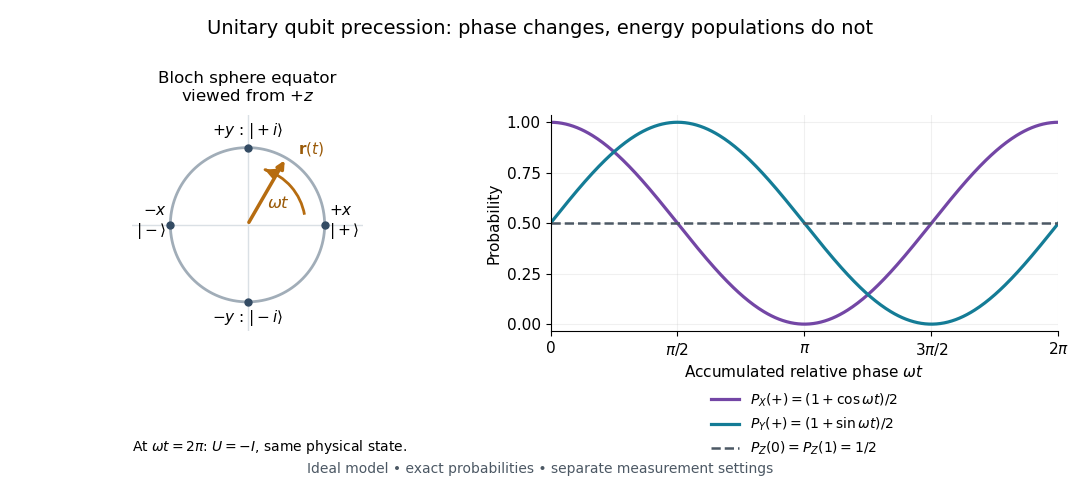

At , the time-evolution operator is , so . The physical quantum state ray, its density operator, and every measurement's probabilities have returned. The representative vector returns exactly only at , when . The minus sign is a global phase for this isolated evolution; comparing an evolved branch with an unevolved branch through a controlled unitary gate can make it a relative quantum phase, as explained in global phase of an uncontrolled quantum gate is unobservable.
New to topics? Read the docs here!